



 Google reviews

Why an old Dulwich wall shows a gutter leak indoors
The first sign is often inside: a damp patch high on a bedroom wall, or paint lifting just under the ceiling. Go outside and look up, and there is usually a joint dripping or a length that has dropped and spills in rain, right above the patch.
The reason is how the houses were built. The Dulwich Estate's residents' guideline on roofs and walls notes that houses here built before 1919 are likely to have solid brick walls without a cavity. On a wall like that, nothing separates a soaked outside face from the plaster inside. A cavity wall gives water somewhere to go. A solid one passes it through, slowly, over a wet winter.
That describes most of the older stock, from the late 1870s cottages on Boxall Road and Turney Road to the turn-of-the-century houses on Pickwick and Aysgarth Roads and the Edwardian pairs of Court Lane. Fix the gutter and the wall can dry out. Leave it and the brick, and the plaster behind it, keep taking water every time it rains.
Cast iron on the Victorian cottages and terraces
Houses of this age were built with cast iron gutters, and some still have them, or a mix of cast iron at the front and plastic at the back. Cast iron lasts a long time if it is kept painted, but it has its own failures. The bolted joints between lengths rust and open up, the putty or sealant in them dries out, and a bracket that has rusted through lets a heavy length drop and lose its fall. Wet leaves from the street trees add a lot of weight in autumn.
Most of that can be repaired without replacing the run. A rusted joint is taken apart, cleaned and remade. A cracked length can usually be swapped on its own, in the same profile, so a half-round run stays half-round and an ogee stays ogee. A downpipe that has come loose from the wall is refixed before it sends water down the brick at head height. If the fascia behind is soft and brackets will not hold, that needs sorting at the same time.
Where a run is brittle along its whole length and the repairs keep piling up, a new system is better value, and our page on gutter installation in Dulwich covers the choices for each kind of house. If the water seems to be coming from behind the gutter rather than over it, our article on water leaking behind a gutter explains the usual causes.
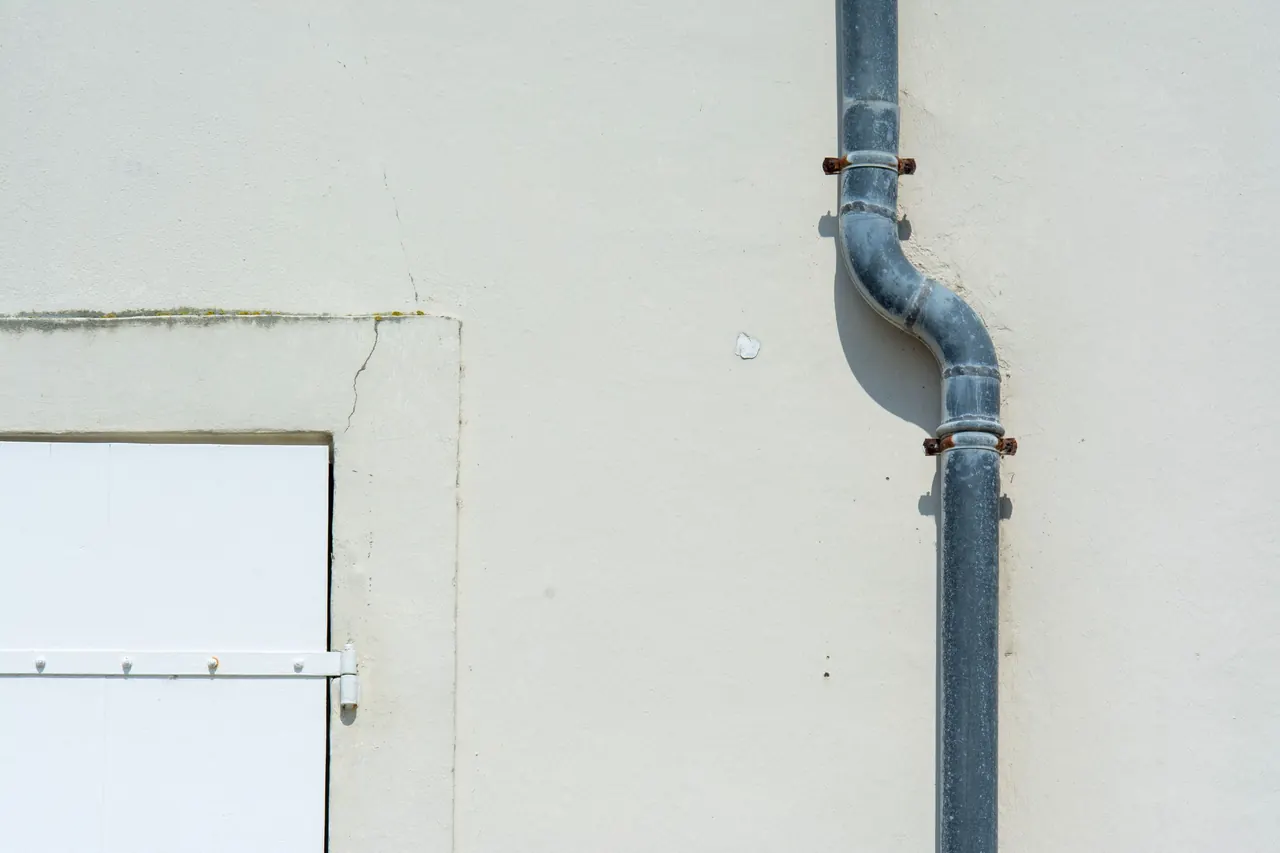
Roseway and Turney Road: stucco under the eaves
The 1920s pairs on Roseway and 157 to 175 Turney Road are a slightly different case. Southwark's appraisal describes them as stuccoed pairs with shallow-pitched roofs and deep eaves. Stucco is lime based, and the council warns that once it is damaged it can deteriorate quickly as water gets in. A downpipe joint that drips onto the render in the same place every time it rains is the kind of fault worth catching early here, because a small render repair is far cheaper than a large one.
For a reference figure, MyJobQuote's November 2026 national guide gives £215 as an average gutter repair across the UK, with London labour often higher. On a three-storey Dulwich house, the height and access make more difference than the repair itself, and we price that in a free quote. Our gutter repairs page sets out the repairs we carry out.
Frequently asked questions
Do I need the Estate's agreement to replace one cracked length on a Turney Road pair?
Southwark treats like-for-like repairs as maintenance, but the Dulwich Estate's Scheme of Management covers repair work too, so check with the Scheme of Management office before work starts. Changing material or colour will certainly need its approval.
Can a cast iron gutter on a Victorian Dulwich cottage be repaired rather than replaced?
Usually, if the run is sound overall. Joints can be remade, a cracked length can be replaced in the same profile, and the whole run repainted. If rust has eaten through several lengths and brackets, renewing it is better value than repeated repairs.
Why is there damp on the inside of the wall just below my gutter?
On a pre-1919 solid-walled house, water from a leaking or overflowing gutter can soak right through the brick. The damp usually shows near the top of the wall, below the fault outside. Once the gutter is fixed, give the wall time to dry before redecorating.





