



 Google reviews

What we do in Kingston
We are a family-run roofing and guttering firm based on Kenley Road in Morden, about 4 miles from Kingston town centre, and we work across the KT1 and KT2 postcodes. That covers roof inspections, repairs, full replacements and new roofs, emergency callouts, flat roofs in GRP, EPDM rubber or felt, chimney work, and every kind of gutter job from cleaning and unblocking to new cast iron, uPVC or seamless aluminium runs, plus fascias and soffits. Quotes are free and often given the same day, and we can look at a roof by drone without putting a scaffold up first.
What changes from street to street in Kingston is the roof itself. A Market Place shop, a Grove Crescent villa and a big house on Kingston Hill were built decades apart in different materials, and they go wrong in different places. The sections below describe each part of the town and what its roofs tend to need.
Market Place and the Old Town
The Market Place, beside All Saints Church, is still the centre of the town. The Old Town conservation area, designated in 1971, takes in the square and the streets around it, among them Church Street, Thames Street, Apple Market, Eden Street, Clarence Street and Union Street. The council's 2006 appraisal describes a roofscape that changes from building to building, with slate next to clay tile and hipped roofs next to mansards and gables. Where a roof can be seen from the street or from neighbouring buildings, its policy is to require natural slate and clay tile and to resist concrete tiles and artificial slate.
Many of these buildings also hide their gutters behind parapet walls, and those hidden gutters are covered on our blocked gutter page for the Market Place. Along the High Street the appraisal records late 20th century flat roofs and lead-clad mansards among the traditional roofs, and by the river Charter Quay and Bishops Palace House have flat or shallow pitched roofs. Those are usually looked after by a managing agent rather than a single owner.
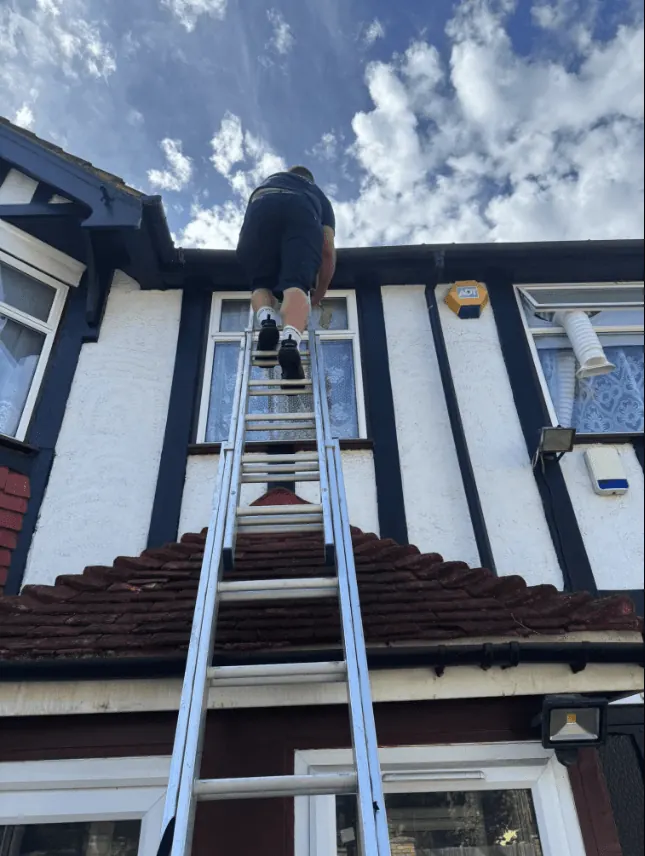
Victorian streets around the Fairfield and Grove Crescent
East and south of the centre are Kingston's Victorian suburbs. When the council proposed the Fairfield/Knight's Park conservation area in 1984, its report noted that Caversham Road was still comparatively unchanged since the 1880s, with slate roofs, bargeboards and stock brickwork. The conservation area was designated the following year.
Further south, Grove Crescent is a planned estate laid out around 1863, covering about 10 hectares and 350 properties, with villas on Springfield Road and Denmark Road and smaller cottages on Portland Road. Slate roofs of that age tend to outlast their nails, so slipped slates are common, along with worn valleys where the main roof meets a back addition and leaking joints in any cast iron gutters that survive. Rebuilt or repointed chimney stacks on the party walls are part of the same picture.
North Kingston: Richmond Road and the river
The council's Canbury character study picks out the late Victorian semi-detached villas at 210 to 226 Richmond Road, between Bank Lane and Durlston Road, for their slate roofs and decorated ridges. On Windsor Road it warns that overbearing extensions are spoiling the roofscape, which is worth reading before adding a dormer. Close by, the Richmond Road conservation area is known for groups of red brick late Victorian houses in a Vernacular Revival style, with gabled fronts, bays and tile hanging.
On the river, Lower Ham Road has a small group of houses from around 1895 with steep tiled roofs and big central chimneys, which our Kingston chimney repairs page looks at closely. Canbury Gardens opened in 1890 with an avenue of London planes, and a chestnut grove lines the barge walk from Kingston Bridge, so autumn leaves are a fact of life for the gutters along that stretch.
Kingston Hill and Coombe
East of the town the land climbs to about 54 metres on Kingston Hill. The council describes the conservation area there as early Victorian to early 20th century large houses in a woodland setting, including Galsworthy House and Dorich House, both listed Grade II. Its assessment found that the 19th century houses generally have slate roofs, and that builders went back to clay tile in the early 20th century.
South of the hill, the Coombe Wood conservation area forms a triangle between Kingston Hill, George Road and Warren Road around Coombe Wood Golf Course, with large Victorian, Edwardian and 20th century houses. Beyond it, the Coombe Hill conservation area along Coombe Hill Road and Beverley Lane is mostly 20th century houses in a spacious landscaped setting, and parts of Coombe are on private roads. Big roofs with several gables and stacks are hard to judge from the drive, which is where a roof inspection in Kingston helps most.
Neighbouring areas with their own pages
If your house is just outside the town, one of our neighbouring area pages will describe it better. Norbiton, east of the centre, has late Victorian villas on the C-roads and Gordon Road, and the Cambridge Road Estate. Surbiton, to the south, grew as a railway town of stuccoed villas and three-storey terraces around Claremont Road and Maple Road. New Malden, beyond Coombe to the south-east, has Victorian villas in The Groves and 1930s streets either side of the railway.
Frequently asked questions
Do I need planning permission to re-roof a building in Kingston's Old Town?
Replacing a roof like for like is normally treated as maintenance. The Old Town appraisal's point is about materials: where a roof can be seen, the council expects natural slate or clay tile, not concrete tiles or artificial slate. If you want to change the covering or the roof shape, check with the Royal Borough of Kingston upon Thames before you commit.
Do you work on the shops and flats round the Market Place?
Yes. We deal with owners, tenants, freeholders and managing agents, plan access around trading hours, and can photograph roofs and parapet gutters by drone before anyone goes up.
The gables on our Richmond Road house are tile-hung. Can loose hanging tiles be fixed?
Yes. Hanging tiles are nailed to battens on the wall, and when the nails rust they slip just as roof tiles do. We refix sound tiles, replace broken ones with the closest match we can find and check the battens behind.
Our Kingston Hill house has both slate and clay tile. Is that unusual?
Not on the hill. The council's assessment records slate on the 19th century houses and clay tile on the early 20th century ones, and a house extended in a later period often carries both. The junction between the two is the part to keep an eye on.





