


 Google reviews

Old Town's steep tiled roofs and leaded dormers
The oldest roofs in Clapham sit in Old Town, the cluster of streets at the north-east corner of the Common. Nos. 39 to 43 Old Town are early to mid 18th century houses, listed Grade II*, with a high-pitched tiled roof and two dormers whose flat tops are covered in lead.
A steep old tiled roof usually holds its tiles well, but the parts around it age faster. Flat lead dormer tops are the first thing to check. Lead laid in long sheets with no proper joints tends to crack along its folds, and once water gets under it, it runs along the dormer cheeks and shows up as a stain beside the window inside. The moulded wooden cornice at the eaves is another weak spot, because it is painted timber, and when the paint goes the wood behind it softens.
On roofs like these we renew split lead on the dormer tops and cheeks, refix or replace the tiles that have moved, and check the eaves timber and any gutter fixed along it. Our roof repair page explains the range of repairs we carry out on pitched roofs. Where the house is listed, as several in Old Town are, we price for matching materials and leave any change to how the roof looks until Lambeth's conservation team has been asked.
Parapets on Grafton Square and Clapham Manor Street
Grafton Square shows stucco fronts, cornices and parapets, but hardly any roof. The largest terrace, Nos. 29 to 38, rises four storeys over a basement and finishes in a parapet with openwork sections, so the roof and its gutters sit out of sight behind it. Clapham Manor Street has the same arrangement on a smaller scale: the listed terrace at Nos. 169 to 175B is two storeys over sunk basements, in stock brick with a rendered parapet along the top.
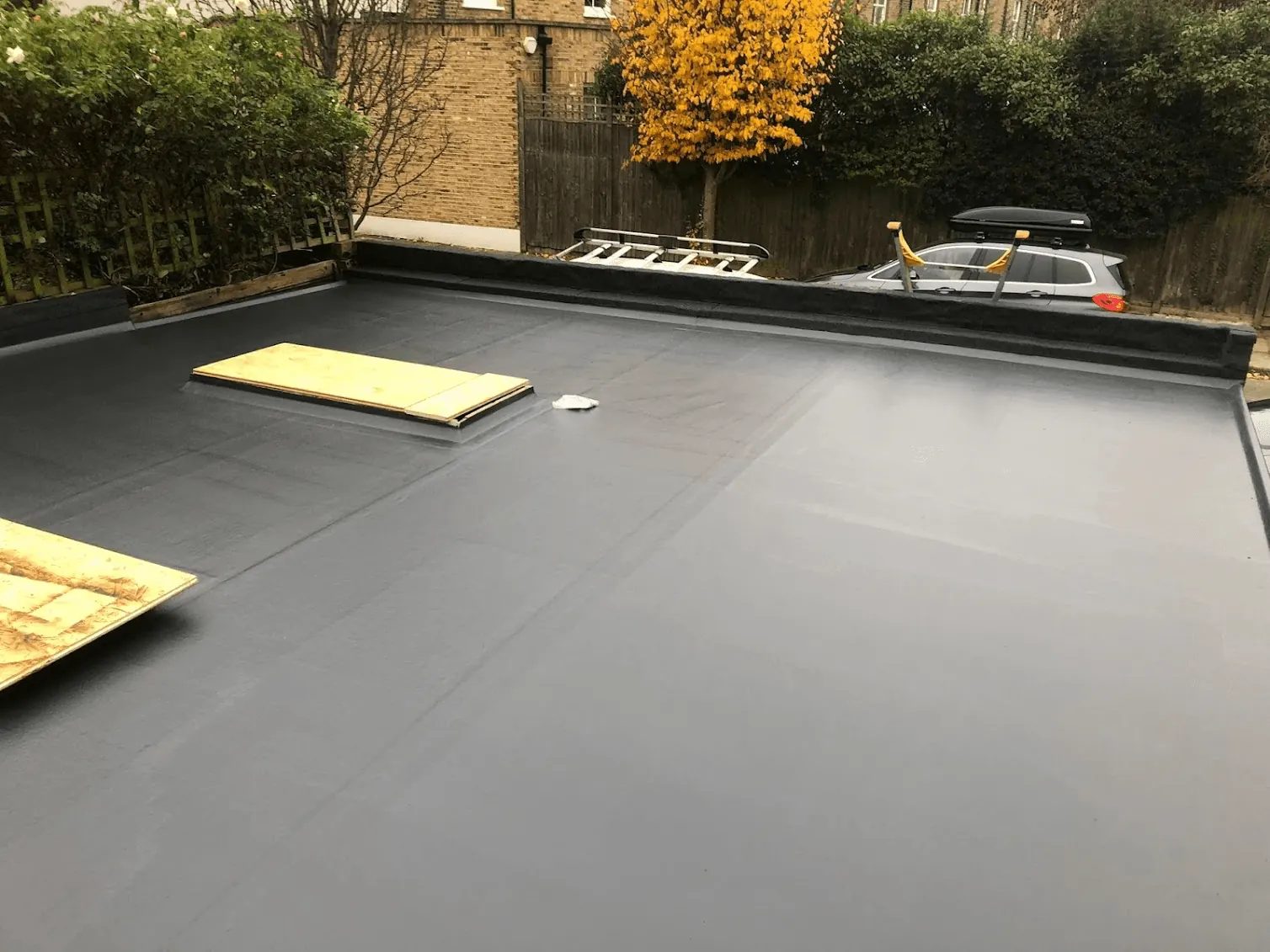
On terraces of this age, the roof behind a parapet is often a London roof, also called a butterfly roof. Two slopes fall inwards to a central valley, and the rain runs along that valley to the back of the house and out through a hopper. There is usually a box gutter behind the front parapet as well. Both are lined, and both are easy to forget because nobody sees them from the pavement.
These roofs tend to fail in a quiet way. Leaves, moss and silt build up in the valley or at the outlet, water rises above the lining, and it finds its way into the room below. A split in old lead does the same thing more slowly. The rendered parapet itself can let water in too, through cracked render or a failed coping on top, and the damp then shows on the front wall inside rather than on the ceiling.
When we work on a hidden valley we clear it, look at the lining along its whole length and check the outlet and hopper at the back. Split lead is renewed, and a worn-out valley can be rebuilt in new lead. MyJobQuote's 2026 roof valley cost guide gives £90 to £225 nationally for a small repair to a lead-lined valley and £550 to £675 for full replacement. Those are its published averages, and a four-storey terrace needs more access than that allows for. If the damp is down a back wall under the hopper rather than on a ceiling, our article on water leaking behind a gutter explains the usual causes.
Clapham Manor Street is also inside Lambeth's Rectory Grove Conservation Area, along with Rectory Grove itself, St Paul's Churchyard, part of Turret Grove and Larkhall Rise up to the railway bridge. Lambeth describes the buildings there as mostly 19th century. Repairs in matching slate and lead keep those roofs looking as they should, and that is how we price them.
Mansard slopes on Crescent Grove
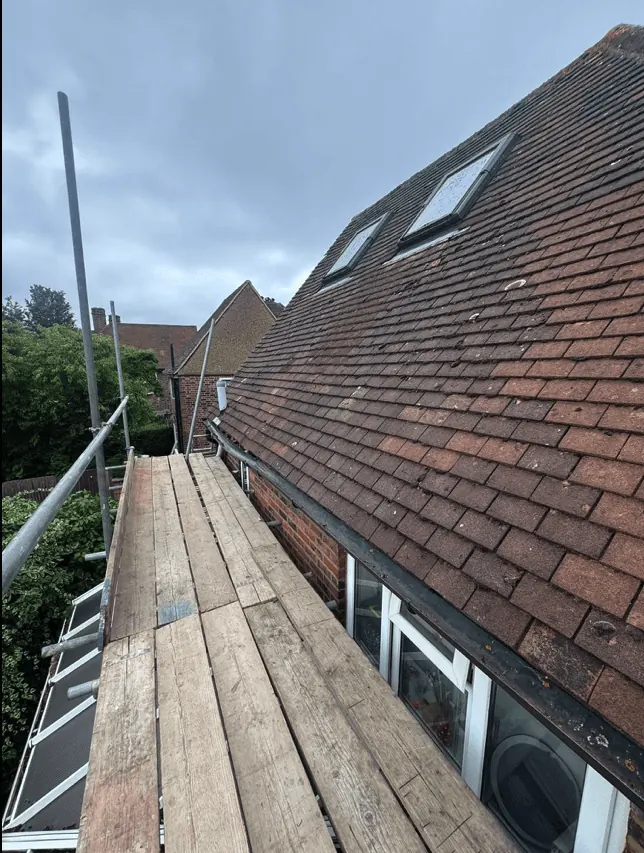
Crescent Grove, the crescent off Clapham Common South Side, has a different roof again. The Grade II listed terrace at Nos. 1 to 35 was built in the 1820s as linked pairs of three storeys with an attic and basement, and its roofs are slate mansards with dormers. A mansard puts the attic rooms inside a steep lower slope, so the slate on that slope is doing the job of a wall as well as a roof.
On a mansard of that age, the slates often outlast the nails holding them. When the nails corrode, slates slide out of place one by one, usually after a windy night, and a single gap on a steep lower slope lets water straight into the room behind. The joints around each dormer, where lead meets slate and timber, are the other place to watch.
Chimney stacks on these terraces usually sit on the party walls, so damp next to a chimney breast often starts with cracked flaunching or lifted flashing that is shared with next door. Our chimney repairs cover flashing, repointing, flaunching and cowls.
Seeing a roof that sits behind a parapet
Most of the roofs described above can't be judged from the street, and on a four-storey terrace a ladder won't reach. A drone lets us photograph the valley, the parapet gutter, the dormers and the stacks without anyone climbing on the roof or scaffolding going up first. Josh flies the drone and you see the same images we do.
That matters most where a large house has been split into flats. The leak usually shows in the top flat, while the roof is often shared, and clear photos help the owners or a managing agent agree on what needs doing. Our roof inspection page explains what we look at on a visit and when a drone is the better option. Quotes are free, and the work carries our 10 year guarantee. When you're ready, call 0330 133 4111 or get in touch and tell us your street and where the water is showing.
Frequently asked questions
The dormers on my Old Town house have flat lead tops. Why do they leak?
Old lead on a dormer top was often laid in large sheets that crack as they expand and contract, and water then runs into the dormer cheeks. A small split can be repaired. Where the sheet has cracked in several places, renewing it in properly jointed lead is the lasting fix.
Water is coming through the top-floor ceiling of my Grafton Square house, but the roof looks fine from the square. Where is it getting in?
Almost certainly behind the parapet. The hidden valley or the box gutter along the front has probably blocked or split, so water rises above the lining. We check both, along with the outlet and the hopper at the back.
Can the slates on a Crescent Grove mansard be reused?
Often, yes. Sound slates can be taken off, sorted and laid again on new battens, with matching reclaimed or new slate for the broken ones. Because the terrace is listed, check with Lambeth before any change to materials.
The render on our Clapham Manor Street parapet is cracking. Can that cause damp inside?
Yes. Rain gets into the cracks and the top of the parapet, soaks down through the brick and shows as damp on the front wall of the top room. The coping, the render and the gutter behind the parapet all need checking together, as any of the three can be the source.





