



 Google reviews

North of Moor Lane: council pantiles, mansards and maisonettes
A hundred years ago Chessington was farmland with a few big houses and a scatter of cottages. The suburb arrived in pockets: semis through the 1930s, with the railway reaching Chessington North and Chessington South in 1939, council and private housing through the 1950s, then planned estates in the 1970s and 80s. The roofs still show those layers, street by street, and each layer has its own weak points.
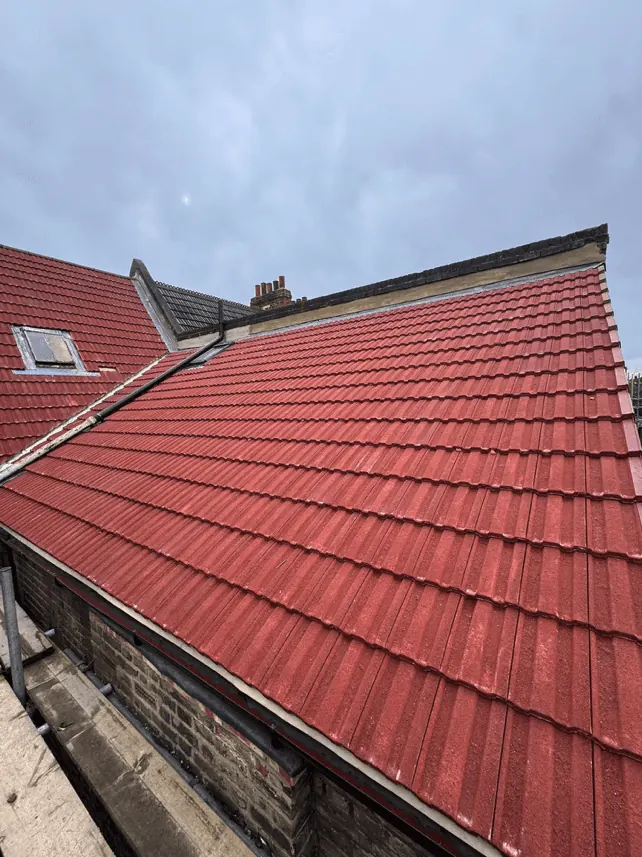
The short terraces on Sanger Avenue, Coutts Avenue and parts of Moor Lane were built by the local authority in the 1950s, and Kingston's character study records the Surbiton Borough Council emblem on them. They are roofed in pantiles, the S-shaped tiles that lock into their neighbours sideways. When one cracks or lifts, rain runs straight onto the felt below and the tiles beside it lose their grip. Repairs on these roofs are about refixing single tiles so they lock back in, and replacing broken ones with a matching profile. Our page on roof repair in Chessington goes into the pantile detail, along with the tile-hung gables of the 1930s semis on Moor Lane, where rusted nails let hung tiles slide out one by one.
On the Crofts' Estate, the 1930s semis on Fircroft Road and Hook Rise are mostly mansard fronted, with a steep lower slope at the front. The change of pitch and the eaves at its foot carry heavy runoff, so the tiles at the kink, the gutter and the board behind it are the parts to watch. Moorfield Road is a cohesive group of 1930s semis with tile-hung gables and oriel windows, many now old enough for a re-roof decision.
Frimley Road and Holmwood Road were built on the site of Chessington Court as a planned estate of maisonettes in formal terraces with strong, continuous roof lines. Near North Parade, Bray Court is a group of post-war mansion blocks. On buildings like these, one roof covers several homes and nobody can see the top from the street, which is where a drone survey helps. Our Chessington roof inspection page explains how we report on shared roofs so leaseholders and freeholders see the same evidence.
South of Moor Lane: tile-hung bays, Arts and Crafts pantiles and pebbledash
South of Moor Lane the 1930s semis and short terraces continue, but the details change. Cheshire Gardens has a strong rhythm of tile-hung bays, some with gabled tops and some hipped, with Tudor-style detailing on the bungalows and semis at its southern end. Bolton Road and Bolton Close have 1930s semis with curved bays, oriel windows and long back gardens, and Parbury Rise has 1940s pebbledash terraces with gable ends.
Pebbledash is common here, and it changes how gutter problems show. Hemsby Road is lined with hipped terraces of four houses with gabled square bays and pebbledash walls, and wide gaps between the blocks. The gutter on a block like that loops round every hip, outlets are often shared between houses, and a leaking joint leaves a dark streak down the render within weeks. Our page on gutter installation in Chessington covers planning a new system across a block of four.
The Compton Crescent area is one of the more distinctive parts of Chessington: a curved street laid out as a set piece, with Arts and Crafts short terraces under clay pantiles and pebbledash walls, some painted. Big pantiled slopes deliver rain to the gutter in concentrated streams, and a small outlet can overflow in a downpour even when the gutter is clean. Our blocked gutter repair page explains how we trace that kind of fault from the gutter down to the gully.
Garrison Lane has bow-fronted maisonettes behind a landscaped verge, and Reynolds Avenue, built where Chessington Hall once stood, has post-war semis and maisonettes. Headley Close is a 1970s cul-de-sac with a garage court, and the 1950s terraces on Chantry Road and Roebuck Road have very long plots with rear accesses to garages, so garage and extension roofs matter here as much as the main ones.
Trees, nature reserves and the green belt edge
Chessington is split between suburb in the north and green belt in the south. Castle Hill, a scheduled monument and local nature reserve reached from Filby Road, is mainly oak and hazel woodland, and the Bonesgate Stream runs along its western edge towards the Hogsmill. Chessington Wood, further south, marks the route of the railway extension to Leatherhead that the Second World War stopped. Houses near any of them get heavy leaf fall each autumn, and oak leaves in particular mat down in gutters rather than washing through. Our Chessington gutter cleaning page covers when to time a clean around the leaf fall.
The open edges bring wind as well as leaves. Merritt Gardens, laid out in the 1990s on the site of the old Air Ministry Rehabilitation Centre, has wide views west over open country from Rythe Close and Grapesome Close. In the north-east, the ground falls away from the junction of Chantry Road and Roebuck Road, with long views east to the Epsom Downs. Roofs facing open ground take a storm first, and ridge and verge tiles are usually the first parts to lift.
No conservation areas, but plenty of character
None of Kingston's 26 conservation areas is in Chessington, so most houses here keep their usual permitted development rights, and like-for-like roof repairs rarely need planning permission. Flats and maisonettes are different, as are green belt plots such as those on Green Lane, where the council's view is worth getting early. Listed buildings are few. They include St Mary's Church on Church Lane, with its flint walls and shingle spire, and Monk's Cottage, both Grade II.
To the north, Chessington runs into Hook, and the two share the KT9 postcode. Hook's page covers its own gabled 1930s streets and its 1880s cottages.
Frequently asked questions
What roof does a council-built terrace on Coutts Avenue have?
Pantiles, according to Kingston's character study, on short terraces built by the local authority in the 1950s and set at an angle to the road. Some will have been re-covered since in a similar tile. Either way, repairs need a tile that matches the profile, or it will not lock in with its neighbours.
Our house backs onto the Bonesgate reserve. What should we keep an eye on?
Gutters and outlets first, especially after the leaves come down in late autumn. Then the flat roofs on garages and extensions, where leaves gather at the outlet and hold water on the deck. A quick look from an upstairs window after heavy rain will show whether water is spilling over the front of the gutter.
The Merritt Gardens houses are from the 1990s. Are they old enough to need roof work?
The tiles themselves usually have plenty of life left, but ridge and verge fixings, mortar bedding and the original gutters and seals are now around thirty years old. On the more exposed western edge, those are the parts worth checking after a storm.
Our Chantry Road garage is reached by the rear lane. What should we check on its roof?
The 1950s terraces on Chantry Road and Roebuck Road sit on very long plots with rear accesses to garages, so a garage roof can go unseen for years. If it is a flat deck, look for splits, blisters and standing water, and check inside after rain. A failing deck can be re-covered in GRP, EPDM or torch-on felt.





