



 Google reviews

Trees over the roofline
Banstead's housing is low density and green, and on most streets the first thing that affects a roof is what grows over it. The council's draft appraisal of the conservation area picks out the historic limes and yews on Park Road as significant features, and names yew, holly and oak as the native trees of the old village, with Scots pine and wellingtonia in some gardens. On the Nork side, Fir Tree Road is named after a line of trees planted along the northern boundary of the old Nork Park, and the long gardens behind the interwar houses are full of mature trees.
Each tree fills a gutter differently. Limes drip sticky honeydew in summer, then drop seed, bracts and leaves in autumn. Yews shed needles all year, and pine needles pack hard into outlets. Gutters under them fill faster than a once-a-year clean allows for, and the overflow is what rots timber fascias and stains walls. For planning a clear-out around the trees over your own house, see Banstead gutter cleaning.
Trees in the conservation area are protected too. Reigate and Banstead Borough Council needs six weeks' written notice before one is felled, lopped, topped or uprooted, which is worth knowing if a branch over your roof needs cutting back before scaffolding goes up.
Peg tile, slate and flint around Park Road
The old village, around the Wellhouse, Park Road, Mint Road and Woodmansterne Lane, east of the modern High Street, has been a conservation area since 1973. The 2014 draft appraisal places it on a ridge of the North Downs, on clay with flints over the chalk, built from local flint and from brick and tiles made from that clay. Its description of the roofs is the most useful part for a roofer:
- the oldest, pre-Victorian houses and cottages carry steep, short-span gables in handmade peg tiles, at a pitch the appraisal gives as roughly 50 degrees
- the mid-Victorian houses, in brick, flint or weatherboard, turn to slate on shallow hipped roofs
- the listed houses on Park Road mix the two: Rosehill has a plain tile mansard, Park Cottage has slate on the front range and tile behind, and Woodmans Cottage is weatherboarded under plain tile
Steep peg tile and shallow slate need different handling. A peg tile roof can lose a tile and still shed most of the rain, but the handmade tiles are uneven and a bright machine-made replacement shows. A low slate roof is less forgiving, and one slipped slate lets water through quickly. Our page on roof repair in Banstead goes through both, including how old tiles are matched.
The appraisal asks owners to keep chimneys and pots, use appropriate materials in repairs and avoid concrete tiles. It also proposed an Article 4 direction that would bring changes of roof covering on road-facing slopes under planning control. Like-for-like repair is normally maintenance, but check the current position with the council before you change a covering. If a stack is the problem, see our Banstead chimney repairs page.
Nork's interwar houses
West of the A217, Nork was part of the Nork House estate until the estate was sold for building in 1923. It was not built out by one developer to one design. Different builders bought single plots, so the interwar houses along and around Nork Way vary from one to the next, and many sit in large gardens. The Rose Bushes estate followed in the 1960s and High Beeches in the 1970s, and since then some of the long back gardens have become small infill schemes.
For a roofer, the practical point is that the house next door is no guide to yours. Two neighbouring Nork roofs can have different tiles, different hips and valleys, and different repair histories. On the oldest, the original battens and underlay are often what is really failing rather than the tiles. Where that is the case across a whole roof, our roof replacement in Banstead page explains how a re-roof runs and how to choose a covering.
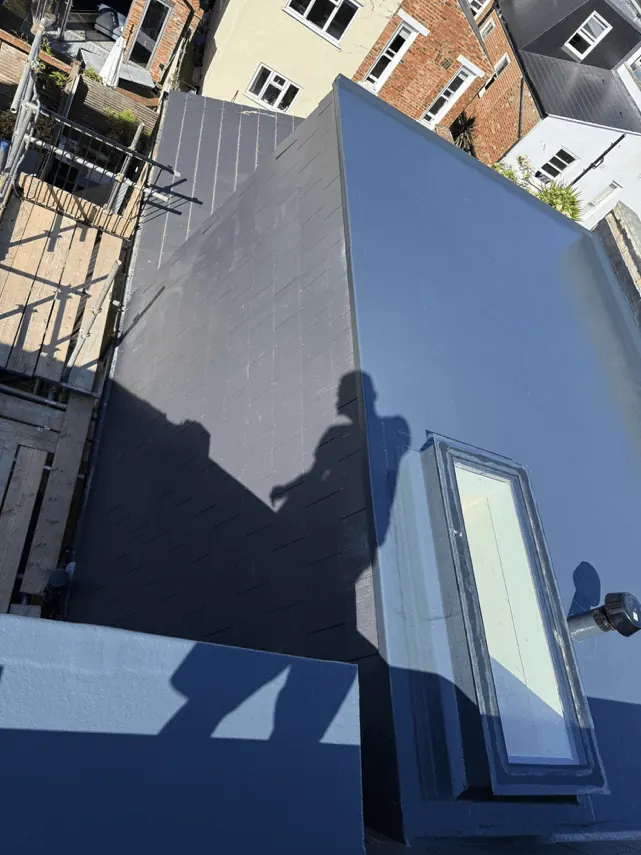
Many Nork houses have also gained flat-roofed garages, kitchen extensions and dormers over the decades, each added at a different time by a different builder. One property can carry two or three flat roofs of different ages, and the oldest is often the one hidden behind the garage where nobody looks.
Frequently asked questions
My house is on Mint Road in the conservation area. Can I replace the peg tiles with concrete ones?
The council's draft appraisal discourages concrete tiles in the conservation area and proposed bringing changes of covering on road-facing slopes under planning control. Ask the council about the current rules before you decide. Sound peg tiles can often be reused, with the shortfall made up from the closest match.
Why does my Nork roof look different from the one next door?
Because after 1923 Nork was built plot by plot by different builders. Tiles, pitches and details often change from house to house, and many roofs have been repaired or re-covered since. We look at your roof on its own rather than assume it matches its neighbour.
A lime on Park Road overhangs my roof. Can it be cut back before the roofers start?
If it is in the conservation area, the council needs six weeks' written notice before it is lopped or topped, so raise it as soon as the work is planned. If the tree is listed in a tree preservation order, a separate consent applies, and the council can tell you which.
Can the old peg tiles go back on after a repair on a village cottage?
Usually, yes. Sound handmade tiles are lifted, stacked and refixed, and the shortfall is made up from reclaimed tiles of a similar size and colour. The old tiles normally go on the slopes seen from the road.





