



 Google reviews

What most Worcester Park roofs need
The roofs on the Sutton side of Worcester Park mostly went on between 1919 and 1938, and the jobs that come with that age are fairly predictable. Hip and ridge tiles work loose as their mortar fails, nails corrode so tiles slip, and the lead around stacks and bay roofs splits. Behind the houses, the flat roofs over kitchen extensions and garages wear out faster than the main roof. Gutters on the older plastic systems leak at the joints and sag where brackets have let go.
We are a family run firm, working for over 20 years from Kenley Road in Morden, and we cover every service on this side of KT4. For a single fault the place to start is roof repair in Worcester Park. Where the faults are spread across every slope, our page on re-roofing in Worcester Park explains the choices. If you are not sure which you need, a drone survey shows the whole roof without scaffolding, and quotes are free, often the same day.
Three councils, one KT4 suburb
Worcester Park sits on a boundary. Most of it is in the London Borough of Sutton, whose Worcester Park North and Worcester Park South wards cover roughly the eastern two-thirds of the area. The streets around The Avenue and Cleveland Road, to the south-west, are on the Epsom and Ewell side, in Surrey. The station itself, and part of the KT4 post town around Old Malden, are in the Royal Borough of Kingston upon Thames (Wikipedia).
This page and its service pages concentrate on the Sutton side: Central Road, the interwar streets either side of it, Longfellow Road, Green Lane and the Beverley Brook, and the newer homes to the north. The Epsom and Ewell side has its own page, roofing in Cuddington, which covers The Avenue, Cleveland Road and the 1960s houses built on the old brickworks land. Old Malden, North Cheam and Stoneleigh each have their own pages too.
The station is where the suburb started. It opened on 4 April 1859 on the line to Epsom, under the name Old Malden, and was renamed Worcester Park in 1862. Sutton's draft Character Study records that it was built on Malden Green, a village common, and that the part of that common in Sutton survives as Back Green.
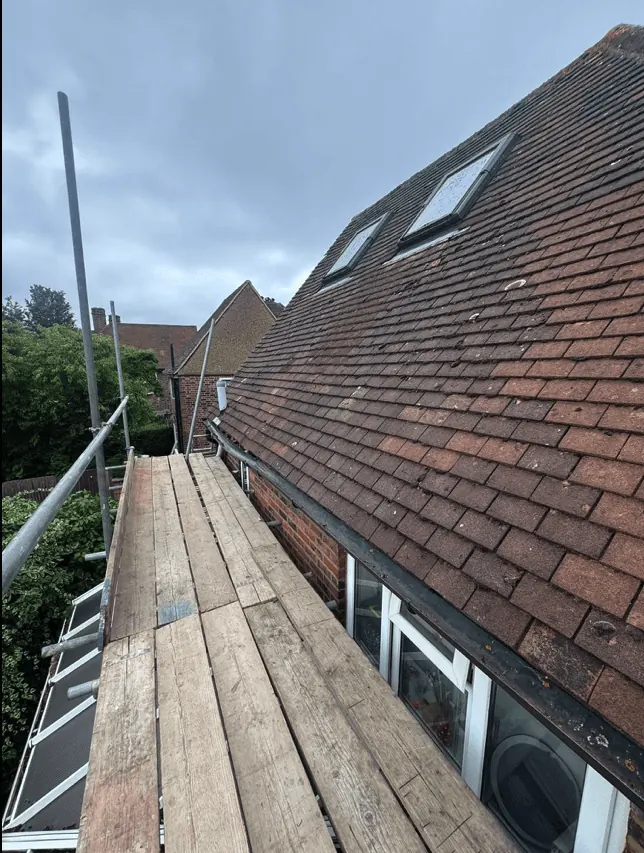
The interwar streets of North and South Worcester Park
The character study describes Worcester Park as largely interwar housing built between 1919 and 1938, much of it Metro-land semis and short terraces inspired by the garden suburbs, and many in the half-timbered Tudorbethan style. South Worcester Park also has Art Deco inspired houses, some villas, modern terraces and courtyard blocks, such as those on Hemingford Road.
On a Tudorbethan semi, the parts to watch are the hips or gables, the bay roof at the front, the stack on the party wall and any later loft conversion, where new tiles meet old. The half-timbered gables can also let driven rain in behind the boards, which is easy to mistake for a roof leak. The blog post on common roof problems in Worcester Park homes goes into more detail.
Longfellow Road and the Central Road parades
Two parts of the Sutton side are older or more distinctive than the streets around them.
Longfellow Road has terraced houses built from the late 1860s, among the oldest homes in this part of the borough, with newer houses mixed in along the east side. Sutton first designated an Area of Special Local Character here in 1988, and a 2006 review recommended cutting the area back to the Victorian terraces, taking out Lincoln Road and the interwar houses to the north. It is a local designation rather than a conservation area. Like-for-like roof repairs are normal maintenance, and if you want to change how a terrace roof looks, check with Sutton's planners first.
Central Road, the A2043, is the high street: about half a mile of shops, cafes and agents. Above the shopfronts the upper storeys mix Victorian, Tudorbethan and Art Deco designs, and some of them are flats. Caldbeck Parade, 98 to 122 Central Road, carries a 1932 date on its parapet and is on Sutton's local list as the earliest and best example of 1930s architecture in Worcester Park. The roof over a shop parade is usually the freeholder's responsibility, and our flat roofing work in Worcester Park covers those roofs as well as the extensions behind the semis.
The Hamptons, Sherbrooke Way and the Beverley Brook
North of the older streets, the housing changes completely. Worcester Park Sewage Works, which dated from the 1950s and drained into the Beverley Brook, closed in 1996. Its land is now The Hamptons and the houses on Sherbrooke Way, with Mayflower Park and its wetlands alongside. The character study describes the estate's New England style coloured weatherboarded houses and rates its townscape value very highly. The roofs and gutters here are young, and the work is mostly maintenance and matching a damaged section rather than replacement.
The Beverley Brook runs north beside Green Lane, an area the Edith's Streets local history blog says suffers considerably from flooding. Sutton Council's Surface Water Management Plan names Worcester Park as the most at risk Critical Drainage Area in the borough, and the council's scheme at Cuddington Recreation Ground is designed to store about 4,000 m³ of floodwater. That is ground-level drainage, which no roofer can fix. What a roofer can do is make sure the roof copes with the same cloudbursts: valleys and flat-roof outlets kept clear, gutters big enough for the roof, and downpipes that go somewhere sensible.
Frequently asked questions
My house is just off The Avenue. Is that Worcester Park or Cuddington?
Both, in a sense. It has a Worcester Park address, but the streets around The Avenue and Cleveland Road are on the Epsom and Ewell side of the boundary, and our Cuddington page covers their houses in detail. We work on either side of the boundary.
Is every house on Longfellow Road part of the Area of Special Local Character?
No. The 2006 review recommended that only the Victorian terraces stay in, with the interwar houses to the north and Lincoln Road taken out, and there are newer houses among the terraces too. If you are unsure whether your house is covered, Sutton's planning team can tell you.
Will the Cuddington Recreation Ground flood scheme stop water getting into my roof?
No. It stores floodwater on the ground to protect homes from surface flooding. Water coming in through a roof is about the roof itself, its valleys, flashings, flat-roof outlets and gutters, which need to be in good order to cope with heavy rain.
Do The Hamptons homes need a roofer at all, given how new they are?
Less often than older houses, but newer roofs still need gutters clearing, especially near Mayflower Park, and occasional repairs to soffits, roof windows or flashings. If a defect shows up early, check whether any builder's warranty still covers it before paying for a repair.





