



 Google reviews

From St John's church to Malden Manor station
Old Malden sits on the south-eastern edge of the Royal Borough of Kingston upon Thames, between New Malden and Worcester Park. Kingston Council's character study draws its edges at the A3 to the north, the Hogsmill River to the west and the borough boundary to the south and east. Most homes carry a KT4 or KT3 postcode.
The oldest roof in the area is on St John the Baptist, at the western end of Church Road. Flint walls survive in the chancel from the medieval church, and the nave and tower were rebuilt in brick in 1611. Until the Edwardian era, Church Road was the main settlement. The study notes that Church Road, Malden Road and South Lane still follow the pattern on a map drawn in 1623.
Most of what surrounds that lane is much newer. The study describes the built form as predominantly 1930s semi-detached houses with cohesive details, laid out as planned estates, with a large area of post-war council flats and houses along Sheephouse Way. Malden Manor station opened in 1938. Our base on Kenley Rd in Morden is about 2.6 miles away as the crow flies.
The 1930s estates either side of Malden Road
The biggest single area is what the study calls the Forest Side area: classic 1930s suburban development, built at one time, spanning Malden Road. The houses carry double-height bays, tile hanging and Tudor detailing to the gables, with Arts and Crafts touches on Broadmead Avenue, where the tile-hung gables sweep low. Plots are consistently large, and streets such as The Manor Drive, Forest Side and Broadmead Avenue are wide, with grass verges. Malden Green Avenue and Brockenhurst Avenue have landscaped centres.
On these roofs the usual trouble spots are the hips and ridges bedded on ninety-year-old mortar, tile hanging on bays and gables where nails have corroded, and the small roofs over the bays. Our roof repair page for Old Malden goes through each. Columbia Avenue, with its swept gables, Tudor detailing and leaded lights, has much the same roof parts.
Later infill added a few cul-de-sacs to the estate: Paddock Close in the 1980s and Chelsea Close in the 1970s and 1980s. Further south, around Malden Green, the old Lower Green Farm land became Lower Green Gardens in the 1990s. These newer houses have simpler roofs, and their gutters are a different question, covered on our seamless gutters page for Old Malden.
The large plots also mean rear extensions, side garages and dormers, many of them with flat roofs that cannot be seen from the street. Those, and the flat roofs on and around the post-war blocks, are covered on our flat roofing page for Old Malden.
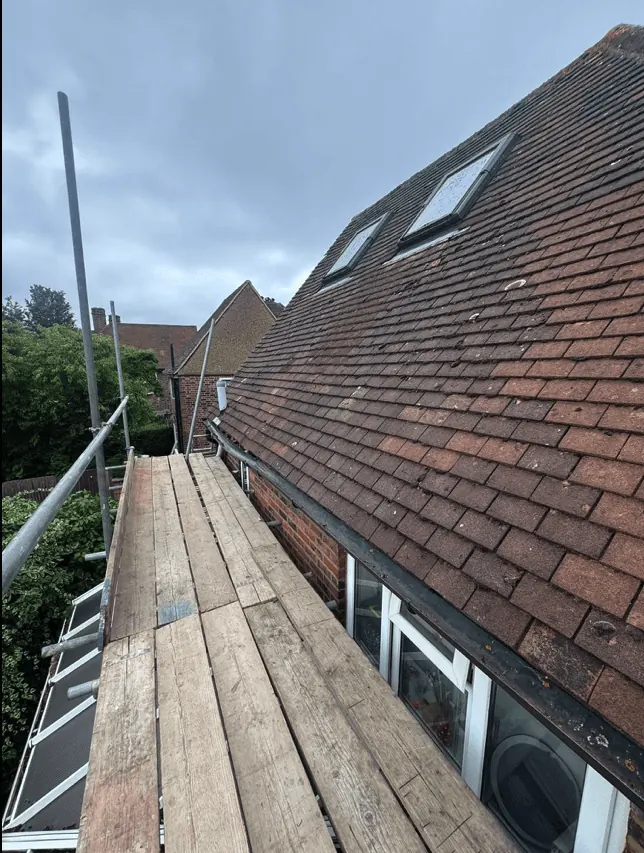
Pockets that sit apart: Idmiston Square, Pembury Avenue and Sheephouse Way
Idmiston Square and Idmiston Road form a compact, older area that does not join the 1930s street layout. The study records Victorian terraces from the 1880s and 1890s with ground floor bays, 1920s additions, flat-fronted short terraces with pebble-dashed first floors, and half-timbered mock-Tudor semis on Idmiston Road. Terraces mean roofs, chimneys and gutters that run from one house to the next.
Pembury Avenue and Kingshill Avenue are cut off from the rest of the borough by the railway and reached only from Green Lane. They are consistently designed 1930s short terraces behind wide verges and street trees, with tile-hung double-height bays and large tile-hung gable ends on the end houses.
Sheephouse Way runs north of the railway from Malden Road to the Hogsmill, with post-war flats and houses in generous landscaping around Malden Manor station and the parade on Manor Drive North. Four five-storey blocks stand in grounds leading down to the Hogsmill Local Nature Reserve. South of the line, Stroudes Close has 1950s flat-fronted semis around a generous communal landscape, and Percy Gardens is a 1990s mix of flats up to four storeys and houses. Roof and gutter work on flats goes through the landlord, freeholder or managing agent.
Because the ages and designs change so much between these pockets, an inspection is the best first step before buying or planning work. Our Old Malden roof inspection page explains what a drone and loft check covers.
Rules and trees around Church Road and Plough Green
The Old Malden Conservation Area was designated in March 1971. It covers 11.2 hectares and 56 properties in two parts: St John's, around the church and the Manor House, and Plough Green, with its pond, the Plough Inn and the Victorian cottages at 16 to 28 Church Road. Kingston Council lists no Article 4 Directions for it. Householders keep their permitted development rights, but those rights are narrower inside a conservation area, so a change to how a roof looks from the road deserves a word with the council first. Like-for-like repairs in matching materials are normal maintenance.
Four buildings here are listed Grade II: the church, the Manor House, the war memorial and the Plough Inn, which dates from the 15th century and has two chimneys, one of them large. Most changes to a listed roof or stack need listed building consent. Our page on chimney repairs in Old Malden covers the older stacks.
Trees shape a lot of the work here. The 1985 conservation leaflet records many mature trees under Tree Preservation Orders on the hillside between the Hogsmill and the church. At Malden Green, most of the poplars lining Malden Road were felled for internal rot in 2010 and replaced with oaks. Leaf fall from both is the reason gutter cleaning in Old Malden matters more on some streets than others.
Frequently asked questions
My house is on Church Road. How do I know if it is inside the conservation area?
Kingston Council publishes a map of the Old Malden Conservation Area on its website. It covers the two ends of the road, around St John's and around Plough Green, so check the map rather than assuming the whole road is included.
Which Old Malden houses have the oldest roofs?
The listed buildings and cottages around St John's and Plough Green, then the Victorian terraces of Idmiston Square from the 1880s and 1890s. The Forest Side, Columbia Avenue and Pembury Avenue estates are 1930s, and Sheephouse Way is mostly post-war.
My house is on Idmiston Road. Is it part of the 1930s estates?
Not quite. Idmiston Square and Idmiston Road form an older pocket with Victorian terraces from the 1880s and 1890s, 1920s houses, flat-fronted terraces and half-timbered mock-Tudor semis. The roof on your house depends on which of those it is, so it is worth knowing before you plan any work.
Do you work on the flats around Malden Manor as well as houses?
Yes, but on a shared block the roof is the landlord's responsibility. For council flats on Sheephouse Way that is Kingston Council. For privately managed blocks, it is the freeholder or managing agent, and we can inspect and report for them.





