



 Google reviews

The arched pairs of Blakes Avenue
Walk down Blakes Avenue and the house type repeats: a semi-detached pair with a side passage at each end, joined to the next pair by a curved brick arch over the passages. Kingston Council's borough character study names this as the typical house of its Motspur Park character area, number 7 in the Old Malden section, and rates the area one of established high quality, on a planned street layout that is mostly curved.
For a roofer, three things follow from that description.
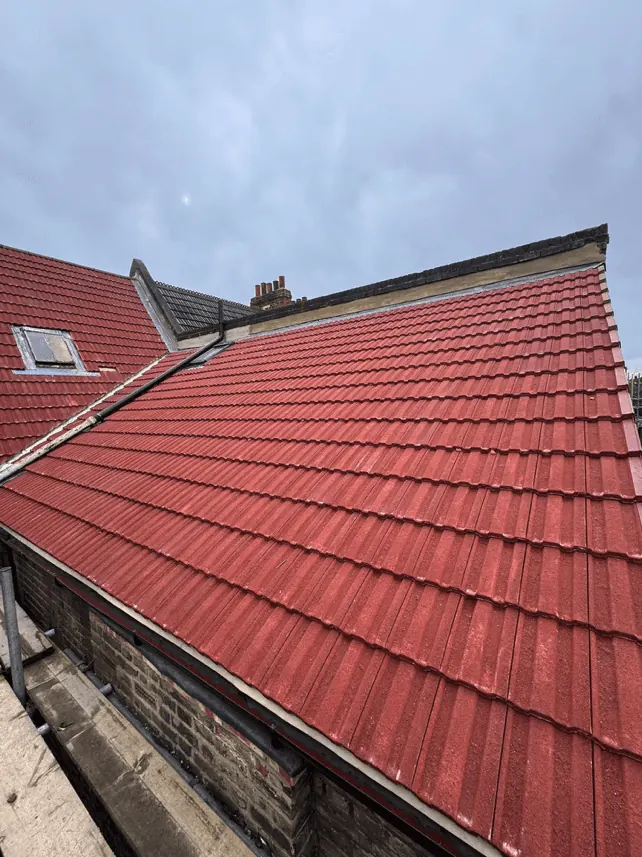
- Hips on every corner. Many of these pairs have hipped roofs, so each house has long runs of hip tiles bedded in mortar and a gutter that turns a corner at every hip. Mortar that has broken up on a hip tends to end up in the gutter below it.
- The arch itself. The top of the arch, its flashing and the brickwork where it meets each house collect water, and it is easy to forget because nobody looks up at it.
- Curved streets. On Ancaster Crescent or Hollington Crescent each pair sits at its own angle, so two houses a few doors apart can have rear slopes facing quite different ways. One house's weather damage is not a guide to the next.
When a hip or the arch flashing gives way, our roof repairs in Motspur Park start there.
Wates, Kenneth Bland and the tile-hung houses
Wates were busy builders on this side of the railway between the wars. The houses on Wendover Drive are recorded as the work of the architect Kenneth Bland for Wates & Wates, in brick with tile-hanging and timber cladding under a pitched roof, and the same record suggests the whole estate around it was his. Houses put up by one builder over a few years tend to share the same build-up under the tiles: the same era of battens, nails and mortar-bedded hips.
The character study also picks out Glebe Gardens, where the pairs have brick ground floors, tile-hung bays and half timbering above. Tile-hanging is vertical tiling on nails and battens, and the nails rust long before the tiles wear out. On these houses a repair often ends up being as much about bays and gables as about the main slopes.
Meadow Hill and Barnfield's flat roofs
A short walk away is a small group of houses unlike anything else nearby. On Meadow Hill and Barnfield the 1930s semis are rendered, with flat main roofs, in the Moderne style of the period. The character study describes them as generally excellently preserved, some still with original Crittall windows. Numbers on Meadow Hill are recorded as built in 1935 to 1938 by Wates & Wates with R A Duncan as architect.
A flat main roof is a different job from a flat roof on a garage, because its edge is part of the look of the house. Our flat roofing page for Motspur Park deals with these houses in detail.
Where the Kingston side starts and stops
The name comes from a farm. In the 14th century the Mot family held land here, and their farm west of the Beverley Brook was later known as Motspur Farm. It stood between what are now the road called Motspur Park and Chilmark Gardens. The brook still marks the border: the streets east of it, such as Seaforth Avenue and Marina Avenue, are in Merton. This page covers the Kingston streets, and our base on Kenley Rd in Morden is about 2.2 miles from the middle of them.
Kingston's character study counts Meadow Hill, Barnfield and Glebe Gardens as part of its Motspur Park character area, which is why they appear here, even though many people who live on them would say they live in Old Malden. The study treats Kingshill Avenue and Pembury Avenue, a run of short terraces cut off from the rest of the borough by the railway line, as a separate character area, and those streets are covered on our Old Malden page.
Planning and smoke control on these streets
There is no conservation area in Motspur Park. Kingston has 26 of them, and the nearest is Old Malden's, around St John's church and Plough Green. None of the council's Article 4 directions covers houses here either. Like-for-like re-roofing is normally treated as maintenance and needs no planning permission, and new gutters and fascias are the same. A loft conversion or a change to the roof shape is a different matter, so check with the council before you commit. Building Regulations still apply to a re-roof and to any new roof.
The whole of Kingston is a smoke control area. If a fireplace is still in use, it has to burn an authorised fuel or be an exempt appliance, which affects what a stack and its pot need. A stack that is never used still needs its flashing, pointing and flaunching kept sound, because it is the tallest and most exposed thing on the roof.
If you are not sure what state your own roof is in, a roof inspection with the drone shows every slope, the arch and any flat roof without scaffolding. You can reach us through the contact page.
Frequently asked questions
Who looks after the curved arch between the pairs on Blakes Avenue?
That depends on your deeds, and it is often shared. What we can do is look at the top of the arch, its flashings and the brickwork where it joins each house, photograph it, and price the work so each owner can see which part is theirs.
Can the flat roof on a Meadow Hill Moderne house be re-covered without changing how it looks?
Usually, yes. The things that change the look are the edge trim and the height of any upstand. We match the edge profile as closely as the chosen system allows and talk you through the detail before anything is ordered.
My Wendover Drive house has tile-hanging and timber cladding. Does that need different care?
Yes. The tile-hanging needs its nails and battens checked, and timber cladding needs its paint and the flashing above it kept sound. Both get wet if the gutter above them leaks, so it makes sense to look at the gutter at the same time.
Is Glebe Gardens in Motspur Park or Old Malden?
Both names are used. Kingston's character study puts Glebe Gardens in its Motspur Park character area, for its well detailed Tudor-style pairs. For the roof, the name matters less than the tile-hung bays and half timbering, which need the same care whichever you call it.





