



 Google reviews

Timber roofline on the Wendover Drive estate
The houses on Wendover Drive are recorded as the work of Kenneth William Bland for Wates & Wates in the 1930s: pitched roofs, brick walls, tile-hanging and timber cladding. The same record suggests the whole estate around it was his design, and notes that the house type appears in Abercrombie's Book of the Modern House.
On houses like these, the boards at the edge of the roof are not just a place to hang a gutter. Painted timber fascias, soffits and bargeboards sit next to tile-hanging and cladding, and together they make the front of the house. Replacing them all in the bulkiest white board available changes that.
Original or early timber boards can last a very long time if they are kept painted and the gutter in front of them does not leak. When they fail, it is usually from the back. A gutter that has dripped behind itself for years soaks the top edge of the fascia, the paint holds the water in, and the timber softens where nobody can see it. The first visible sign is often a gutter that has started to sag or pull forward.
Bargeboards on tile-hung gables
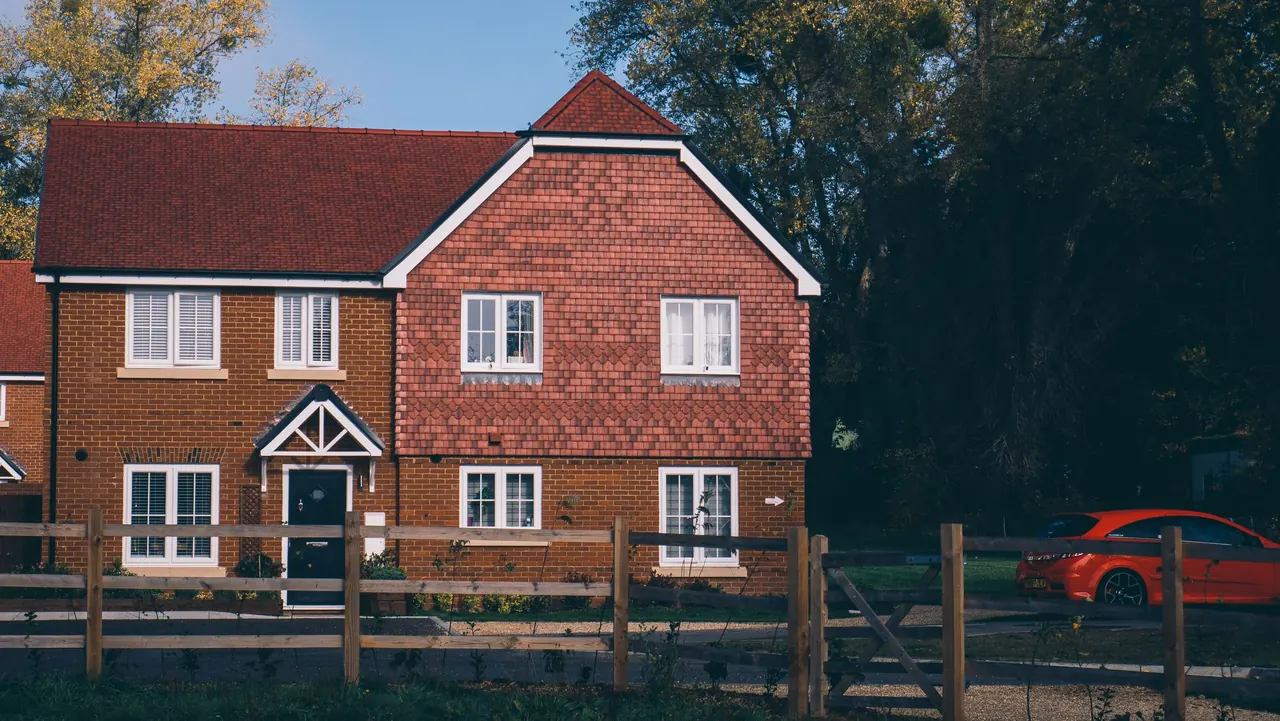
Where a roof ends in a gable, the sloping edge is finished with a bargeboard. On houses with tile-hanging, such as those on Wendover Drive and the Tudor-detailed pairs of Glebe Gardens, a gable bargeboard can sit right above the vertical tiling, with the verge tiles of the roof overhanging it.
A bargeboard faces the weather on both sides and has no gutter to protect it. When it rots, two things follow. Rain gets in behind the top course of tile-hanging and wets the battens, and the verge tiles above lose some of their support. So on these houses we look at the bargeboard, the verge and the top of the tile-hanging together, and repair them as one detail rather than treating the board on its own.
The same applies on any hipped pair that has had a hip-to-gable loft conversion. The new gable has its own bargeboard and verge, and where the new fascia meets the original one at the corner there is a join that is worth checking a few years after the conversion.
Corners and soffits on the hipped semis
Many of the arched semis around Blakes Avenue are hipped, so the fascia and soffit run round three sides of the house. The corners, where two boards meet under a gutter angle, take the water from two slopes and are where timber rot shows first. Soffits on these houses are often narrow boards under shallow eaves; once a section has rotted or dropped, there is a gap straight into the roof space, and wasps and birds find it quickly.
Where a section of board is rotten but the rest is sound, it can be cut out and replaced. Where rot runs along most of the length, a full replacement is better. Capping, which covers existing timber with a thin uPVC board, only makes sense over timber that is completely sound; over rot it hides the problem.
Keeping the 1930s look in uPVC or timber
Motspur Park has no conservation area or Article 4 direction, so the choice of material is yours. If you want low maintenance, uPVC fascias and soffits come in white, black, grey and woodgrain finishes, and a plain board with a modest profile sits more comfortably next to tile-hanging than a deep, heavily moulded one. On a semi, it is worth matching what the other half has, or agreeing a finish together.
Because the fascia carries the gutter, the sensible time to replace it is with new guttering; see our gutter installation page. If you are not sure how far the rot goes, a roof inspection with the drone shows the side and rear boards you cannot see from the road.
For a benchmark, Checkatrade's fascia and soffit cost guide gives £90 to £170 per linear metre for replacement. Our main fascias and soffits page goes through the options.
Frequently asked questions
Can the bargeboards on my Wendover Drive house be replaced in timber?
Yes. Timber suits the cladding and tile-hanging on these houses, as long as it is primed and painted on all faces before it goes up. We can also fit uPVC if you prefer lower upkeep.
The top course of tile-hanging on our Wendover Drive house is loose. Is that the bargeboard?
Where the tile-hanging runs up under a gable, it often is. A rotten bargeboard lets rain behind the top tiles. We replace the board and refix the tiles and verge together.
Our Blakes Avenue semi has a rotten corner where two fascias meet. Do we need a whole new run?
Not always. If the rot stops at the corner, we can replace that section and the corner joint. If it runs along the boards, a full run is better value.





