


 Google reviews

Montpelier Row and the parapets by Marble Hill
Montpelier Row went up in 1720 on the edge of what is now Marble Hill Park, the grounds of the Neo-Palladian villa built for Henrietta Howard between 1724 and 1729. Richmond council's appraisal of the Twickenham Riverside conservation area describes the row's roofline as tall stacks and mono-pitched roofs behind panelled parapets. From the pavement you see the parapet, not the roof.
A parapet roof drains differently from an ordinary pitched one. Rain runs into a lead-lined gutter behind the wall, then out through an outlet or hopper to the downpipe. When that hidden gutter silts up or its lead splits, the water goes into the top of the wall or the ceiling below, well away from where you would expect a roof leak.
On these houses the gutter behind the parapet is where we start. A roof inspection by drone shows the hidden side of the parapet and the valleys between the slopes without anyone stepping on old slates or putting up a scaffold just to look.
Alexandra Road, Morley Road and the East Twickenham terraces
South of Richmond Bridge, East Twickenham is a tight grid of red brick terraces built in the late 1800s and early 1900s. Richmond council's planning guidance describes Alexandra Road as two storey terraces with slate roofs and contrasting clay ridge tiles, and Morley, Denton and Cresswell Roads as close relatives, roofed in dark slate or tile. Next door, the St Margarets estate was laid out earlier, in 1854, as one of the first garden suburbs.
On terraces like these, the joins give way before the slopes do: the valley where the main roof meets the back addition, the lead where the back addition's wall rises past the slope, the mortar under the clay ridge, and the flashing round the stacks on the party walls.
Repairs here go wrong when the replacement does not match. A concrete tile in a run of grey slate, or a modern ridge on a red clay one, shows from the street. The same guidance notes that rooflights added to front slopes interrupt the regular roofscape, particularly on Cresswell Road and Cambridge Road. You can check whether your road is in a conservation area on the council's conservation area pages. If a job would change how the front of your roof looks, we say so when we quote. Weighing up whether a tired slate roof is worth saving? Our guide on repair or full replacement sets out what to look at.
Strawberry Hill Road gables and the Bonser Road terraces
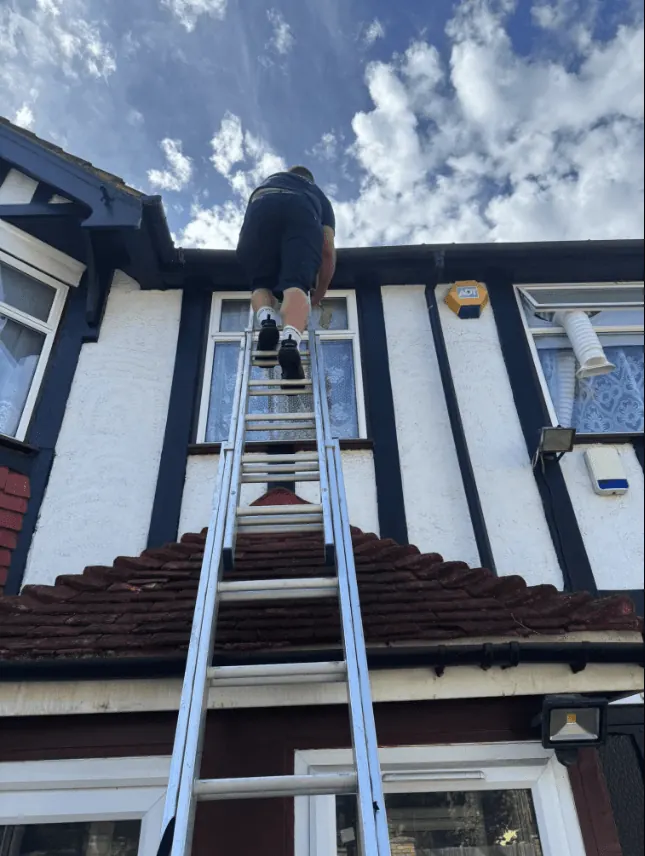
Horace Walpole began rebuilding Strawberry Hill as his Gothic villa in 1749, but the streets around it are a much later layer. Strawberry Hill Road and Waldegrave Gardens were developed from the 1880s with two and a half storey late Victorian houses, and the council's conservation area summary describes their roofscape as steeply gabled clay tile roofs, hips and integral dormers with prominent brick chimneys. Nearer the river, Bonser Road, Holmes Road and Riverview Gardens had been laid out with Edwardian terraces and semis by 1912.
A steep roof broken up by gables and dormers has a lot of short valleys and abutments, and old plain tiles hang on nibs and nails that loosen with age. Water usually finds its way in beside a dormer cheek or down a valley, not through the open slope.
On the terraces, a loft conversion usually means a flat-roofed rear dormer, sometimes above a single-storey kitchen extension, which puts two flat roofs on one house. In East Twickenham the council's guidance on Park House Gardens, a street of Art Deco semis built after 1929, notes that dormers and loft extensions are common and that in some cases the roofline between houses has been altered dramatically.
Dormer leaks tend to show in the loft room ceiling close to the main roof, because the joint between the dormer covering and the slates is the hardest detail to keep watertight. Blistered felt, split seams and water still sitting on the surface days after rain mean the covering itself is worn out. Our flat roofing work covers patch repairs and full re-covers, and we look at the abutment and the outlet at the same visit.
Party-wall stacks and the green river front
Most Twickenham terraces have stacks that straddle the party wall, so the stack and its flashing are usually shared with next door. Cracked flaunching and the lead where the stack leaves the slope are the usual culprits when a chimney breast shows a damp patch. Our chimney repairs cover re-flashing, repointing, new flaunching and cowls. On a shared stack, agree the work with next door before it starts. MyJobQuote's 2026 chimney repointing guide gives a national range of £150 to £300 for a flaunching repair, before any scaffold.
The river front is the greenest part of town: Marble Hill Park's 66 acres, Radnor Gardens and the tree-lined promenade along the Embankment. Houses close to them catch leaves in their gutters and in the hidden gutters behind parapets, often more than once a year. Overflowing gutters, damp streaks on brickwork and water dripping from behind the gutter line are the signs to act on. We clear and repair existing runs, and where the timber behind an old gutter has gone soft, we fit new fascias and soffits first so the gutter goes back onto sound boards.
To arrange a look at your roof, call 0330 133 4111 or use the contact page.
Frequently asked questions
Our Cresswell Road terrace has a slate main roof and a back addition. Why does the leak always appear in the back bedroom?
That bedroom usually sits under the valley or abutment where the back addition meets the main roof. Water from both slopes gathers there, so a split in the valley lead, a slipped slate beside it or failed mortar at the wall joint lets it straight in. We check those joins first, then the slates either side.
Water is coming through the ceiling of our loft conversion on Bonser Road. Which part of the roof is letting it in?
If the stain is close to where the dormer meets the slope, it is usually the upstand or flashing at that joint. A stain further out under the dormer points to the flat roof covering or a blocked outlet. We look at both, since the two often turn up together.
The slates on our Alexandra Road house keep slipping. Does the whole roof need replacing?
Not always. The slate itself is often still sound. If only a few are moving, they can be refixed. If slates are slipping across the whole slope, stripping and relaying with new fixings and reusing the sound slate is often the better long-term job, and we will show you which applies.
A few clay tiles have slipped on our Strawberry Hill Road gable. Will it need a scaffold?
It depends on the height of the gable and where the gap is. These are two and a half storey houses with steep roofs, so a ladder rarely reaches safely. The drone photos show exactly which tiles have moved and what is around them, and we tell you what access the repair needs before you agree to anything. Replacement tiles are matched to the old clay plain tiles so the gable still reads as one roof.





