



 Google reviews

Two hundred years of roofs between Acre Lane and Coldharbour Lane
Until the early 19th century this was farmland and market gardens. The enclosure of Lambeth Manor in 1806 and the opening of Vauxhall Bridge in 1816 brought the first terraces and villas along Brixton Road, and the railways of the 1860s brought the boom that turned it into south London's main shopping centre. By the 1880s, Electric Avenue was one of the first streets to have electric light.
That history is still in the roofs. The oldest, on Acre Lane and the Lambeth Wick estate either side of Brixton Road, are late Georgian: stock brick fronts with parapets on Acre Lane, and slate roofs with wide overhanging eaves on some of the Brixton Road villas. Loughborough Park's hipped villas and London roofs followed in the 1840s and 1850s, and Angell Town in the 1850s. The town centre added shops with flats above, then mansion blocks on Coldharbour Lane and Rushcroft Road, then the glass-roofed market arcades of the 1920s and 1930s. After the war came the big estates: Loughborough, Angell Town, and Southwyck House on the Somerleyton Estate.
The pages below go into each kind of roof in more detail. This one is the overview.
St John's Crescent, Angell Terrace and the Brixton Road villas
Angell Town was laid out in the 1850s around Wiltshire Road, mostly as villas three storeys over semi-basements, in stucco or grey brick with stucco dressings. Most of it was cleared in the 1970s for the Angell Town Estate. The survivors line the south side of St John's Crescent and the southern end of Wiltshire Road, now inside the town centre conservation area. On Brixton Road itself, Angell Terrace (Nos. 341 to 361), agreed in 1855, rises four storeys and is listed, and No. 147, a listed villa of 1822, keeps its overhanging eaves and slate roof.
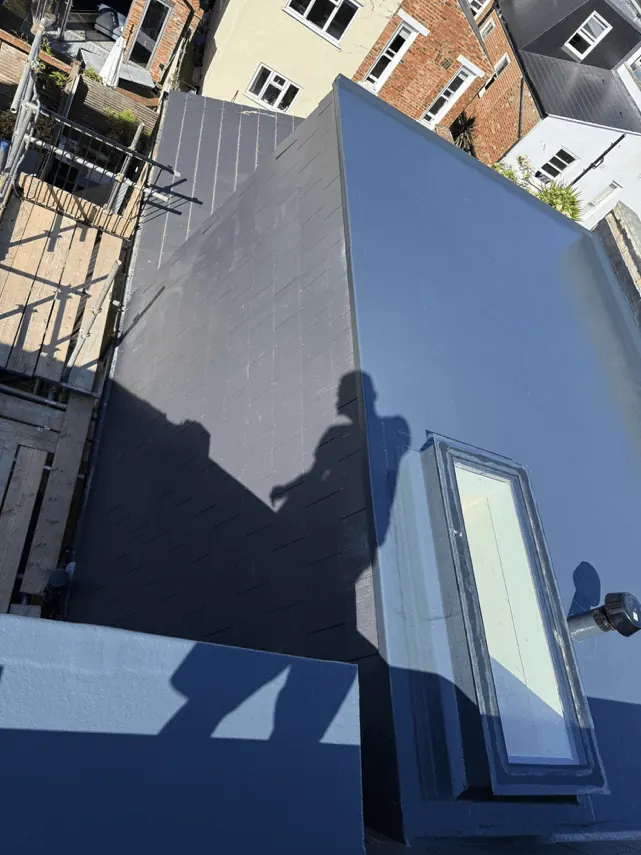
Where a house like this has been split into flats, the roof is usually shared and the person who sees the first leak lives on the top floor. The slates themselves last for generations. The nails, battens, valleys and lead round the stacks are what give out, and on a house this tall it is hard to judge any of it from the pavement. That is why a drone roof inspection in Brixton is a sensible first step, with slate and lead work covered under roof repair in Brixton.
Coldharbour Lane, Loughborough Park and the motorway that never came
South-east of the town centre, the Loughborough Park conservation area covers Coldharbour Lane, Loughborough Park, Barrington Road, Millbrook Road and Moorland Road. Lambeth's 2025 appraisal describes a roofscape generally covered in natural slate, with hipped villa roofs, London roofs behind front parapets, a few mansards and some notable chimney stacks, including the broad stacks at 261 to 267 Coldharbour Lane.
These streets were nearly lost. A motorway planned in the 1960s would have taken the historic houses fronting Coldharbour Lane. Lambeth patched many of them up as a short-term measure in 1969, and when the scheme was abandoned in the mid-1970s, borough architect Ted Hollamby oversaw a fuller restoration for council housing. Where a roof was renewed in that work, it is now more than 45 years old, though the records rarely say which were. Broad stacks with long runs of lead are covered under chimney repairs in Brixton.
Flats above shops, mansion blocks and estates
The town centre has a lot of flat roof between its pitched ones. Behind the shopfronts of Atlantic Road, Electric Avenue and Coldharbour Lane there are rear additions with low felt roofs, and some of the mansion blocks were built with flat roofs as shared terraces. On the estates, the large block roofs belong to the council or housing association, but private owners nearby still have garages, porches and extensions to look after. Our page on flat roofing in Brixton covers repair and re-covering in GRP, EPDM and felt.
Gutters on these buildings tend to fail out of sight: above a shop sign, behind a parapet, or four floors up on a villa. In the Brixton town centre conservation area, Lambeth's 2012 statement asks for original cast iron rainwater goods to be kept, and replaced in cast iron or cast aluminium where needed, so the choice of material at the front is not open. Our gutter installation in Brixton page explains how that works on a tall front.
Who you will meet
Ryan runs the business, with Luke as operations manager and Mark in the office taking your call. Simranjeet is our roofing surveyor, Liam is our lead roofer, and Jed and Gurpret are our roof and guttering specialists. Josh, our apprentice, flies the drone. On a Brixton job that usually means a survey and photos first, a written quote, and the work booked around shop opening hours, a managing agent's access rules or the other flats in the building.
If your house sits further up the hill, among the bay-fronted terraces around Elm Park and the mansion blocks facing Rush Common, our separate Brixton Hill pages are written for those streets.
Frequently asked questions
How do I know if my house is in the Brixton town centre or Loughborough Park conservation area?
Lambeth publishes maps of both areas (CA26 and CA27) on its conservation area pages, and its planning team can confirm an address. It matters for roof work, because both expect original roof coverings, traditional roof shapes and historic chimneys to be kept.
Our St John's Crescent house is three storeys over a basement. Will the roof work need scaffolding?
For a full re-roof or work on a high stack, almost always. For a few slates or a short length of gutter, a tower or ladder may be enough. We decide after looking at the drone photos, so you only pay for the access the job needs.
We are a shop on Atlantic Road with flats above. Can you work without closing the shop?
Usually. Most roof and gutter work happens above and behind the shop, and noisy or messy stages can be timed before opening or after closing. We agree the plan with the shop, the flats and the freeholder before we start.
Is there anything in Brixton you would not touch?
The listed market arcades and the big council blocks are looked after by their owners and landlords, so we would point you to them. For houses, flats, shops and their extensions, we cover the whole range of roof and gutter work.





