



 Google reviews

Wray Park Road, Alma Road and Alders Road
The big houses north of the railway, between Reigate Hill and Wray Common, belong to the Wray Park estate, which was laid out from the middle of the 19th century. The council describes the houses on Wray Park Road, one of the earliest parts of that estate, as Victorian mansions mostly finished in painted stucco, with a classical feel. All of the mansions in the stretch the council looked at in 2024 are locally listed, and in February 2024 its planning officers recommended adding them to the Wray Common Conservation Area, which was first designated in 1988.
Next door, Alma Road and Alders Road carry another group of mid and late 19th century mansions. The council's 2023 review lists the materials: Reigate stone and greensand stone, handmade brick, handmade clay plain tiles, painted stucco, natural slate and decorative joinery. Wray Park Hall on Alma Road, built of greensand stone, is listed along with its lodge and coach house.
Houses this size rarely have one simple roof. They tend to have several pitches meeting in valleys, lead-lined gutters behind stucco parapets or cornices, dormers, bays and tall stacks, and a lot of that cannot be seen from the drive. We start these jobs with a drone flight over every slope and stack, so the quote is based on what is actually up there. Our roof inspection page sets out what that survey includes.
Slate work here is mostly refixing and renewing lead. Broken handmade clay tiles need matching in colour and size, or the repair stands out. Stucco also shows water fast, so an outlet spilling onto painted render is worth sorting before the render blows.
Blanford Road's tile-hung gables
Blanford Road was built up in the late 1890s and early 1900s, and the council's 2023 conservation area review proposed it as a new conservation area. Its houses are in the Old English style made popular by Richard Norman Shaw, with arts and crafts touches. Several are locally listed, and the review names their builders and dates, from number 41 in 1896 to number 9 in 1905.
The review lists what gives the road its look: tile hanging, handmade clay plain tiles, handmade red stock brick, timber framing, some local Wealden sandstone, painted modillion cornices at the eaves, bargeboards and substantial chimney stacks.
Three of those are where these houses usually let water in. Hung tiles on a gable or upper wall slip as their fixings give, and the gap lets rain onto the battens behind. The painted timber of the bargeboards and cornices rots from the back once the paint fails, and because the original profile is part of the road's look, it is repaired or copied rather than swapped for a plain board, which our fascias and soffits work covers. Then there are the tall stacks, with long runs of stepped lead flashing down each side: when the mortar holding that lead weathers out, water runs down inside the stack and shows on a chimney breast. Our chimney repairs cover flashing, repointing, flaunching and pots.
Behind the High Street, Bell Street and Church Street
The town centre is a conservation area with dozens of listed buildings, among them the Old Town Hall at the east end of the High Street, a red brick building from about 1728 listed Grade II*.
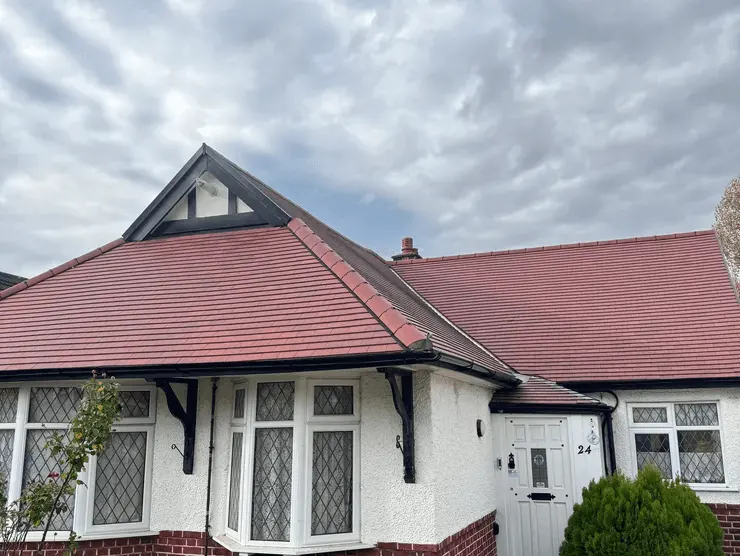
Plenty of cottages, shops with flats above and older houses off the main streets are listed or sit inside the conservation area. On those, repairs should be like for like: the same kind of tile or slate, lead detailed the way it was, and lime mortar where the building was built with lime. Anything that changes how a listed roof looks, such as a different covering, a new roof window or taking down a stack, normally needs listed building consent from Reigate and Banstead Borough Council first. We flag it when we quote.
Much of the work on these older roofs is lead around stacks and abutments. As a national guide, MyJobQuote's 2026 chimney repointing guide lists £150 to £350 for a lead flashing repair. Our own quote is free and often given the same day, and the work carries a 10 year guarantee.
Down the hill to Woodhatch and across to Reigate Heath
The town centre and Reigate Heath sit on the sandy Folkestone Beds, the same rock the sand caves under the castle were dug into, while Woodhatch to the south sits on Weald Clay, which was once dug for bricks at Brown's Brickyard. Reigate Hill rises to 235 metres above sea level on the North Downs, so houses on its upper slopes take more wind than those down in the town.
South Park and Woodhatch have a broad mix of family houses, and the council's local plan picks out Seale Hill as a Residential Area of Special Character. On tiled roofs of any age out here, the faults we look for first are cracked ridge and hip mortar, slipping tiles, and felt on garage or extension roofs that has split along its laps. Where repairs keep coming back in new places, our roof repair visit ends with a straight view on whether patching is still worth it.
Reigate Heath, at the western edge, is a Site of Special Scientific Interest, mostly heath and acid grassland with patches of woodland. Houses along the heath edge and beside Priory Park get a steady fall of leaves, so regular gutter cleaning matters more there than in the middle of town.
To arrange a visit, call 0330 133 4111 or use our contact page.
Frequently asked questions
My house on Wray Park Road is locally listed. Does that change how a roof repair is done?
Local listing is a council record of a building's interest, not the same as national listing, so it does not bring listed building consent on its own. If the house is inside the Wray Common Conservation Area, though, the council will expect repairs that keep the roof's look. Matching slate or handmade tile and renewing lead to the same detail is normally fine. If you want to change the covering or add roof windows on a visible slope, check with the council's planning team first.
Can a slipped section of tile hanging on a Blanford Road gable be fixed without stripping it?
Usually, yes. Where only a few hung tiles have slipped or cracked, they can be refixed or replaced with matching handmade clay tiles. If a large area is loose, the battens or nails behind it have usually failed and that part of the face needs taking off and rehanging, reusing the sound tiles.
The felt on our garage roof in Woodhatch has split along the laps. Is it worth patching?
If the split is in one place and the deck underneath is firm, a patch can buy a few years. Splits along several laps, blisters and water standing after rain mean the felt has reached the end of its life, and re-covering the whole garage roof is the better spend. We check the timber deck and the edge where the roof meets the house wall at the same time, as that joint is often where water gets into the garage.
Where is a leak most likely to start on a big Victorian roof up by Alders Road?
On roofs with several pitches, the usual suspects are the valleys between slopes, the lead around dormers and stacks, and any parapet or concealed gutter behind a cornice. The stain inside is often some distance from the fault, which is why we look at the whole roof from the air before deciding what to repair.





