



 Google reviews

A village on the edge of the Downs
Woodmansterne sits on a small plateau and the southern slope of the North Downs. The primary school, the recreation ground and Carshalton Road are on the high northern part, at about 140 metres above sea level, according to the village's Wikipedia article. A benchmark on the east wall of St Peter's Church on Rectory Lane reads 143.71 metres, as the church's own history records.
From there most of the homes run down a long, gentle slope to the south, reaching about 85 metres near Chipstead station. Around the edges are woods, allotments and two small farms, all in the Metropolitan Green Belt.
For a roof, that setting means two things. Wind reaches the houses across fields rather than through rows of other buildings, so ridges, hips and chimney pots on the outer edge of the village get the worst of it. And leaves, twigs and moss come down from trees on most sides, so gutters, valleys and flat roofs fill up.
Rectory Lane, Woodmansterne Street and the postwar avenues
Woodmansterne is a linear village, strung along two main roads with a few side estates. The council's 2004 design guide groups it with Chipstead, Walton-on-the-Hill and Banstead Village as an example of a pre-Victorian village centre and country lane settlement. Its 2008 townscape study lists north Woodmansterne among the borough's notable pockets of pre-Victorian development.
Most of the houses came later, and the church grew with them. St Peter's records that its parish, which is wider than the village, had about 8,000 people by 1960, and a north aisle and vestries followed in 1961. The 2011 Census put the village itself at about 2,979 residents. Reigate and Banstead's 2008 townscape assessment describes the wider area, from Banstead and Nork to Woodmansterne and Chipstead, as extensively covered by 1930s to 1950s suburbia. It uses Kingscroft Road as its picture of the long, straight avenues and Chipstead Way as an example of the curving roads.
The council's design guide sums up housing of that period in the borough as almost totally brick and tile, with gables, dormers and hips. Some roofs are still on their original clay tiles. Others have been re-covered at some point, and a later covering can sit differently at the eaves and verges from the one beside it.
The older buildings are a different job again. St Peter's was rebuilt in 1876 to 1877 to a design by Joseph Clarke, and the church notes that it is not listed. Weston Acres on Woodmansterne Street is Grade II listed, and its list entry describes an Arts and Crafts house of pebbledash with brick quoins, tiled roofs with hooped gutter brackets and brick chimneystacks. Its north entrance front was designed in 1915 by Sydney Tatchell.
What houses like these tend to need
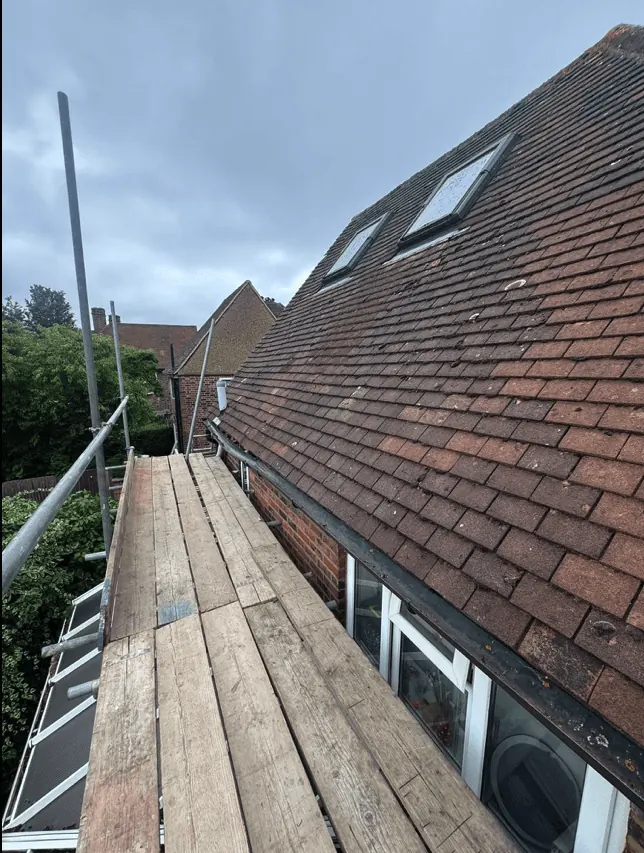
We work from Kenley Rd in Morden, about 6 miles north of the village. Before anyone climbs a ladder, our drone can show every slope of a hipped roof, including the back hip and the valleys you cannot see from the garden. From there, the work on houses like these tends to fall into a few groups.
- Ridges and hips on the high ground. On the plateau and the outer edge of the village, the mortar under ridge and hip tiles cracks and washes out, and a loose hip tile is often the first piece to lift in a gale. Our Woodmansterne roof repair page explains how we deal with it.
- Gutters under garden trees. The 2008 study notes a relatively high degree of mature tree cover in gardens across this part of the borough, and clearing Woodmansterne gutters twice a year suits many homes close to big trees.
- Stacks on the party wall. The design guide calls substantial chimney stacks a feature of the Surrey style. On a pair of semis the stack usually serves both houses, so flashing and flaunching on one side affect the other.
- Coverings reaching their limit. A house from the 1930s to the 1950s may still be on its original battens and underlay, or on a re-roof that is itself several decades old. At some point repairs stop being good value, and a full roof replacement becomes the better spend.
- Flat roofs added later. Rear kitchens, garages and loft dormers on houses of this age usually have flat roofs, and these often need attention long before the main roof does.
If you are not sure which group your roof falls into, a roof inspection in Woodmansterne answers that before you spend money on the wrong fix. You can also see some of our recent work.
Postcodes, the station and the lanes
The village has two post towns, Banstead (SM7) and Coulsdon (CR5), and sits in Reigate and Banstead's Chipstead, Kingswood and Woodmansterne ward. The station named after it is not in the village. Woodmansterne station opened in 1932 on Chipstead Valley Road, just over the border in Coulsdon in the London Borough of Croydon, about a mile south-east of the village centre. Homes right by the station may come under Croydon rather than Reigate and Banstead.
The council says Article 4 Directions have been served on most conservation areas in the borough, so if you are unsure about your road, check its Where I Live map before changing the look of a roof. Like-for-like repairs and re-roofs on an ordinary house do not normally need planning permission. A listed building such as Weston Acres is different, and works that affect its character need listed building consent.
Some lanes are tight. Bus route 166 was moved off Woodmansterne Lane in 2003 because the lane was too narrow for it. Where scaffold or a skip has to stand on the road or pavement it needs a licence, and that goes into the timing of any big job.
Frequently asked questions
Our house is up on the plateau near Carshalton Road and the ridge mortar keeps cracking. Is that the wind?
Very likely, along with age. Mortar on an exposed ridge dries, shrinks and gets rocked by gusts until it lets go. Lifting the ridge, cleaning it off and rebedding it properly usually stops the cycle, and we check the hips at the same time, since they take the same weather.
We are in one of the older houses in the village core near St Peter's. Do you work on plain clay tiles and old detailing?
Yes. On older roofs we keep the existing materials wherever they are sound, match replacement tiles by size, colour and camber, and set aside sound old tiles rather than throwing them out. If a house is listed, we tell you before anything starts if consent is likely to be needed.
Our garden backs onto woodland at the Chipstead Bottom end. What should we keep an eye on?
The gutters and valleys on the side facing the trees, and any flat roof that sits under them. Leaves and moss hold water against tiles and outlets. A clean in late autumn and a look in spring will catch most problems before they reach a ceiling.
Is a house near Woodmansterne station in Croydon or Reigate and Banstead?
It depends which side of the border it is on, since the station itself is just inside Croydon. It makes no difference to us, but it matters if you ever need to check planning rules, so look at the council tax bill or the council's own map.





