



 Google reviews

Stanley Park and the edges of the hill
Ask someone who lives here where they are and there is a fair chance they will say Stanley Park rather than Carshalton on the Hill. The park sits in the middle of the area, and the name has spread to the streets around it. It is a residential patch on the high chalk ground south of Carshalton Park, with Boundary Road on its eastern side and Crichton Road, Queen Mary's Avenue and Diamond Jubilee Way along the west. Past that western line you are in Carshalton Beeches. To the south the houses give way to the smallholdings of Little Woodcote.
The Stanley names are not a coincidence. A man who grew up on Pine Ridge in the 1940s and 1950s, writing in a memoir for the Friends of Honeywood Museum, notes that the streets were named after the Earls of Derby, who owned The Oaks. Stanley is the Derby family name, and Oaks Park, laid out for the Earl in the 1770s, still lies to the south beyond the smallholdings.
There is no old village core up here. The landmarks are a park, two schools on Stanley Park Road, the allotments off Stanley Road where the community lavender field grows, and Queen Mary's Park at the top of the hill on what used to be hospital land. Our base on Kenley Rd in Morden is about 4 miles away.
Four kinds of house on the hill
The 1930s council houses. A former resident, born on Stanley Road in 1946, described his home in a second Honeywood memoir as a well constructed 1930s council house, one of a group in the eastern middle of Stanley Road and Stanhope Road. Those roofs are now around ninety years old. Even where the tiles have been changed, the timbers, the ridge bedding and the chimney stacks are often original, and those are the parts that tend to need work first.
Private terraces and semis. The same writer remembers privately built terraces and semis mixed in among the council homes, with a few older and taller buildings near the shops. Pairs of semis share a ridge line and usually a chimney stack, so a roof here is rarely a job that stops neatly at your own boundary.
Houses raised from bungalows. The Pine Ridge memoir describes two neighbouring houses on Pine Ridge as small, flat-roofed, two-bedroom bungalows that were later given an upper floor, one of them in 1956. That is two houses on one street, not a whole estate, but any house that has grown a storey decades after it was built has a junction between old and new work, and that junction deserves a closer look than the rest of the roof.
Homes on the Queen Mary's Hospital land. The Friends of Queen Mary's Park record that the eastern part of the hospital site was built on in 1999 and 2000, and the rest after the remaining buildings came down in 2011. These are the youngest roofs on the hill. The earliest of them are now about 25 years old, which is when original plastic gutters, soffit joints and roof window seals start to need attention.
Open ground, park trees and the conservation boundary
Much of the hill looks out over open land: Stanley Park itself, the allotments, the smallholdings to the south and the fields of Queen Mary's Park, which the Friends describe as having open views towards the downs. Houses on those edges have little to shelter them and can lose tiles in a gale that sheltered streets ride out. Loose ridge tiles, lifted verges and lead that has worked out of a chimney are the usual results, so a look after a big storm is worth having.
Trees bring the other routine job. Stanley Park is bordered by young and mature trees, particularly along its north side, and Queen Mary's Park has an avenue of mature trees and an area of woodland. Gardens backing onto either fill their gutters faster than most.
Stanley Park is not in a conservation area, according to the London Gardens Trust inventory. Carshalton's conservation areas lie to the north, and Carshalton Park itself sits inside one, so if you live towards Ruskin Road or Ashcombe Road, check with Sutton Council before changing the look of a roof or cutting back a tree.
Where to start with your roof
If you are buying on Stanley Road or simply have not had the roof looked at in years, a roof inspection on the hill with drone photos of every slope is the sensible first step. If something has already gone wrong, our roof repair page for the area covers the wind-exposed southern edge, and the chimney repairs page deals with the old coal-fire stacks on the 1930s houses.
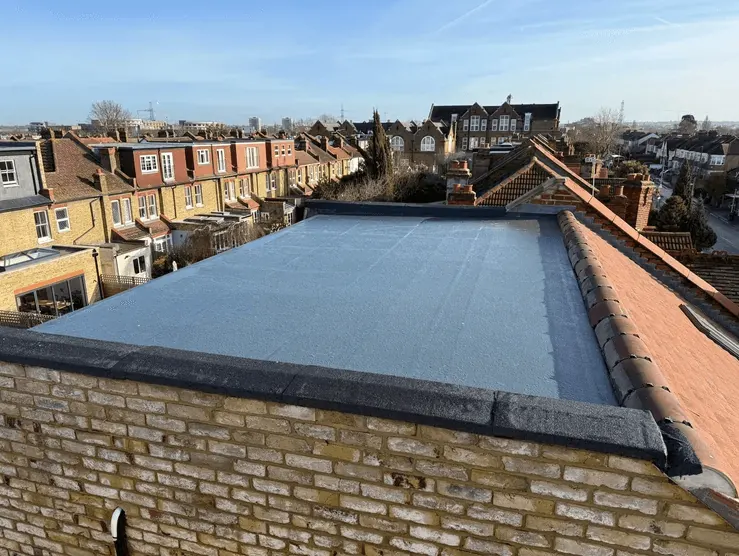
Extensions, garages and the surviving flat sections on raised houses are covered on our flat roofing page for Carshalton on the Hill, and homes near the park trees will find timing advice on the gutter cleaning page.
Most jobs start with a phone call on 0330 133 4111 and a visit. Simranjeet, our Roofing Surveyor, or one of the team looks at the roof, and where a slope cannot be seen from the ground, Josh can put the drone up so you see the same photos we do. Liam, our Lead Roofer, runs the work with Jed and Gurpret, and Mark in the office books it in.
Frequently asked questions
Is Carshalton on the Hill the same as Carshalton Beeches?
No. They sit side by side on the high ground south of Carshalton, but the Beeches lies west of Crichton Road and Queen Mary's Avenue. Carshalton on the Hill is the area around Stanley Park, running east as far as Boundary Road.
My house on Pine Ridge was once a bungalow. Where should a roofer look first?
At the joins between the original build and the added storey: the flashing where a lower roof meets the newer wall, any flat section that survived the conversion, and the eaves of the newer roof. Those details were done decades after the walls went up, often by a different builder.
We live on the old Queen Mary's Hospital land. Is our roof too new to have problems?
Not if it dates from 1999 or 2000. The tiles are probably fine, but by 25 years old dry-fixed ridges and verges, roof window seals and plastic gutter joints can start to let go, especially on the side that faces open ground.
Why are so many streets here named Stanley?
Stanley is the family name of the Earls of Derby, who owned The Oaks to the south. A local memoir records that the streets were named after them, which is also where Stanley Park gets its name.





