



 Google reviews

Bridge Street and Church Street: slate, red tile and stone
The old town runs down Bridge Street to the River Mole and up Church Street towards the parish church. Mole Valley District Council designated it a conservation area in March 1974, and parts of it also sit under an Article 4 direction, which removes some of the alterations a householder could otherwise make without planning permission.
The roofs here change every few doors. The Running Horse at the foot of Bridge Street is a late medieval hall house, listed Grade II*, and its list entry describes a red tile roof with four courses of stone slates over the eaves and a slate roof on the rear addition. Further up, the local history society's survey of Bridge Street records early nineteenth century stock brick and stucco houses with slate roofs, including the terrace at Nos. 28 to 34. On Church Street, The Mansion was rebuilt in brick in 1739 under a tiled roof, and Sweech House on Gravel Hill, timber framed and probably late fifteenth century, carries red tiles.
The work here is usually small and careful: refixing a slipped slate, rebedding a ridge, renewing a strip of lead where a roof meets a wall, clearing a valley between two slopes of different ages. The covering has to match what is already there. A concrete tile in a run of old red clay, or a new slate of the wrong colour, shows from the street and is the kind of change the council notices. If a repair would alter how the front of your roof looks, we say so when we quote, so you can speak to the planning team first.
Fairfield, Highlands and Kingston Roads: the Edwardian spread
The railway reached Leatherhead in 1859, and the present station, built in 1867 for the London, Brighton and South Coast Railway, was built in red brick with polychrome dressings under red tile roofs. Between 1900 and 1905 new houses went up in Fairfield, Highlands and Kingston Roads and Queen Anne's Garden, and later that decade in Copthorne, Clinton, Reigate and Woodville Roads, Kingston Avenue and St Nicholas Hill.
Houses of that age are now well over a hundred years old, and their weak points are rarely the slates or tiles in the middle of a slope. They are the joins. Bay window roofs, a small lead or tiled hat over the front room, pull away from the wall. Back additions meet the main roof in a valley that carries water from both slopes. Chimney stacks rise through the roof with lead flashing that has been dressed and redressed for decades. A damp patch in the back bedroom or above the bay usually traces back to one of those joins, not to the main slope.
Our chimney repairs cover new lead flashing, repointing, flaunching and cowls. For the joins themselves, MyJobQuote's 2026 roof leak repair guide gives £200 to £500 as a national range for fixing broken flashing. When you cannot tell which part of the roof is letting water in, a roof inspection by drone shows the stack top, the valleys and the rear slopes without anyone climbing on an old roof.
Poplar Road, Kingston Road and St Mary's Road: the interwar estates
After the First World War the council started building. Leatherhead Urban District Council put up 59 houses in Poplar Road in 1921 and another 90 on Kingston Road in 1925. On the private side, the grounds of Elm Bank, sold in 1924, became the St Mary's Road estate, and Yarm Court was sold for housing in 1935. After the Second World War, new houses replaced bomb-damaged ones along Cleeve, Kingston and Copthorne Roads.
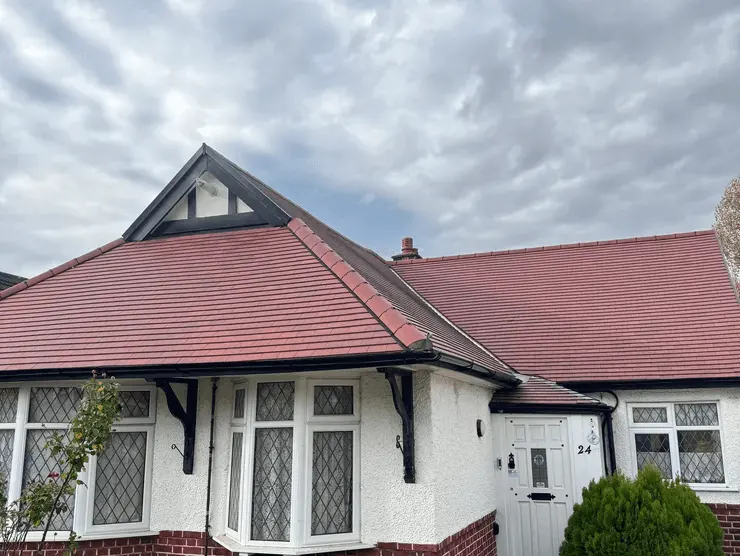
Roofs of this period were commonly laid in clay or concrete tiles, with hips and ridges bedded in mortar. After the best part of a century the tile nibs and nails wear, the mortar on the hips cracks and drops out, and tiles begin to slip in a line down the slope. Where a whole slope is going the same way, stripping it and re-covering with new membrane, battens and matching tiles is usually better value than chasing them one at a time.
Many of these houses have also gained a garage, a kitchen extension or a dormer with a flat roof. Old felt splits at the seams and around rooflights. Repairs and re-covers for those come under our flat roofing service.
Givons Grove: big houses on wooded plots
South of the town, towards the Downs, Givons Grove grew out of a Georgian estate. A Leatherhead building syndicate bought the house and 130 acres in 1927, demolished two wings of the mansion and in 1928 advertised wooded plots of half an acre to three acres. Plots sold as woodland mean big trees close to big roofs, so the gutters are the main job.
Leaves, twigs and moss collect in the gutters, in the valleys between gables and at the outlets, and a downpipe blocked behind a hopper can soak a wall for weeks before anyone notices. Large detached houses also have long runs of timber fascia, and where an old board has gone soft the gutter brackets stop holding. We clear gutters through our gutter cleaning service, and where the boards behind them have rotted, new fascias and soffits go on before the gutter goes back up, so the roofline is done in one visit.
Trees also matter in a gale, and on a wooded plot a branch coming down is the obvious risk to a roof. If one has opened yours, ring 0330 133 4111: we answer at any hour, and our emergency roof repair page explains what happens next.
Frequently asked questions
Can you repair a roof on a listed building in Leatherhead town centre?
Yes. On a listed building the aim is to repair like for like: the same slate or tile, the same ridge and lead details, and the same way of fixing them. Listed building consent can be needed for work that would not need permission elsewhere and is the owner's to obtain, so if a repair goes beyond like for like we set out what would change for you to check with Mole Valley District Council first.
Does the Article 4 direction in the Leatherhead conservation area affect a roof repair?
Article 4 directions are generally aimed at changes rather than repairs: a different roof covering, rooflights on a front slope, or alterations to a chimney. A straight like-for-like repair is not usually the concern. If your house is in the conservation area and the work would change how it looks from the street, check with the council's planning team first.
Tiles are slipping in a line down the back of our 1920s house on Poplar Road. Patch or re-cover?
A line of slipping tiles usually means the nibs or fixings along that slope are going together, so patching one spot tends to move the problem a few courses along. If it is one slope, that slope can be stripped and re-covered with new membrane and battens, matching the tiles to the rest of the roof. If the other slopes are the same age and showing the same signs, it is worth pricing the whole roof at once.
There is a stain above the bay window of our Edwardian house off Highlands Road. Is it the main roof?
Often not. The bay has its own small roof, and the joint where it meets the front wall is a common way in for water. Cracked lead, a failed mortar fillet or a blocked gutter on the bay can all put a stain on the ceiling inside. We check the bay roof and the flashing above it before looking at the main slope.





