



 Google reviews

A spa town's high street, seen from above
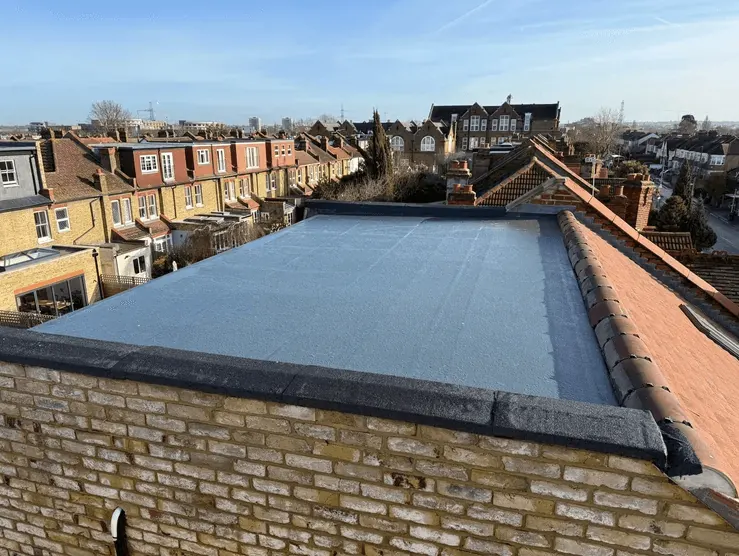
Epsom grew as a spa in the late 1600s, and its High Street still runs from the old spa-era buildings at the west end, past the clock tower of 1847 to 1848, to the Upper High Street. At street level it reads as a run of shopfronts. The roofs above tell the town's history more clearly: old plain tile on the spa-era and Georgian buildings, Victorian slopes behind decorative parapets, steep 1930s clay tile, and gabled Edwardian terraces.
Epsom and Ewell Borough Council's Town Centre Conservation Area appraisal covers the High Street with short runs into West Street, South Street, Waterloo Road, Ashley Avenue and the Upper High Street. Of its 106 main buildings, 47 are listed and 8 more are locally listed. The appraisal also notes that there is very little housing in the area: the exceptions it names are a newer block on South Street and Apex House on West Street, converted to flats. That shapes most roofing jobs here, because the roof is as likely to belong to a freeholder, managing agent or business as to a homeowner.
This page covers that commercial core. For the homes further out, by Epsom Common, in Stamford Green or up towards the Downs, see our page for roofers in Epsom.
Five kinds of roof between West Street and the Upper High Street
Spa-era and Georgian buildings
The former Assembly Rooms at Nos. 149 to 153 High Street, probably built around 1692, are listed grade II*, with hipped plain tile roofs, flat-roofed attic dormers and a courtyard later roofed over. Nos. 127 and 129, also grade II*, have a tile roof behind an 18th century parapet. Nos. 94 to 98, including Yew Tree Cottage, and No. 17 West Street both have large old tile roofs with flat-topped dormers. These roofs need patient, like-for-like work with matched handmade tiles.
Victorian buildings behind parapets
The appraisal picks out the Victorian buildings at Nos. 126 to 132 High Street, whose balustraded parapets with urn finials give them a classical front while hiding vernacular peg-tile roofs behind. Every parapet like that has a gutter behind it, and that gutter is where many town centre leaks begin.
Weatherboarded buildings in South Street
South Street keeps some of Epsom's older timber buildings. The appraisal describes the weatherboarded buildings at Nos. 30 to 34 South Street as restaurants and public houses. No. 34 itself is listed as roughcast, with a hipped tile roof and weatherboarding on parts of its side and rear. No. 29, timber-framed and weatherboarded, has a pitched corrugated iron roof according to its listing.
The 1930s parade
Nos. 12 to 64 High Street form a three-storey neo-Georgian parade with steeply pitched clay tiled roofs and substantial brick stacks. Absent from the 1934 map and shown on the 1955 one, their roofs are now at the age where nails and battens give out.
Gabled Upper High Street shops
The c1900 group at Nos. 11 to 33 Upper High Street has terracotta details and half-timbered gables, and at Nos. 2 to 14 each two-window bay has its own gable, which means bargeboards to the street and valleys behind.
Listed status, consent and the clock tower
Being in a conservation area does not stop you repairing a roof. It changes how closely the repair has to match. On a listed building, Listed Building Consent is needed for alterations that affect its character, which can include a change of tile, a new roof light or work to a parapet. Like-for-like repairs are treated differently, but if in doubt, ask the council before work starts.
The council's Article 4 Directions for the town centre concern changes of use of offices and shop frontages rather than roofs, unlike the heritage directions on streets such as Church Street and Stamford Green.
At the centre of it all, the clock tower of 1847 to 1848 is itself grade II listed, with an open octagonal lantern under a crocketed pagoda roof. The regular market sets up beside it every Thursday and Saturday, which affects when roof work can be done on that stretch of the street.
What goes wrong on these buildings
Most faults here are slow ones that go unseen because the roofs cannot be viewed from below. Hidden parapet gutters are the best known, and the rest tend to be these:
- old tiles slipping on rear slopes over yards that nobody looks at
- lead lifting round the big brick stacks of the 1930s parade
- downpipes in alleys knocked loose and soaking side walls
- felt failing on roofed-over yards and kitchen extensions
We are a family run firm from Morden, going for over 20 years, with a surveyor, Simranjeet, and a drone pilot, Josh, on the team, which suits buildings where the first job is usually finding out what is up there.
Each service page goes into the detail for town centre buildings, from repairs to spa-era tile roofs to clearing blocked parapet gutters. Before most jobs, a drone inspection shows the hidden parts first, and our contact page is the quickest way to arrange one.
Frequently asked questions
Do you work on listed buildings on Epsom High Street?
Yes. We repair old tile roofs, leadwork and gutters in matching materials. If the job goes beyond like-for-like repair, such as a change of tile or a new roof light, the owner will need Listed Building Consent first, and we flag that before quoting.
Can you get to roofs over the pedestrian area by the clock tower?
Yes, but not by flying a drone over shoppers. The CAA's Drone Code rules out flying over crowds, so we fly there early in the day and away from the Thursday and Saturday markets, launching from a rear yard where there is one. Otherwise the roof is reached from the yards behind or with a ladder or scaffold.
I own the freehold of a South Street building with a restaurant below. Who should arrange roof work?
Usually the freeholder, unless the lease passes repairs to the tenant. We can quote and report to whichever of you is responsible, and work around the restaurant's opening hours.
Does scaffolding on a High Street pavement need a licence?
Yes. Scaffolding or a hoarding on the footway needs a licence from Surrey County Council, the highway authority, applied for at least 10 working days ahead. That lead time is built into any programme, which is one reason to look at the roof by drone first and only scaffold when the job needs it. Call 0330 133 4111 to talk it through.





