



 Google reviews

Cornices on the Assembly Rooms and Gwynne House
Many of the Georgian and spa-era buildings in the town centre have no plain fascia at all. The listing for the former Assembly Rooms at Nos. 149 to 153 High Street records a heavy wooden dentilled eaves cornice. The council's 2009 appraisal notes an eaves cornice of paired modillions on Gwynne House, Nos. 9 to 11 West Street. Other buildings end in a parapet with no exposed eaves.
A cornice like that does the job of a fascia and soffit, carrying the gutter and closing off the rafter feet, but it is also part of the building's special interest. Replacing it with plastic or boxing it in would be an alteration needing Listed Building Consent and is unlikely to be allowed. The work is to cut out timber that has gone soft, match the profile in new wood where a length is beyond saving, and keep the gutter above it sound so the rot does not return. Where a carved profile needs a specialist joiner to reproduce, we say so at the quote stage.
Rot in a cornice almost always starts from above. A gutter joint that has dripped for years, or a lining that overflows in heavy rain, keeps the top of the timber wet, and paint on the underside flakes long before the damage shows.
Plain rooflines: flats, newer blocks and the backs of parades
Post-war buildings, converted offices, the 1980s and 1990s housing on the south side of the Upper High Street, and most rear elevations have ordinary timber or uPVC fascias and soffits. Signs these need work:
- soft or rotten timber, usually starting behind a leaking gutter
- gutters pulling away because the brackets have nothing solid to hold
- flaking paint and dark staining along the boards
- gaps in soffits where birds, squirrels or wasps have got into the roof space
Here, full replacement in uPVC is often the long-term answer, especially if new gutters are going up at the same time. It comes in white, black, grey and woodgrain, and ventilated soffits keep air moving through the roof space. Capping, which covers existing boards with a thin uPVC sheet, is cheaper but only works over timber that is completely sound. Checkatrade's fascia and soffit cost guide gives a published national figure of about £90 to £170 a linear metre for replacement.
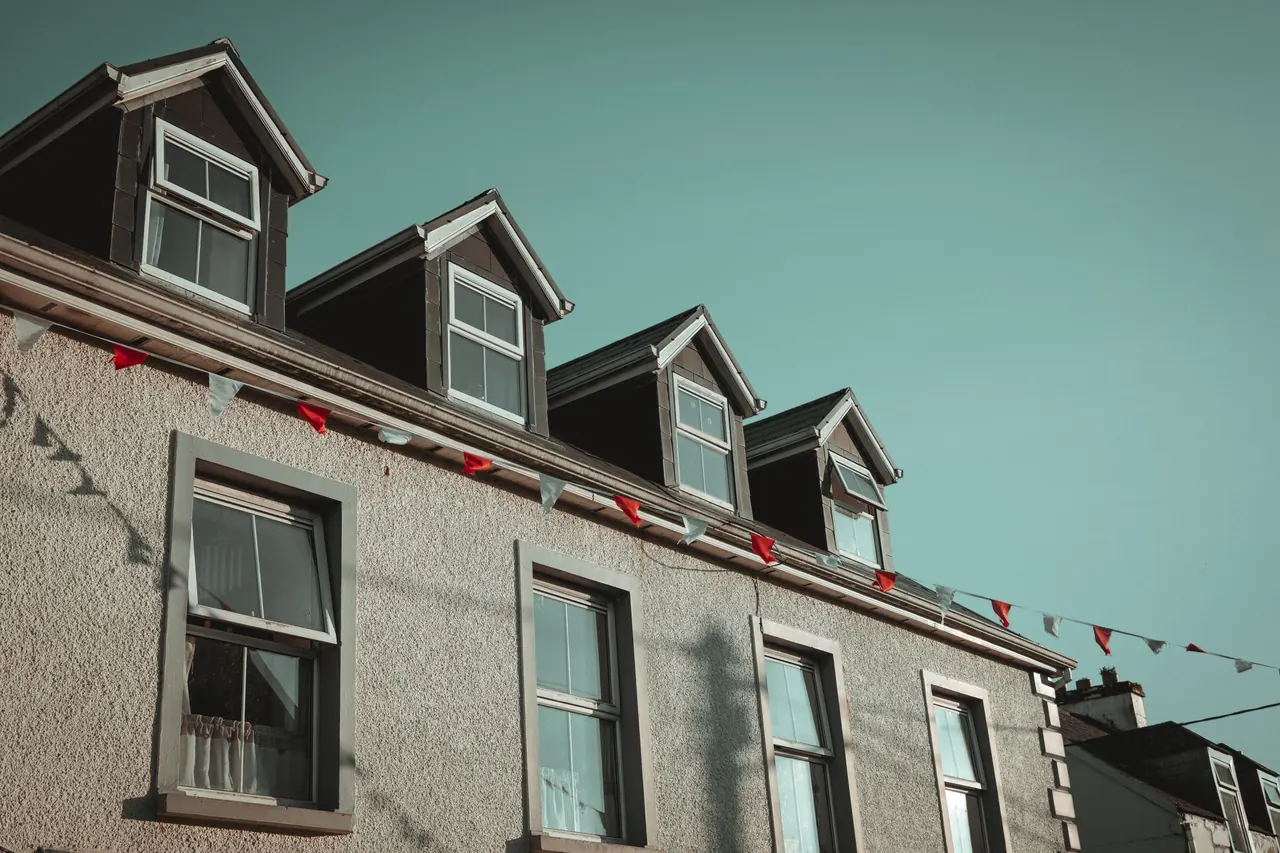
Bargeboards on the Upper High Street gables
At the eastern end of the town centre, the c1900 group at Nos. 11 to 33 Upper High Street has terracotta details and half-timbered gables, and at Nos. 2 to 14 every two-window bay has its own gable to the street. Each gable has a pair of bargeboards up its sloping edges, and they take the weather full on. Paint breaks down at the bottom ends first, water gets into the end grain, and the lower part of each board softens while the rest looks fine. Left long enough, the rot spreads into the half-timbering below and the verge tiles above lose their support.
One access for the roofline and the gutters
Because the boards carry the gutters, it makes sense to renew both together through our gutter installation for town centre fronts, so access on a tall front is only paid for once. If the boards rotted because the gutters overflowed for years, regular gutter cleaning afterwards keeps the new ones dry. On tall buildings we can look at the roofline by drone first, and what a full roofline job involves is on our main fascia and soffit replacement page.
Frequently asked questions
The cornice on our listed building in West Street is flaking and soft in places. Does it have to be replaced?
Usually not all of it. Soft lengths are cut back to sound wood and replaced in timber to the same profile, and the rest is prepared and painted. Any change to the design would need Listed Building Consent, so the aim is a repair you cannot see from the street.
Can the timber fascias on our post-war block near the High Street go to uPVC?
On a building that is not listed, usually yes, and it needs less upkeep than painted timber. We check the rafter ends behind the old boards before fitting, because rot there needs dealing with first.
The bargeboards on our Upper High Street gable are rotten at the bottom. Can the ends be pieced in?
Sometimes. If the rot is limited to the lower ends, they can be cut out and replaced in matching timber. If it runs most of the length, a new board to the same decorative profile is better, so the gable still matches its neighbours.





