



 Google reviews

Three Tolworths either side of Red Lion Road and the A3
In the 1870s much of this ground was still known as Talworth Common. By the end of the nineteenth century Tolworth was a cluster of small settlements with no real centre, housing was starting to go up around Ellerton Road and Pyne Road, and Ewell Road had become the main route north into Kingston from the south. Most of the rest was built in the 1930s after the Kingston Bypass opened in 1927, and the Sunray Estate followed, mostly in the late 1940s and early 1950s. The station on Kingston Road came in 1938, an art deco building with concrete arcs for canopies, and Tolworth Tower stands over the lot.
For anyone who works on roofs, that history leaves three quite different places within a short walk. West of Red Lion Road is a tight grid of Victorian and Edwardian houses. East of it, up to the A3, are curved avenues of interwar semis and short terraces. South of the A3 is the Sunray Estate, with tile-hung cottages under plain clay roofs. Kingston Council's character studies for Tolworth and Sunray describe each one, and each brings its own repairs.
Precise Roofing & Guttering has been family run for over 20 years. Across Tolworth we repair, replace and build roofs, mend chimneys, and fit, clear and repair gutters and the boards behind them. Quotes are free and often given the same day, finished work carries a 10 year guarantee, and the phone is answered around the clock for emergencies. A drone lets us look at a rear slope or a tall stack before anyone puts up a ladder.
Princes, Hamilton and Kingsmead: the interwar avenues
The streets around Princes Avenue and Hamilton Avenue were laid out mainly in the 1930s, on a curved plan with semis and short terraces, wide grass verges and street trees. Kingsmead Avenue is a consistent line of two-storey hipped pairs with wide gaps between them, and Ladywood Road has short terraces on slightly smaller plots. Behind the Princes Avenue semis, long back gardens widen as the road nears the A3, and Hook Rise faces the A3 itself.
Roofs here are around ninety years old, so ridges and hips bedded in mortar are reaching the end of their bedding, and many houses have gained a loft conversion with a dormer at the back. Our Tolworth flat roofing page covers those dormer and kitchen extension roofs.
The verge trees that make these avenues green also fill their front gutters each autumn. A clean once the leaves are down, usually late November, is the cheapest way to keep bays and fascias dry, and our Tolworth gutter cleaning page explains how the timing differs between tree-lined and open streets. The same trees can drop a limb in a winter gale, which is when our emergency roof repair in Tolworth comes in.
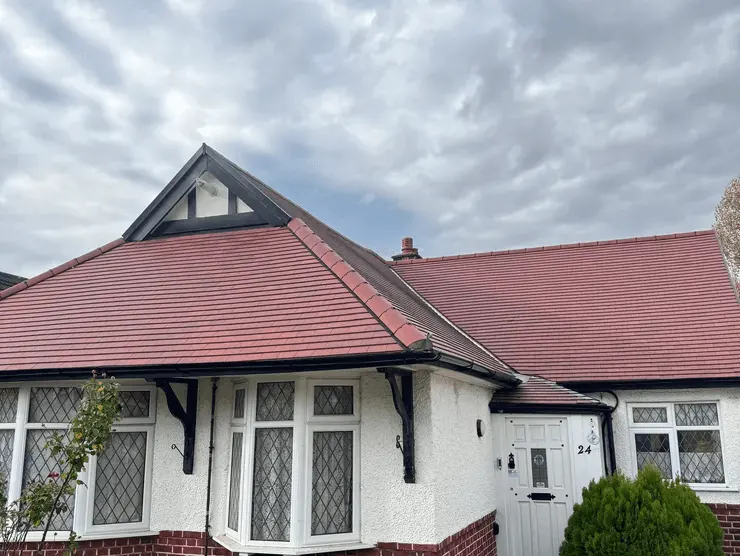
West of Red Lion Road: the oldest houses
Around Ellerton Road, Douglas Road, Pyne Road and Egmont Road the street pattern is a tighter grid of Victorian and Edwardian houses, from small terraces to large villas on Ewell Road. The council's study notes that some properties in this western part date back to the 1870s. It also picks out the Edwardian terraces set around a formal garden at Lenelby Road, and the regular gables of Egmont Road and Egmont Avenue, which it describes as high quality early suburban detailing.
These roofs are more complicated than the interwar ones. Back additions meet the main roof in valleys and abutments, chimney stacks are tall and often repointed in hard cement at some point, and gutters sit tucked between houses where nobody sees them. The leaks that follow tend to show up in the back bedroom or the room in the back addition. On a house this age it pays to see the whole roof before anything is done, and our Tolworth roof inspection page explains how.
The Sunray Estate, south of the A3
The council's Sunray study area runs from the A3 south to the railway, with the Hogsmill nature reserve to the east, and the Sunray Estate fills its southern half. The estate was laid out on garden suburb principles, with houses of one consistent design in short terraces along long avenues and around grassed cul-de-sacs. Woodland Way, Sunray Avenue and Vincent Avenue were nearly complete by the end of 1935, but most of the estate went up in the late 1940s and early 1950s.
Each house is rendered at ground floor, with a tile-hung first floor that juts out on masonry brackets, and a plain clay-tiled roof topped by a chimney with curved tile details. The council's study rates the estate highly and says it would be worthy of status as a local area of special character, though it has no formal designation. Owners are free to choose materials, but every roof and chimney is part of a matching terrace. Our chimney repairs in Tolworth page explains how the curved-tile detail is kept when a Sunray stack needs work.
North of the estate, around Oakdene Drive and Collingwood Avenue, the roads were laid out between 1930 and 1940 with semis of varying styles, some bungalows and Tudor-detailed bays. Donald Woods Gardens, built around the 1980s on the site of former government offices, adds three-storey flats and terraced houses.
Kent Way, Chaffinch Close and the later estates
The newest housing in Tolworth is no longer new. Kent Way is a low-density 1970s estate with an open-plan layout, no front boundaries and some garages in short terraces. Chaffinch Close is a self-contained 1980s estate. Fuller's Avenue is a 1950s estate of short terraces, Verona Drive has 1950s maisonettes, and School Lane has 1960s flats.
On houses of this age the first wear tends to show at the ridge and along the verges, and on timber boards at the eaves that have missed a few coats of paint. With no front walls on Kent Way, every board and gutter is on show from the street, so our fascias and soffits work in Tolworth is often the first job those houses need.
Frequently asked questions
We live off Oakdene Drive. Are the houses there built like the Sunray cottages?
No. The Oakdene Drive and Collingwood Avenue roads were mostly built up in the 1930s, with semis in a mix of styles, some with Tudor-style bays, plus a few bungalows. Their roofs have more in common with the interwar avenues north of the A3 than with the clay-tiled Sunray terraces next door.
Our Ewell Road villa is much older than the houses behind it. Does that change the roof work?
Yes. A Victorian villa will have older details: tall stacks, valleys, lead at the abutments and perhaps a slate roof. Repairs need different materials and more care than on a 1930s tiled roof, so we look at the whole roof before pricing.
Do you work on the three-storey blocks at Donald Woods Gardens?
Yes. On taller buildings we check the access first, and a drone flight shows the roof and gutters before we decide what equipment the job needs.
Which part of Tolworth has the oldest roofs?
The streets west of Red Lion Road, around Ellerton Road, Pyne Road and Ewell Road. Houses there were going up in the late nineteenth century, while most of the area east of Red Lion Road and the Sunray Estate came after the bypass opened in 1927.





