



 Google reviews

The curved-tile stacks of the Sunray Estate
Look along Sunray Avenue, Vincent Avenue, Warren Drive or Alpine Avenue and the chimneys are what you notice: the stacks carry curved tile details above plain clay-tiled roofs. The estate was laid out on garden suburb principles, mostly in the late 1940s and early 1950s, and Kingston Council's character study describes these distinctive chimneys. Every house was built to a consistent design, so a chimney stripped of its tile detail stands out along the terrace straight away.
When one of these stacks needs work, the quick route is to knock the tile detail off and point the stack up plain. We would rather not. The stack is photographed first, ideally from the drone, so you can see what is there. Then the work goes on around the curved tiles: new flashing, repointing and fresh flaunching while the decorative courses stay in place. If any curved tiles have come loose or broken, we show you before touching them and agree the approach.
What gives way first on a Tolworth stack
Inside, a chimney fault usually shows as a brown stain on a bedroom wall where the breast runs up, or a damp smell around the base of the stack in the loft. Outside, the causes are few. Lead flashing lifts or splits where the stack meets the tiles. Mortar between the bricks erodes until rain soaks straight in. The flaunching, the sloped mortar collar holding the pots, cracks and lets water run down inside the stack. Which comes first depends on the age of the chimney, and in Tolworth that changes from one side of Red Lion Road to the other, and again south of the A3.
For a sense of scale, MyJobQuote's chimney flashing guide gives a national guide figure of £150 to £250 for a patch repair to lead flashing, with full re-leading costing more.
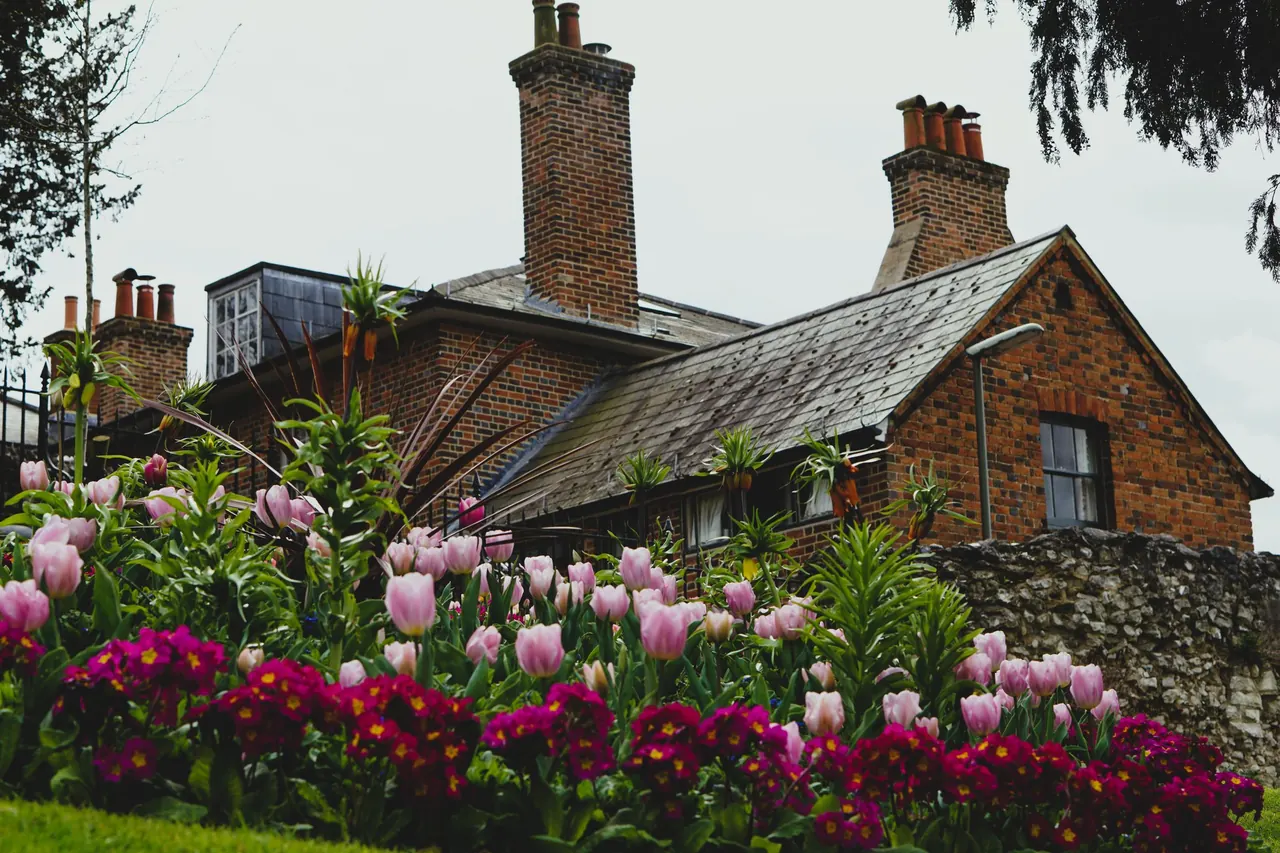
Ewell Road villas and the Lenelby Road terraces
West of Red Lion Road the stacks are older. The council's study notes that some properties in this part of Tolworth date back to the 1870s, describes large villas on Ewell Road, and picks out Edwardian terraces set around a formal garden at Lenelby Road. Houses of this age tend to have taller stacks with several flues, originally laid in soft lime mortar that was meant to be repointed from time to time.
Some have since been repointed in hard cement, which is the wrong material for old brick. Cement does not flex or breathe, so moisture gets trapped behind it, the brick faces start to flake, and the joints open up again. Repointing in a suitable softer mortar and renewing the lead properly is the repair that lasts. Tall stacks like these generally need scaffolding for anything more than a small fix.
On the interwar pairs east of Red Lion Road the stack usually sits on the party wall and serves both houses, so the flashing on one side meets next door's and work is neatest when both owners agree to do the whole stack. Our main chimney repairs page covers cowls and caps for unused flues, and the chimney maintenance guide lists what to check each year. If tiles around the stack need relaying too, our Tolworth roof repair page covers that side.
Frequently asked questions
One of the curved tiles on our Sunray chimney has cracked. Can it be replaced to match?
We look for a tile that matches in size, curve and colour. If a good match cannot be found, we talk through the options with you, such as reusing a sound tile from a less visible spot, before anything is changed.
Does the Sunray Estate need permission for chimney work?
Not for like-for-like repairs. The council's study says the estate would be worthy of special character status, but it has no designation, so keeping the curved-tile detail is a choice rather than a rule. If you plan to remove a stack altogether, check with Kingston Council first.
The stack on our Lenelby Road terrace was pointed in cement years ago. Does that matter?
It can. Hard cement on old brick tends to trap water and damage the brick faces around it. When the stack next needs work, raking out the cement and repointing in a softer mortar is worth the extra time.
Our Ewell Road villa has a tall stack with four pots. Will it need scaffolding?
For repointing or re-leading, almost certainly. For refixing a single pot or a short length of flashing, roof ladders can be enough. A drone look first tells us which, so the quote includes the right access.





