



 Google reviews

Round the Cricket Green and Church Road
The oldest roofs in Mitcham are round the Cricket Green, the Lower Green and along Church Road, most of them inside the Mitcham Cricket Green conservation area. Merton Council's appraisal and management plan describes roofs here in plain clay tile, pantile and, increasingly through the 19th century, Welsh slate. Ivy and Elm Cottages, probably from around 1800, sit under a hipped slate roof; the villas at 11 and 13 Cricket Green have slate with lead flashings and tented lead porch canopies; and the Grade II Mary Tate Almshouses of 1829 face the green under slate.
Some of the earlier buildings hide a valley gutter between two inward-falling slopes, which our page on roof inspection in Mitcham explains. On the slate roofs, rusting nails let slates slide one by one, which is a common reason for roof repairs in Mitcham on these streets. The chimneys of the older houses break up the skyline here too.
The management plan counts a change of roof covering among the small changes that wear away the area's character, so repairs and re-roofs here are done like for like.
West of Church Road the picture changes. The Church Road neighbourhood was industrial for a long time, and in 1933 an explosion at W J Bush's distillery stripped the roofs from dozens of houses around Belgrave Road. Later came the Phipps Bridge estate, built in the 1960s with 776 homes and five tower blocks, four of which were demolished in the 1990s and replaced with 360 new homes. The later cul-de-sacs round Brangwyn Crescent and Batsworth Road, built in the 1980s and 1990s, have red or brown pantiled roofs, and along the west side the old Bunce's Meadow land runs beside the Wandle.
Mitcham Park and Bramcote Avenue
South of the greens, Mitcham Park was laid out before 1916 with substantial Edwardian semis on deep L-shaped plans. Many keep their original steep plain-tiled hips, though there is now a mix of finishes. On some houses a pair of French windows upstairs leads out onto the bay roof, and the road is lined with trees. The long hips are where these roofs wear first, as the mortar under the hip tiles breaks up after a century of frost.
Nearby, Bramcote Avenue and Denham Crescent were built in the 1930s on narrower plots as short terraces with two-storey curved bays, half-timbered gables and tiled porches. Their roofs are younger and simpler, but at close to ninety years old, many are reaching the point where the covering itself, not just a ridge or a tile, needs thought.
Flat roofs turn up all over Mitcham, on bays you can step onto, porch tops, rear kitchen extensions and dormers. They fail in different ways from the pitched roofs above them, mostly at the upstand where they meet the wall. Our page on flat roofing in Mitcham covers repairs and re-covering.
North Mitcham: Figges Marsh and Lavender Avenue
Mitcham's population roughly doubled in ten years, from 14,903 in 1901 to 29,606 in 1911, and the streets north of the centre show it. Arnold Road, Finborough Road and Swains Lane were the first wave of suburban building by 1896. Pitcairn and Crusoe Road followed with Edwardian terraces whose half bays have their own red tiled roofs, and Inglemere and Grenfell Roads are red-brick Edwardian terraces with front gable projections. Grenfell Road also has an unusual 1930s three-storey terrace with a decorative parapet.
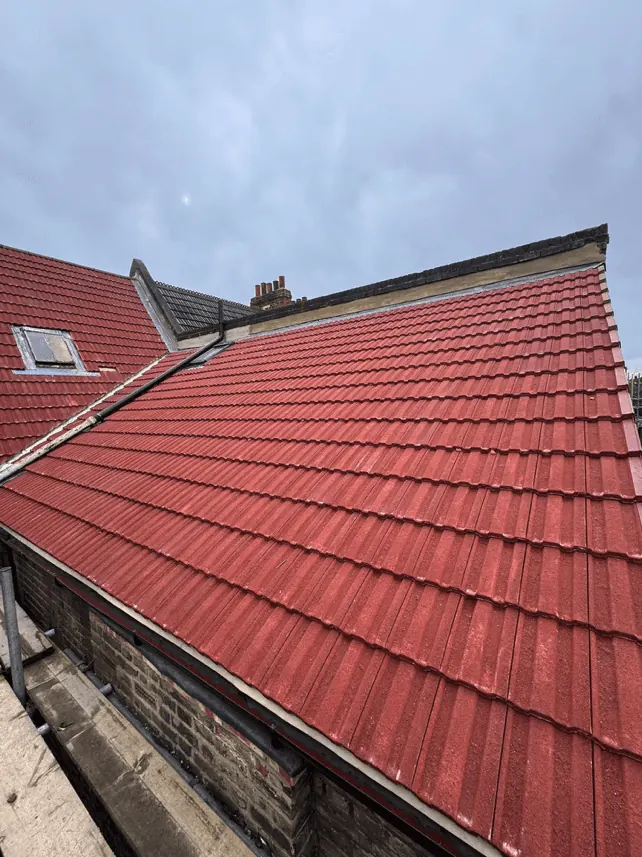
The Lavender Avenue and Bordergate council estates went up in the early 1920s, and between 1934 and 1938 Wilson Avenue, Hawke Road, Turner Avenue, Biggin Avenue, Poplar Avenue and Manship Road were added. Much of it has canopy porches and red tile hanging, and many houses share one hipped roof with their neighbours, so a repair or re-roof has to work with next door's roof as well as yours.
Figges Marsh itself is a 10-hectare open space named after William Figge, who held the land from 1357, and it is lined by two rows of mature trees along London Road. Those trees, the protected yews and hollies round Park Place and the street trees on Mitcham Park mean that gutter cleaning in Mitcham is best timed to the trees nearest your house rather than to the calendar.
Along Commonside East
Commonside East runs along the northern edge of Mitcham Common, and the houses there face the common across the road. They were built from the Edwardian period to the 1930s: a block of Edwardian red-brick houses with front gables and decorative bargeboards, modest rendered cottages near the junction with Windmill Road, and 1930s terraces with a ground-floor projection and square bay above, under red terracotta tiles. The locally listed pair at 205-207 Commonside East has steep gables and tall diagonal chimneys in stepped brick.
The roadside elms were lost to Dutch elm disease and are now scrub, which drops a flush of seed in late spring on top of the autumn leaves. Footways are narrow and parking is tight, which matters when a scaffold has to go up. The newer blocks of flats along the road are looked after by their managing agents.
Off Cranmer Road, Mitcham Garden Village was built between 1929 and 1932 round a green, with steep tiled roofs and prominent chimneys, and is locally listed. Its homes belong to a charity, so roof faults there go to the charity first. The town centre and Mitcham Junction have their own pages, and Pollards Hill and Eastfields are covered separately too. We work from Kenley Rd in Morden, about 2.2 miles away.
Frequently asked questions
Why do some old houses by the Cricket Green have a gutter in the middle of the roof?
They have a London roof with a hidden central valley; our roof inspection page explains how it works and how it is checked.
How do I know whether my house is in the Cricket Green conservation area?
The conservation area has six parts: Church Road, the Cricket Green, Cranmer Green, Three Kings Piece, Mitcham Park and Mitcham Garden Village. The appraisal includes a boundary map, and the council's planning team can confirm it for a particular address.
Were the roofs round Belgrave Road really blown off in 1933?
Yes. The council's study of the Church Road neighbourhood records that the explosion at W J Bush's distillery stripped the roofs from dozens of houses. Some were repaired and others demolished, so on the older houses that remain, the roof may well not be the original one.
My house is in a block of 1930s houses near Figges Marsh that shares one roof. Can I re-roof just mine?
Yes. Your section stops at the party wall line and is joined to the neighbours' tiles; our page on roof replacement in Mitcham explains how.





