



 Google reviews

Between the station and Goat Road
The housing that belongs to Mitcham Junction is a narrow band on the west side of Carshalton Road, running south from the station towards Goat Road, with Tramway Path behind it and Mitcham Common across the road. It is small enough to walk in ten minutes, and it was built in three quite separate goes.
The oldest part is the row once called Tramway Terrace. Mitcham History Notes records 30 houses there, south of Arneys Lane and north of Goat Road, shown on the 1894 Ordnance Survey map. In 1925 they lost the terrace name and became 24 to 53 Carshalton Road. The Merton Historical Society adds that the row went up on former common land, and that the southernmost house, nearest The Goat, once carried the date 1882 high on its gable end.
North of Arneys Lane, between it and Aspen Gardens, came the houses first called Rumbold Villas, built in 1923 and 1924. Mitcham Urban District Council lent buyers the money under the Small Dwellings Acquisition Act of 1899. Aspen Gardens itself followed in the early 1930s, on the site of a house called Aspen Cottage. Behind all of them runs Tramway Path, which the historical society says keeps alive the memory of the Surrey Iron Railway, and which has its own terraced houses and two newer blocks of flats, Michelham Lodge and Jessop Place.
The 1882 terrace and the path behind it
Recent energy certificates for two houses in the row, Nos. 35 and 49, describe mid-terrace houses with solid brick walls and pitched roofs, one with 100 mm of loft insulation and one with none recorded. Solid walls and an uninsulated loft make for a cold, damp roof space in winter, and that is where condensation, rusting nails and tired battens start.
The front slopes face the road and the common. The back is a different roof altogether: the rear additions, the valleys where they meet the main roof, and the stacks, all seen properly only from Tramway Path or from the air. On a row this old the covering may not be the one the builder laid, and next-door roofs can be decades apart in condition. A drone and loft inspection of a terrace house here is the quickest way to find out which state yours is in.
Because the houses are joined, almost everything on the roofline is shared at the edges: the gutter carries on into next door's, the stacks sit on party walls and a new section of roof has to meet an old one at each end. We price your part and explain how the joins will be made before anything starts.
Aspen Gardens and the 1920s villas
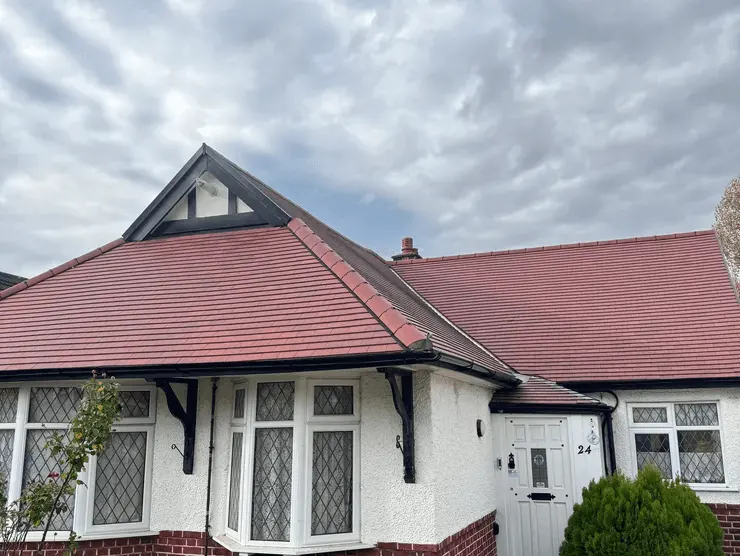
The interwar houses are a different job. Aspen Gardens is a short road of semi-detached and detached houses. One recent certificate, for No. 15, records a solid brick main house with a cavity-walled extension and two separate pitched roofs, which is typical of a house that has grown at the back. Every addition like that brings its own gutter, its own flashing against the old wall and its own chance of a leak at the join.
On houses of this age, the usual work is rebedding ridges and hips, renewing valley linings, sorting the roofs over extensions and garages, and replacing timber fascias that have spent decades under a dripping gutter. If yours is one of the 1920s houses near Arneys Lane, our fascia and soffit page covers the eaves in more detail.
Where Mitcham Junction stops
This page is deliberately narrow. Mitcham Garden Village off Cranmer Road, the cottages round Cricket Green and the older houses near the parish church are covered on our Mitcham page. The Garden Village homes are owned and looked after by a registered charity, so residents there report roof faults to the charity rather than booking work themselves. South of Goat Road, the mill houses and new streets by the Wandle belong to Beddington Corner.
What is left is the station, Carshalton Road between it and The Goat, Aspen Gardens, Arneys Lane, Drake Road and Tramway Path. Our base on Kenley Rd in Morden is a little over 2 miles away as the crow flies, a longer trip by road.
We cover every one of our 13 services here. Most jobs start with a look at the roof, by drone where the back is hard to reach, and you see the photos before you see a price. Call 0330 133 4111 or send a message through our contact page.
Frequently asked questions
Are the houses on Carshalton Road in the Cricket Green conservation area?
Merton's appraisal puts the part of Mitcham Common between the railway and Carshalton Road inside the conservation area, along with Cranmer Green. It does not describe the terrace or Aspen Gardens as part of it. Check your address on Merton's conservation area map before planning a change of roof covering or a dormer.
My house on Tramway Path has its own front door on the path. Is it the same age as the Carshalton Road terrace?
Not necessarily. Tramway Path has older terraced houses and newer blocks of flats such as Jessop Place and Michelham Lodge. A look at the roof and loft tells us more about the build than the address does, and it changes what we would check first.
Which roofs here need the most attention?
On the 1880s terrace, it is usually the back: rear additions, valleys and chimney stacks. On Aspen Gardens and the 1920s houses, it is more often ridges, hips, the roofs over later extensions and the timber at the eaves.
I live in Mitcham Garden Village. Should I book roof work myself?
No. The homes are owned and maintained by the Mitcham Garden Village charity, so report the fault to them first. If they ask us to look, we quote them directly.





