



 Google reviews

The house most Hackbridge streets are made of
Walk the side roads off London Road and the same house keeps coming back: a two-storey semi from the 1920s or 1930s, often in the Tudorbethan style. Semis of that period were typically built with a tiled roof, often hipped, a chimney stack on the party wall shared with next door and, on Tudorbethan fronts, mock-timber boarding on the front gable. The Hackbridge and Beddington Corner Neighbourhood Plan puts it plainly: the housing here dates mostly from those two decades and is mainly low-density, two-storey homes either side of the A237. It also lists tiled or slated roofs, brick, plaster and timber as the common materials.
That one house type explains most of the roof work in the suburb. The tiles on these roofs often outlast the things that hold them on, so the repairs tend to be at the top and the edges: ridges and hips, the felt at the eaves, valleys where a back extension joins the main slope, and the lead round the stack. Our Hackbridge roof repair page goes through those faults one by one and how each is put right.
The question owners of these houses face sooner or later is whether to keep repairing or to strip the roof and start again. Because the houses come in pairs, that choice has a neighbour in it. Your ridge runs on into theirs across the party wall, and the stack often belongs to both of you. A re-roof on one half has to be joined to the other half cleanly and should not leave the pair looking mismatched from the street. The roof replacement page covers how that join is planned and what the job involves.
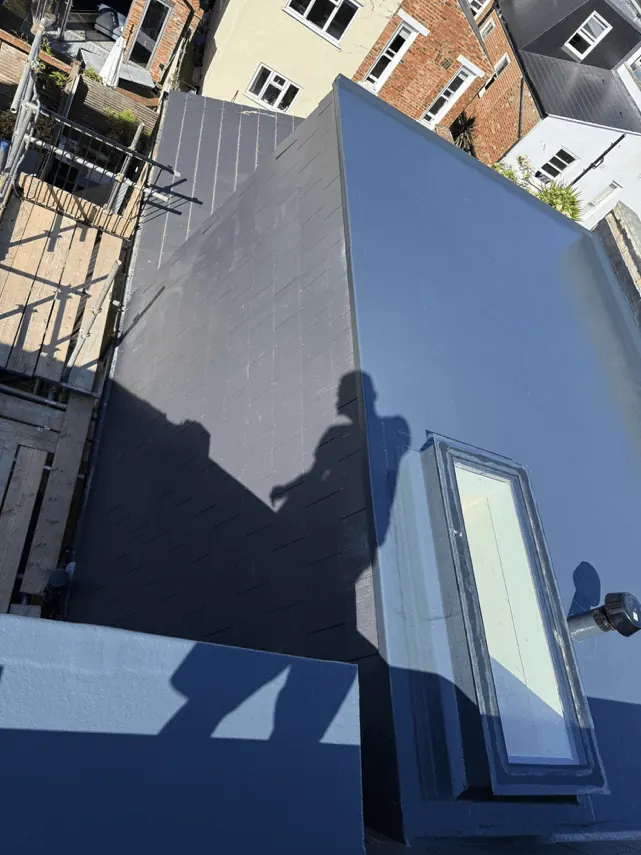
Many of these semis have also been added to since they were built. Single-storey kitchen extensions with flat roofs, side garages, rear dormers and hip-to-gable lofts are typical later additions to semis of this age. Each brings its own roof, and the place where a new roof meets an old one is where a lot of leaks start. A flat roof over a kitchen that went up decades ago in felt is likely to be near the end of its life now.
Older buildings round the Green and the crossroads
A small number of Hackbridge buildings are much older than the semis. On Hackbridge Green there are two rows of 18th-century cottages, Grade II listed, whose listing records old slate roofs and dentilled brick eaves. On Hackbridge Road the Old Red Lion, also Grade II listed, with an older part the listing dates to the early 18th century, has a tiled roof with two flat-topped dormers and an external chimney stack at one end.
Work on these follows different rules. Repairs go back in matching materials, soft mortar replaces hard cement on old brick, and anything that changes the character of the building needs listed building consent from Sutton Council first. Like-for-like repair is the usual answer, and our chimney repairs page covers the old stacks in more detail.
Where London Road meets Hackbridge Road, the centre of the suburb is a parade of two-storey shops and Victorian cottages, now facing the six-storey Saxon House. Shops of that age often have flats above and a flat-roofed addition at the back that nobody sees from the pavement.
Low ground beside the Wandle
Hackbridge takes its name from the Hack Bridge, which carries the old Carshalton-to-London road over the River Wandle, and the suburb sits low in the river's valley. The neighbourhood plan names flooding as a risk in parts of the area and says paving over gardens makes it worse, because rain runs off into the drains instead of soaking in.
A roofer cannot do anything about the river. What we can affect is where the water from your own roof goes. A gutter that overflows, or a downpipe that stops short and splashes onto paving, keeps the foot of the wall wet all winter. That is why, when new gutters go on a Hackbridge house, we plan each downpipe's route into a drain, soakaway or water butt as carefully as the gutter run itself.
Gutters near Hackbridge Green also have the old plane trees to contend with. Their large leaves settle over outlets each autumn, so houses close to the Green fill their gutters faster than most, as our gutter cleaning page explains.
Newer homes, from Mullards Close to New Mill Quarter
Since the 1990s Hackbridge has added a great deal of housing. The old Mullards factory, later owned by Philips, was redeveloped for homes in the mid-1990s, and only its name survives in Mullards Close. More recently came Saxon House, The Wave on Hackbridge Road and, on the former Felnex industrial estate, the Barratt-built New Mill Quarter with 440 homes. BedZED, the eco-village built between 2000 and 2002, sits about 500 yards north of the station.
Most of this newer housing is flats, where the roof, gutters and roofline usually belong to the building's freeholder. If you live in one, the managing agent is normally the first call, and we can inspect and quote them directly. Our fascias and soffits page covers the roofline on those 1990s blocks.
If you are not sure where to start on any Hackbridge house, a look at the whole roof first, from the ground, the loft and the air, usually tells you whether it needs a repair, a re-roof or nothing at all yet. A Hackbridge roof inspection does exactly that.
Frequently asked questions
Do you cover all of Hackbridge, including the streets east of the railway by Beddington Farmlands?
Yes. We work across Hackbridge and the rest of SM6, from the Green and the London Road side streets to the homes that look out over the Farmlands, and the newer developments near the station.
Is there a charge for someone to come and look at a roof in Hackbridge?
No. Quotes are free and can often be done the same day you call. If the problem is high up or round the back, a drone look means nobody needs scaffolding just to see it.
Is roof work on a Hackbridge house guaranteed?
Yes. Our work comes with a 10 year guarantee, and the quote tells you what it covers for the job in question.
Do pensioners in Hackbridge get a discount?
Yes. We give a 20% discount to OAPs on our work. Mention it when you call and it goes on the quote.





