



 Google reviews

Which part of Ewell are you in?
Ewell covers a lot of ground in the KT17 and KT19 postcodes, and the roofs change sharply from one part to the next. Precise Roofing & Guttering is a family run roofing and guttering firm, and we have written separate pages for each part of Ewell, because the advice for a timber-framed house on Church Street is no use to someone with a 1930s semi near Stoneleigh Broadway.
- The old village. The core round the High Street, Church Street and Spring Street sits inside the Ewell Village Conservation Area, with timber-framed and Georgian houses under handmade peg tiles, weatherboarded cottages in Mill Lane and West Street, and Victorian slate on Epsom Road. See roofing in Ewell Village.
- West Ewell. Between Ewell West station and the Hogsmill: builders' plots on the old Fitznells Farm sold from 1933, self-built houses on Chessington Road, Edwardian terraces on Plough Road and post-war streets beyond. Our West Ewell roofers page covers them.
- Stoneleigh. A planned 1930s estate of steep-roofed chalet semis round Stoneleigh Broadway and the station, with many loft conversions. See Stoneleigh.
- Ewell Court. Interwar semis and detached hipped houses on the old Ewell Court Estate, between Kingston Road and the Hogsmill, round Ewell Court Park and its lake. See Ewell Court.
- Cuddington. The Epsom and Ewell side of KT4, with long hipped bungalows on The Warren and The Grange and 1930s houses on Mortimer Crescent. See Cuddington.
The rest of this page covers the south and east of Ewell in KT17: the Harwood estates on Ewell Downs Road, The Green, Higher Green and Longdown Lane North, and the interwar streets of East Ewell running up to Nonsuch Park and Warren Farm.
Ernest Harwood's estates south of the railway
Ernest Harwood, a local builder, put up Ewell Downs Road and The Green from the late 1920s, working to plans by an Epsom firm of architects. The council's conservation area appraisal describes three-bay detached houses with low eaves, pitched roofs, front gables and porches, jettied first floors, leaded windows and white render with half timbering. Higher Green and Longdown Lane North, next door, were built by Harwood in the same years, with somewhat larger and plainer houses round their own small green.
These are steep, broken-up roofs: a front gable, a porch roof and a bay each add a valley or an abutment, and those junctions are where water usually gets in first. The roofs were first covered in handmade clay tiles, and many have since been re-covered in machine-made clay, which matters when a single tile needs replacing. Our roof repair in Ewell page explains how to tell the two apart and match them.
A few houses on each road have been rebuilt altogether. The appraisal counts 73 houses on Ewell Downs Road, 18 of them modern or rebuilt, and 79 on The Green, of which nine are later or heavily altered. A rebuilt house can carry a quite different roof from its neighbours, so the work follows the house in front of us, not the estate pattern.
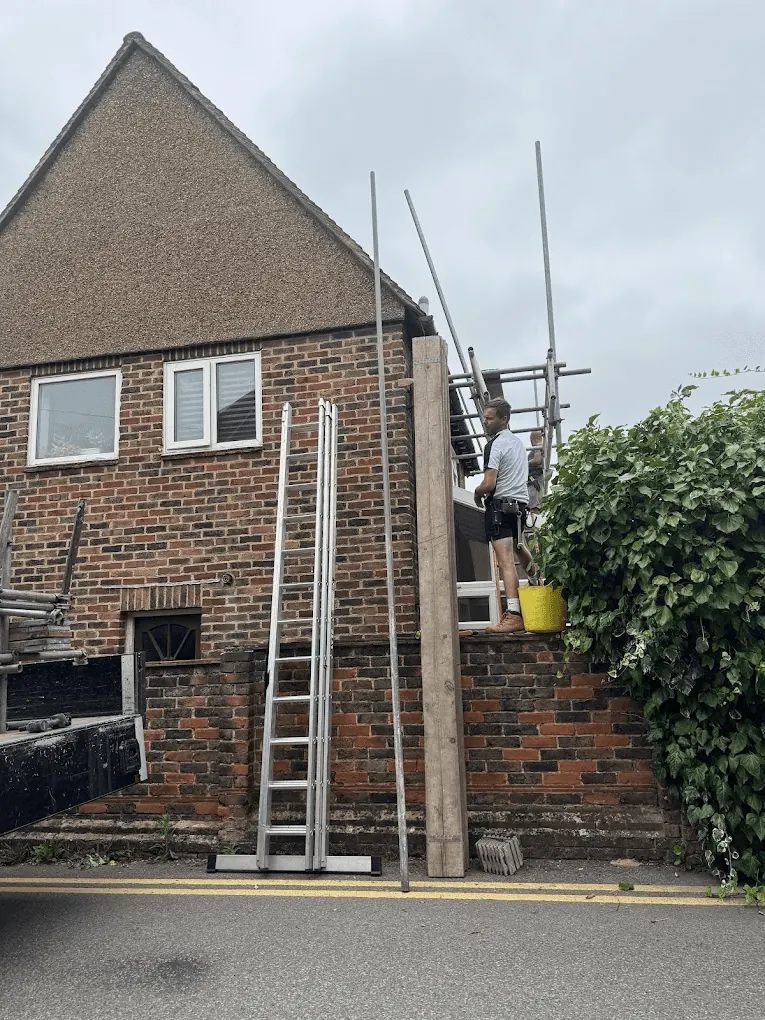
East Ewell's semis between Cheam Road and Nonsuch Park
North of the railway, East Ewell is mostly 1930s semi-detached housing. According to the local history site Epsom and Ewell History Explorer, Cheam Road curves because it was diverted round the southern edge of Nonsuch Park, and between the wars housing filled the land between the railway and the park. Castle Avenue and Fairfax Avenue run through that strip, with semis alongside larger detached houses.
These roofs are simpler than the Harwood ones: a main pitched roof, a chimney stack, and at the back whatever later owners have added, from kitchen extensions to dormers. At close to a hundred years old, the jobs they tend to need are ridge and hip mortar, slipped tiles, chimney flashing and the flat roofs at the back. Where slipping is spread across a whole slope and the battens behind it have gone soft, it is time to talk about a full re-roof rather than another patch.
Gardens on the park side back onto Nonsuch Park and the young woodland of Warren Farm, so leaves and twigs on low roofs and in gutters are part of the autumn here.
Gates, greens and planning on the Harwood roads
Ewell Downs Road and The Green are private roads, not adopted by Surrey County Council, and closed to through traffic in places by white painted timber gates. Their verges and trees are looked after by the residents through road companies, with the Association of Ewell Downs Residents, formed in 1926, taking an overall interest. Longdown Lane North is different: it is an adopted road, and its verges are owned and maintained by Surrey County Council. On the private roads, access decides practical things such as where a scaffold lorry can stand, so we plan that with you before a larger job.
Ewell Downs Road with The Green forms one conservation area, and Higher Green with Longdown Lane North forms another. Both were designated in 2000, and both have Article 4(2) Directions, served in 1999 and 2000. Among other things, they bring changing roof materials and adding rooflights on the front-facing slope under planning control. In the council's wording, the front means the side facing a public highway, private road or waterway. The council's guidance prefers clay tiles or slate to concrete on those slopes. East Ewell's semis are outside both areas.
Trees matter on both estates. The greens are planted with copper beech, beech, horse chestnut and sycamore, and on houses with a clipped beech hedge near the eaves the gutters can fill twice, once in autumn from the trees and again in spring when the hedge drops last year's leaves. The council also says ash dieback is present throughout the borough, which is worth bearing in mind if an ash overhangs your roof.
Frequently asked questions
My house is on one of the private roads behind the white gates. How do we arrange a visit?
When you ring, mention who holds the key or code for the gate nearest you. For an inspection or a small repair, a van parked by the house is all that is needed. For scaffold or a re-roof, we agree dates and where materials will stand with you, so you can let the road association and neighbours know.
Is Higher Green in the same conservation area as Ewell Downs Road?
No. They were built by the same builder in the same years, but the council designated them as two separate conservation areas in 2000. The Ewell Downs Road area takes in The Green as well. Each has its own Article 4(2) Direction with very similar controls on roofs.
What tends to wear out first on a Harwood house roof?
The junctions. Valleys behind front gables, lead at porch and bay abutments, ridge mortar and the flashing round the stacks usually go before the tiles in the middle of a slope. Tile hanging on the first floor also cracks and slips with age, and can let water into the wall.
Can I re-roof my semi on Castle Avenue in a different tile from the original?
The Article 4(2) Directions that control roof materials apply only to the two Harwood conservation areas, so they do not reach the streets north of the railway. Like-for-like re-roofing is treated as maintenance and normally needs no planning permission. If you want a noticeably different covering, check with Epsom and Ewell Borough Council first, and think about how it will look beside the other half of the pair.





