



 Google reviews

What the trees on the greens put into a downpipe
The giveaway is a downpipe that stays dry, or only trickles, while the gutter above it spills over. Water is reaching the outlet and going no further.
The greens at The Green and Higher Green are planted with copper beech, beech, horse chestnut and sycamore, and the Higher Green appraisal picks out a large pine where the green meets Longdown Lane North. Each drops something different onto the roofs:
- Beech and copper beech shed their nut husks, the beech mast, along with small, tough leaves. The husks are hard and spiky and catch on the lip of an outlet.
- Horse chestnut drops spiky conker cases and large leaves. A split case wedged in a swan neck makes a dam that silt builds up behind.
- Sycamore sends down winged seeds that slide along a gutter and collect at the outlet.
- The pine sheds fine needles that mat with roof grit into a fibrous plug.
Leaves lying along the gutter itself are a cleaning job, and our gutter cleaning in Ewell page covers when to book one. This page is for when the gutter is already overflowing because something has jammed.
Offsets round Harwood bays and porches
A Harwood front on Ewell Downs Road or The Green is broken up by gables, porches and bays, so its downpipes rarely run straight. Where the eaves overhang, the pipe drops from the outlet through a swan neck, two bends close together, and an offset round a bay or porch adds more. Debris catches at each bend, especially where a section has slipped and left a lip.
We work from the top down. The outlet and swan neck are cleared by hand, then the downpipe is rodded or flushed through until water runs freely at the bottom, and the whole run is tested with water before we leave. If a bend has cracked or a section has dropped, that is part of the fix, because a pipe that keeps catching debris will block again. If the gutter has sagged and lost its fall towards the outlet, our gutter repairs in Ewell page covers resetting it.
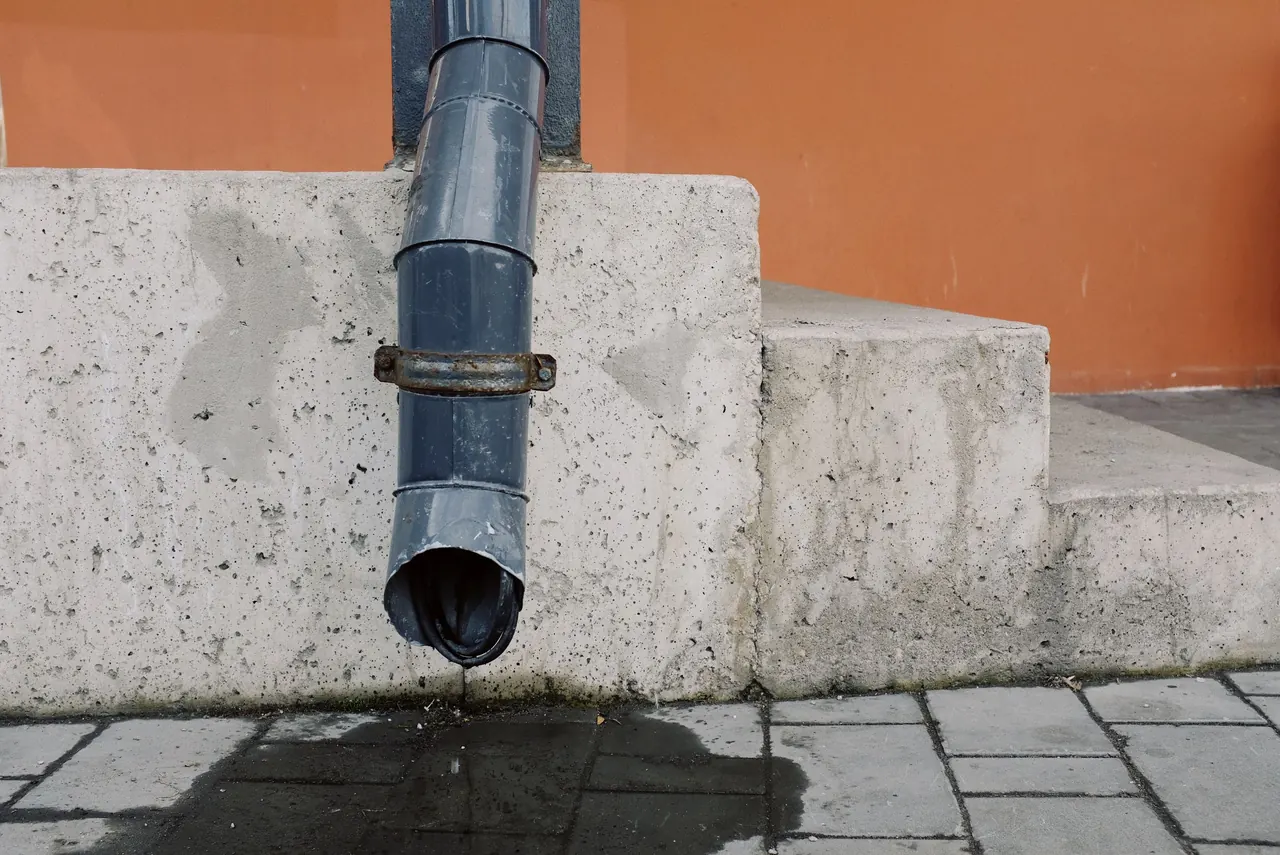
The shared pipe between a pair of East Ewell semis
North of the railway, East Ewell is mostly 1930s semis. Where a pair has its two front gutters meeting in the middle at one outlet, a single downpipe takes the water from both roofs. That pipe collects twice the debris, and houses backing towards Nonsuch Park and Warren Farm get their share of leaves and twigs.
Clearing the pipe fixes the symptom. Checking the swan neck for a cracked bend, and the fall on both gutters towards it, deals with the cause. Because the pipe serves both houses, it helps if both owners agree the work.
Gullies, soakaways and water that will not wait
A downpipe here can end over an open gully or run into the ground, to the drains or to a soakaway. If the water stands at the foot of a clear pipe after rain, the trouble is below ground, and that is work for a drainage firm. We confirm the pipe itself runs freely and tell you so rather than guess.
Most blocked downpipes can wait for a booked visit. If overflow is pouring onto a doorway or into an air brick, running down an inside wall, or backing up under the tiles at the eaves, ring our emergency roof repair line instead. More on causes and warning signs is on the main blocked gutters and downpipes page.
Frequently asked questions
Water bubbles out of the gully by my back door on Ewell Downs Road in heavy rain. Is that the gutter?
Probably not the gutter itself. It suggests the gully or the drain beyond it cannot take the flow, either because the grid is covered or because there is a blockage below ground. We can clear the grid and the downpipe and tell you whether the problem continues underground.
My house is near the big pine at the corner of Higher Green. Why does the same outlet keep blocking?
Pine needles are fine enough to slip past many gutter guards, then knit together with silt at the outlet. A guard with a finer mesh at that outlet, and a clear of the swan neck after the main needle fall, usually stops the repeat.
How can I tell whether my downpipe goes to a soakaway or the drains?
If the pipe ends over an open gully with a grid, it usually goes to the drains. If it disappears straight into the ground with no grid, it may go to either. Running water down it and watching the nearest inspection chamber is the simplest test, and we can do that on a visit.





