



 Google reviews

The tight streets west of the High Street
West of the town centre, the council's guidance notes that the houses were originally roofed in natural slate. The Charlwood Road and Lifford Street conservation area holds Putney as it was built between the 1830s and about 1900, and Wandsworth's appraisal of the area runs from semi-detached villa pairs on Charlwood Road, Spencer Walk and Stratford Grove, the earliest of them built by 1850, to the narrow terraces of Lifford Street and the cottages opening onto Quill Lane and Modder Place, and on to the Edwardian red brick of Chelverton Road.
The details that matter to a roofer change from street to street. Lifford Street's terraces finish in a parapet at roof level. Spencer Walk has low-pitched roofs with overhanging eaves and decorative brackets. Stratford Grove's villas have hipped slate roofs, and Chelverton Road's houses have two-storey square bays under small gabled roofs. Several villa pairs carry their stacks on the party wall between two houses. A leak on a parapet terrace and a leak on a bracketed villa start in different places, which is why roof repairs in Putney begin by finding where the water gets in, not by guessing from the stain.
Two points in the council's guidance shape most work here: concrete tiles should be avoided where the original roof was slate, partly because they are heavier, and chimneys should be kept. Where a villa has been split into flats, the freeholder or managing agent comes into any roof decision as well.
Mansion blocks and boathouses on the Embankment
Along the river, the Putney Embankment Conservation Area appraisal describes roofs of the late Victorian and Edwardian years, building by building. Star and Garter Mansions, at the bridge end of the Lower Richmond Road, is locally listed and has a domed roof. Kenilworth Court, built in 1902 to 1904, is seven blocks of mansion flats rising to six storeys at the back, with Dutch gables over full-height bays. On buildings like these the roof is a collection of gables, copings, valleys, leadwork and hoppers that nobody can judge from the pavement, and access has to be agreed with the managing agent before any work is priced.
Further along, the boathouses are mostly two storeys, some with roof extensions, Ruvigny Mansions rises to five storeys, and the twin terraces either side of Glendarvon Street are three storeys under flat roofs. Between the Lower Richmond Road and the Embankment, the Queen Anne terraces of Ruvigny Gardens have Dutch gables, dormers and chunky chimneys. On roofs of this height a drone roof inspection in Putney is often the cheapest way to see what is happening before anyone pays for scaffold.
Deodar Road and the Lower Common
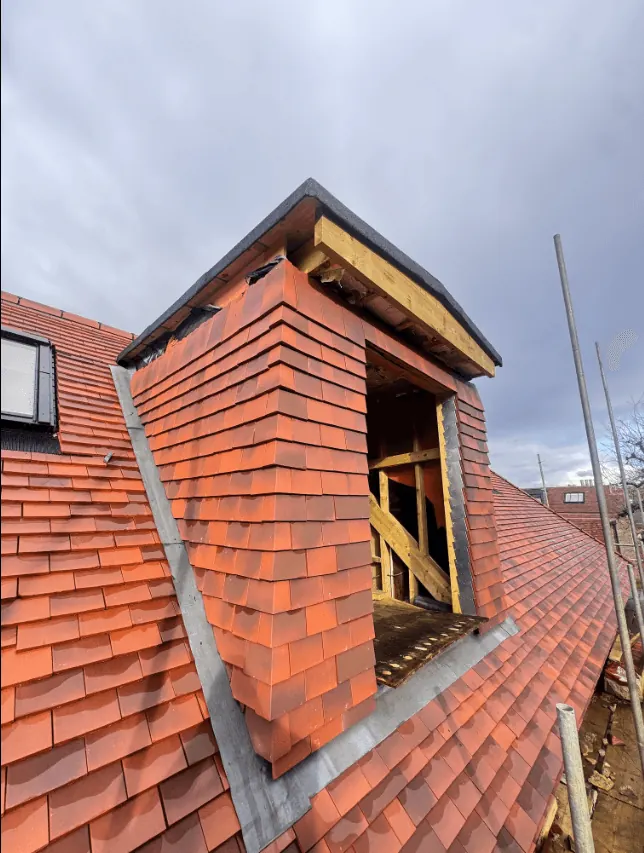
Deodar Road is a conservation area on its own. Its large three-storey houses went up just after 1896, most of them by the Fulham developers Morrison and Hulbert, and on the north side, which forms the conservation area, their long back gardens run down to the Thames. The houses are gabled with decorative bargeboards and finials, and the council's guidance asks for their slate roofs to be re-covered in slate.
At the western end, Putney Lower Common covers about 13 hectares and is ringed by mature forest trees, with pollarded limes around All Saints' churchyard. The Lower Common appraisal notes plain clay tile roofs with terracotta ridges on Lower Common South, slate on Putney Common and Commondale, and the Nelson Cottages at 15 to 36 Commondale, built in 1862 and covered by an Article 4 Direction that brings visible roof alterations under planning control. Under those trees, gutters fill fast every autumn.
What common Putney jobs cost
We do not publish our own prices, because height and access change them so much on these streets. For a sense of scale at the small end, MyJobQuote's roof tile guide lists replacing five slates at around £225 to £260 nationally, before any access costs.
The bigger jobs vary far more. Natural slate on a three-storey Deodar Road house is a very different re-roof from a two-storey Commondale cottage, and scaffold on a narrow Putney street can add a lot to any job. Our Putney roof replacement page sets out when a re-roof is worth it over another repair. For a job on your own roof, ring 0330 133 4111 and Simranjeet or one of the team will come and look.
Next door: East Putney, the Heath and the Vale
East of the High Street, the Queen Anne villas and post-war blocks of East Putney have their own page. Up the hill, the mansion flat estates and Edwardian houses of Putney Heath do too, as does the 1950s council estate in the valley at Putney Vale. Roehampton, beyond the Heath, is covered separately as well.
Frequently asked questions
My flat is in East Putney, not by the river. Is this the right page?
This page covers the riverside and the streets west of the High Street. East Putney, Putney Heath and Putney Vale have different houses and their own pages, linked above, so start there if you live east of the High Street or up the hill.
We share the roof of a Kenilworth Court block. Who should contact you?
Usually the managing agent or residents' association, since the roof is shared and access has to be agreed for the whole block. A leaseholder can still ring us to describe the problem, and we will talk to whoever looks after the building.
Star and Garter Mansions is locally listed. Does that add extra rules for roof work?
Wandsworth's appraisals say local listing adds no planning controls beyond those that already apply. Being flats in a conservation area, its roof still needs the council's agreement before any change to how it looks.
Can scaffold go up on a narrow street like Quill Lane or Modder Place?
Often, but scaffold standing on a pavement or road needs a licence from the council, and a narrow pedestrian lane with little room may need a tower or a narrower design. We look at access when we come to quote, so the scaffold is planned in from the start.





