



 Google reviews

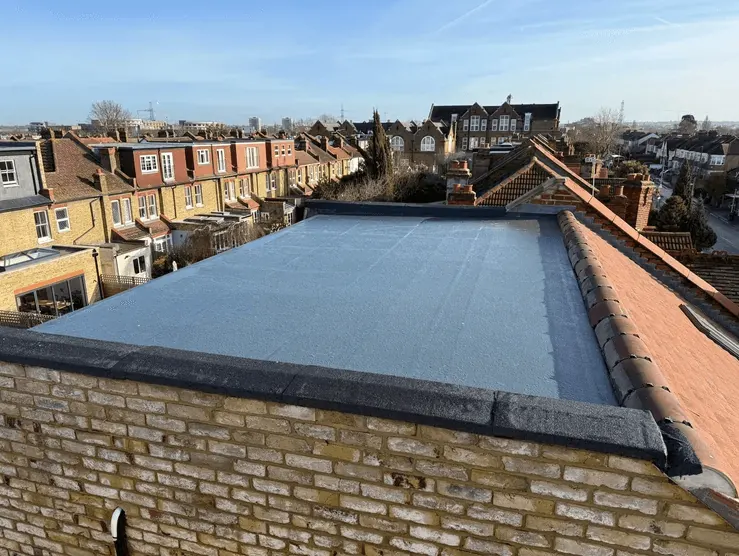
The flat-roofed terraces at Glendarvon Street
Most of the Embankment is low: boathouses mostly of two storeys, giving a low, horizontal line. Wandsworth's Putney Embankment appraisal picks out the exceptions. Ruvigny Mansions, at five storeys, is the tallest building on the stretch, and the flat-roofed twin terraces either side of Glendarvon Street are three storeys high with, in the appraisal's words, an urban townhouse aesthetic.
A flat roof on a three-storey house is a long way up and out of sight. Nobody notices the covering ageing until the top-floor ceiling marks. The weak points are predictable, though: the edges, where the covering turns up a wall or over a trim; the outlets, where silt gathers; and any rooflight or hatch, where the seal around the frame works loose. A drone pass shows all of them in a few minutes without anyone walking on the roof.
Dormer tops and boathouse additions along the river
The appraisal notes that several boathouses have roof extensions, and the council's guidance for the riverside streets favours a small lead-clad dormer with a sash on Victorian and Edwardian houses. Both produce small flat roofs of their own. A dormer top may be only a couple of square metres, but it is the highest surface on the house with nothing above to shelter it, and the junction with the cheeks and the main slope is where it usually lets go.
Repairs to these small roofs are often the right answer: a split patched, an edge trim refixed, an upstand re-dressed. Where the felt has crazed all over or the deck underneath is soft, a re-cover is better value. GRP gives a jointless finish that suits a small dormer top. EPDM goes down in large sheets with very few joints, which suits a bigger area such as a whole terrace roof. Torch-on felt is still a sound choice when it is laid properly. Our main flat roofing page compares how long each lasts.
Back additions behind the Victorian terraces
Away from the river, flat roofs are usually found on the backs of houses: single-storey rear additions and kitchen extensions behind the terraces west of the High Street, and the tops of loft dormers. On each of them, the line where the flat roof meets a 19th century wall is where most leaks start. Soft mortar, uneven brickwork and a flashing that was never properly cut into the wall all let water run down behind the upstand. When we re-cover, the upstand is taken up the wall to a proper height and the flashing above it is set into a mortar joint, so water runs over it instead of behind it.
If your building has been split into flats, check with the council before any work that alters the look, since flats lack permitted development rights. A re-cover nobody can see from the street is a different thing from a new rooflight or a raised edge.
As a benchmark, MyJobQuote's London flat roof guide gives an average replacement of around £2,750 in London. Height, access through the house and the state of the deck all move the figure for a three-storey terrace. If water stands on your roof for days, our article on ponding on a flat roof explains when it matters, and where the gutter below needs replacing as well, our gutter installation in Putney can be done on the same visit.
Frequently asked questions
Our Glendarvon Street house is split into flats and we own the top one. Is the flat roof ours to fix?
That depends on your lease, which usually says whether the roof belongs to the top flat, the freeholder or everyone jointly. Check it before booking work. We can survey the roof and give a quote that whoever is responsible can use.
How do I tell whether a Glendarvon Street roof needs re-covering rather than patching?
Leaks in more than one place, felt that is cracked or blistered all over, or a deck that feels soft underfoot all point to a re-cover. One split near an edge or outlet on an otherwise sound roof is a repair. Drone photographs usually make the answer obvious.
Will a new covering on my rear dormer change how the house looks from the river?
The covering on a dormer top is rarely visible from the ground. The edge trims and the cheeks are, so on the river-facing backs of the Embankment streets we keep the edge detail slim and match the existing finish to the cheeks wherever we can.





