



 Google reviews

Roof and gutter work across SW20
We handle the whole range of roofing and guttering in Raynes Park: inspections, repairs, re-roofs, flat roofs, chimneys, gutters, fascias and soffits, on houses, flats and the parades above shops. Our base on Kenley Rd in Morden is about 1.3 miles east of the middle of Raynes Park in a straight line. A slope you cannot see from the ground can be looked at by drone first, without scaffolding, and quotes are free. For a leak that cannot wait, our emergency roof repair page for Raynes Park explains what happens when you call.
An embankment first, a station later
The London and South Western Railway crossed this stretch of farmland on a high embankment in May 1838, but Raynes Park station did not open until 1871, where the branch towards Epsom and Dorking leaves the main line. Building followed slowly, then in a rush around 1900, and the embankment has divided the place ever since. Merton's Raynes Park character study describes a primary shopping core on Coombe Lane north of the tracks and a secondary one on Kingston Road to the south, with the cattle arch and other tunnels as the links between them.
For a roofer, that split is useful shorthand. North of the line the houses are mostly late Victorian and Edwardian, many with slate, in two conservation areas. South of it the streets are a mix of Edwardian terraces, 1930s and 1950s semis, and a 1970s estate.
North of the tracks: Lambton Road and Dunmore Road
The Lambton Road conservation area covers 8.33 hectares on the lower slopes of Wimbledon Hill, rising from about 14 metres above sea level at Worple Road to around 30 at its northern edge. Merton's appraisal says almost all of it was planned in eight years, from 1898 to 1905, by one developer, William Louis Peters: Trewince, Tolverne, Rosevine, Kenwyn and Pendarves Roads and the whole east side of Lambton Road. The houses share a recognisable set of roof details: mainly slate with red ridge tiles, party and flank walls projecting through the roof planes, and two-storey canted bays with their own hipped or gabled roofs. A few houses break the pattern, like the square flat-roofed bays at 17 to 35 Lambton Road and the slate mansard fronts at 65 to 69.
Those details explain most of the work these roofs need. Old slate slips as its nails rust, the joints along each party wall open up, and the small bay roofs leak where they meet the front wall. Our roof repair page for Raynes Park goes through them street by street.
A short walk east, the Dunmore Road conservation area is one of the smallest in the borough: 41 houses on 1.7 hectares, built in about 1907. Almost all are semi-detached pairs with canted bays under steep gables framed in timber bargeboards, chimneys on the party walls, red tiled cappings on the walls that rise above the roof, and red finials along the ridges. The road is lined with heavily pollarded limes and planes. Merton's assessment asks that box dormers stay on the rear slopes, and as with every conservation area, a dormer here needs planning permission.
The parades on Coombe Lane and Kingston Road
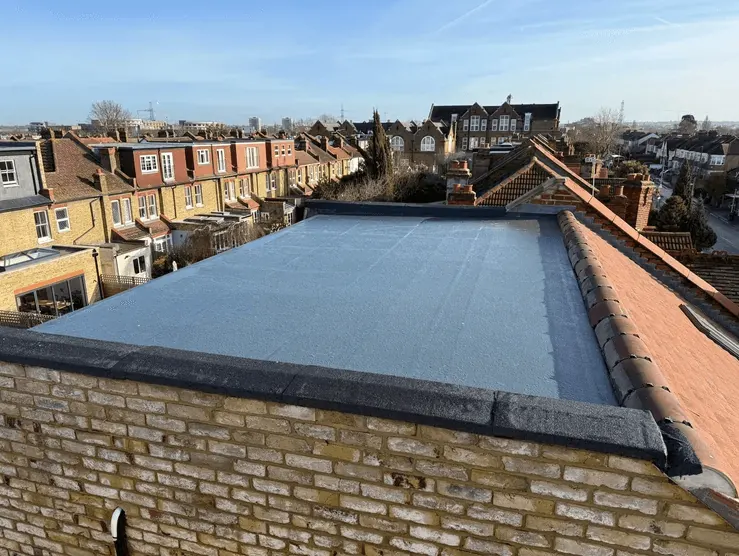
Facing the station, Coombe Lane's shops are mostly Edwardian, two to five storeys, with flats or offices above and a line of moulded cornices and raised parapets. Across the railway, the Kingston Road parades nearer the station have front gables, some mansard roofs and dormers, and turrets at the ends of the blocks. These are the roofs nobody sees: flat or shallow sections behind parapets, hopper heads and outlets that block, and slates on turrets high above the pavement. When they fail, the water usually reaches the top flat first, and our flat roofing work in Raynes Park covers re-covering the roofs behind those parapets.
On the residential stretch of Coombe Lane beyond the shops, houses sit well back behind tree-lined verges. The south side is mostly 1930s semis with hipped roofs and subordinate gables; the north side is early 1900s, including two Arts and Crafts pairs of 1909 with slate roofs and tile-hung bays.
Camberley Avenue, Firstway, the Carter Estate and the Apostles
The study groups the interwar and 1950s cul-de-sacs into the Camberley Avenue character area: Abbott Avenue below the railway, Grand Drive and Firstway just south of the station, and Somerset, Camberley and Taunton Avenues to the west, off West Barnes Lane. They have double bays, timbered gables, red tiled canopies and pebbledash or render above red brick. Firstway's central pairs share a mirrored sweeping gable, and on one side of Camberley Avenue the eaves are deep and carried on decorative brackets. These are the houses where long, plain eaves suit seamless gutters, and where a hipped roof's ridges and hips are the parts to watch.
Each local service page picks up one of these stories. The shared stacks and tile-capped party walls of Dunmore Road are on our Raynes Park chimney page. The street trees of the Lambton Road area, a different species on almost every road, decide when gutters need clearing, which our gutter cleaning page for Raynes Park sets out road by road. The flat bay roofs at 17 to 35 Lambton Road and the roofs behind the parade parapets are on the flat roofing page, the gutters of the 1930s Coombe Lane semis on the gutter installation page, and Firstway and Camberley Avenue on the seamless gutter page.
Off West Barnes Lane, the Carter Estate was laid out in the 1970s with around 400 low-rise flats and houses, in two and three-storey red brick blocks stepping up the slope around Bodnant Gardens. Between Kingston Road and Bushey Road are the twelve tightly packed terraced roads known as the Apostles, which we cover in detail on our Bushey Mead page, just as the Durham Road conservation area and Panmuir Road have their own page under Cottenham Park.
Frequently asked questions
Which parts of Raynes Park have slate roofs, and which have tiles?
The Lambton Road conservation area is generally slate, with red ridge tiles, although some houses on the west side of Lambton Road and elsewhere now have concrete tiles. Dunmore Road is tiled, with red ornamental finials on the ridges. The 1930s streets south of the station and along Coombe Lane are mostly tiled, and the 1909 Arts and Crafts pairs on Coombe Lane are slate.
Are there Article 4 directions on roofs in the Lambton Road or Dunmore Road conservation areas?
Not at present. Merton's Article 4 page lists building alteration directions only for the John Innes Merton Park and Wilton Crescent conservation areas. Being in a conservation area still matters: dormers need planning permission there.
The houses on Trewince and Tolverne Road stand close to the pavement. How do you get up to the roof?
Often we do not need to at first. A drone look shows the front and back slopes from the street. Where a repair needs scaffold on the footway, the scaffolder needs a licence from Merton as the highway authority, and on a terrace it may also mean a word with next door about access.
We live on the Carter Estate off Bodnant Gardens. Do you work on the low-rise blocks there?
Yes. Merton's study describes two and three-storey red brick houses and flats with coloured cladding on the upper floors, and three-storey blocks running beside the railway. For a house we deal with you directly. For a flat, the roof and gutters usually belong to whoever owns the block, so we send them the photos and the quote.





