



 Google reviews

The 1930s cul-de-sacs around Firstway and Camberley Avenue
Merton's Raynes Park character study groups three pockets of 1930s and 1950s cul-de-sacs south and west of the station into one character area. Grand Drive and Firstway sit just south of the station, and Somerset, Camberley and Taunton Avenues lie further west, off West Barnes Lane. Most are quiet cul-de-sacs of two-storey semis and short terraces, with double bays, timbered gables, oriel windows, red tiled canopies over recessed porches, and render or pebbledash above red brick.
Two details stand out for guttering. On Firstway, the central pairs of each terrace block share a mirrored sweeping gable with a semi-circular arched porch. And on one side of Camberley Avenue the houses have deep overhanging eaves carried on decorative brackets. Deep eaves like Camberley Avenue's carry long, plain fascias, and the terrace blocks on Firstway present long fronts. That is where seamless gutter, formed from a coil of aluminium to the length of the run, saves the most joints.
A sectional gutter along a 1930s semi has a union joint every few metres, each with a seal that dries out. On these streets, with tree-lined pavements and front gardens, those joints are also where leaves catch and blockages start. A seamless run has joints only at the corners, the stop ends and the outlets.
One run per house, joined at the party wall
On a terrace block or a pair, the eaves line carries on from one house to the next, so it can be tempting to think of one long gutter. In practice each house should have its own run with its own outlet and downpipe. That way any later repair, or a neighbour's decision to change their gutters, stays on one property. If neighbours replace at the same time, the two runs can be finished neatly where they meet at the party wall, so the line along the front still looks continuous.
On Camberley Avenue the deep eaves usually mean wide soffits and long fascias, and seamless gutter needs a sound board to fix to. If the fascia is soft or the soffits are breaking up, it makes sense to sort them first, which our fascias and soffits page for Raynes Park covers.
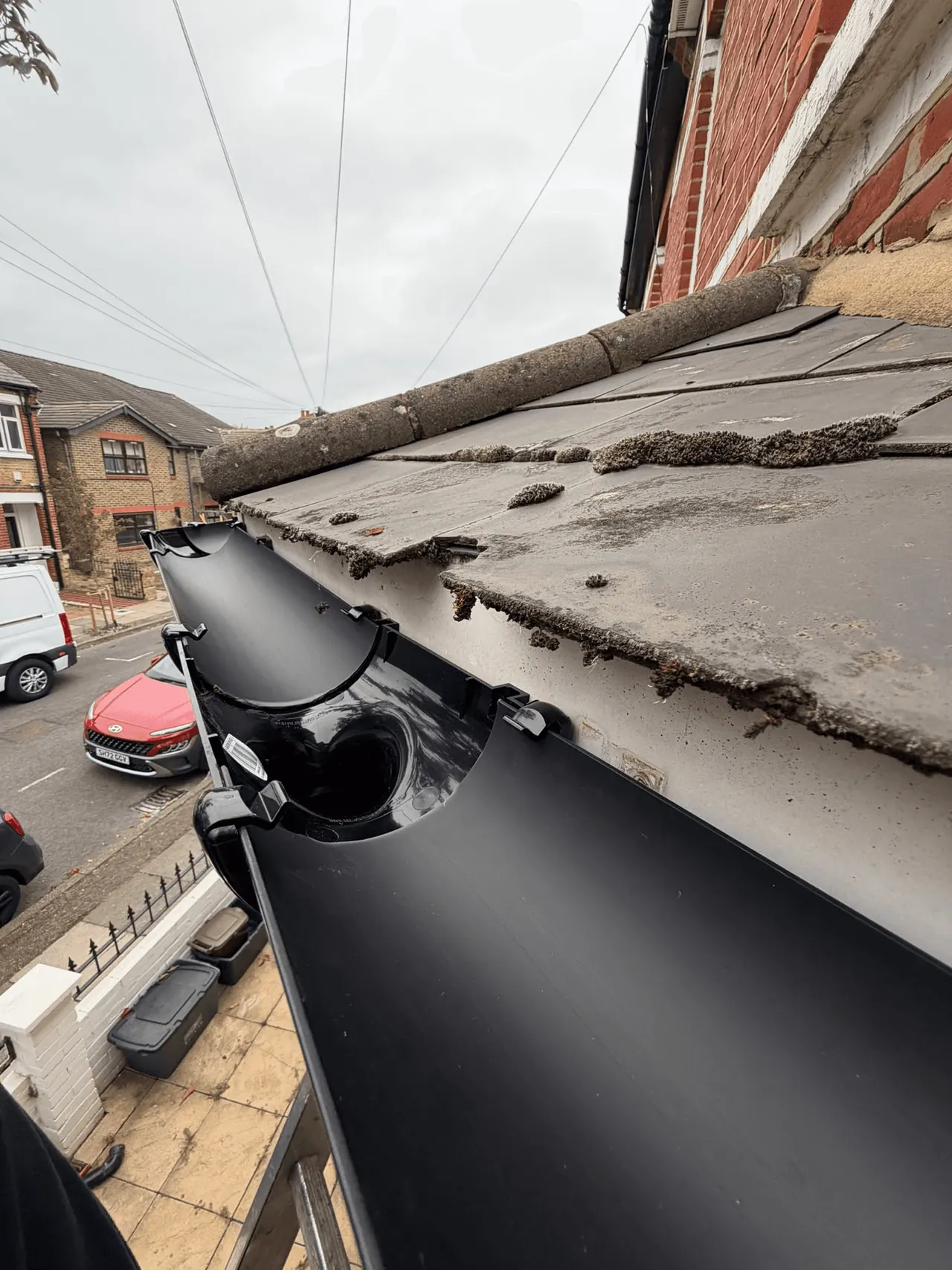
Where it pays, and where a standard gutter is as good
North of the railway, the Edwardian terraces around Lambton Road have short fronts broken up by bays, gables and party walls that stand above the roof. Seamless still removes a joint or two there, but the saving is small, and in the conservation areas a cast iron or period-profile gutter is usually the better match. Our page on gutter installation in Raynes Park covers those options.
The fitting itself starts with accurate measuring, because each run is made to the measured length. We fix the brackets at the right spacing, set the fall at around 1:600 towards each downpipe, form the corners, connect the downpipes and check the run for low spots. Costs vary with the length and corners, but MyJobQuote's guttering cost guide lists aluminium guttering in general at £55 to £78 per metre supplied and fitted. How the gutter is formed on site is explained under seamless gutter installation.
Frequently asked questions
My Camberley Avenue house has deep eaves with brackets underneath. Does that change how the gutter is fitted?
Not the gutter itself, which fixes to the fascia in the normal way. The brackets under the eaves are decorative and stay as they are. What matters is that the long fascia is sound and straight, because a seamless run will show any dip along its length.
Can a seamless run follow the sweeping gable on a Firstway pair?
The gutter runs along the eaves, so it follows the bottom edge of the roof rather than the gable. Where the roofline changes direction, the run is jointed with a formed corner, and each straight length either side stays in one piece.
If my house in the Grand Drive pocket has a plain hipped roof, is seamless a good fit?
Usually, yes. A hipped roof means a gutter on three sides of each half, with corners at the hips, but each straight side is a single length. On a plain interwar or post-war roofline that gives a clean line and very few joints.





