



 Google reviews

The roads that radiate from Circle Gardens
Merton Council's Merton Park character study describes Circle Gardens as a circular hub with roads radiating out along Kenley Road, Poplar Road South and Tybenham Road. The houses were built in the late 1920s and early 1930s, mostly as two-storey terraces of three to six with a few semis, in red brick and pebbledash. Their roofs are generally hipped and covered in red clay tiles.
A hipped terrace has eaves along the front, along the back, and round the hipped ends of the row. On each house, the front and back runs are long and straight, with few changes of direction. In a sectional gutter, each of those runs is made from standard lengths joined together, and every joint has a seal that will one day dry out. A seamless gutter is formed to the measured length of the run, so the only joints left are at the corners, the stop ends and the outlets.
Where it suits, and where it does not
Good fits. The straight front and back eaves of the terraces on Tybenham Road, Kenley Road and Aylward Road, and the houses on Poplar Road South. The same goes for the post-war semis in George Square, which the study describes as small modern houses in a court-style setting, and simple rear extensions with a long single eaves line.
Less suitable. The busiest John Innes roofs. The council's character assessment describes smaller roofs over projecting bays, hips mixed with gables and, on some Quartermain houses, Dutch gables. Lots of short runs and corners leave few joints to remove. The front of a conservation area house also needs thought: the council's design guide names powder-coated aluminium as an acceptable alternative to cast iron, but a seamless profile does not look the same as sectional cast iron with its visible joints. On those houses we would usually suggest seamless only on the back, if at all, and talk it through with you first.
On some detached houses in the Dorset Road area, the roofs have shallow pitches with ornamental brackets under the eaves. A seamless gutter can work there, but the brackets have to be worked around, so we look at each house before recommending it.
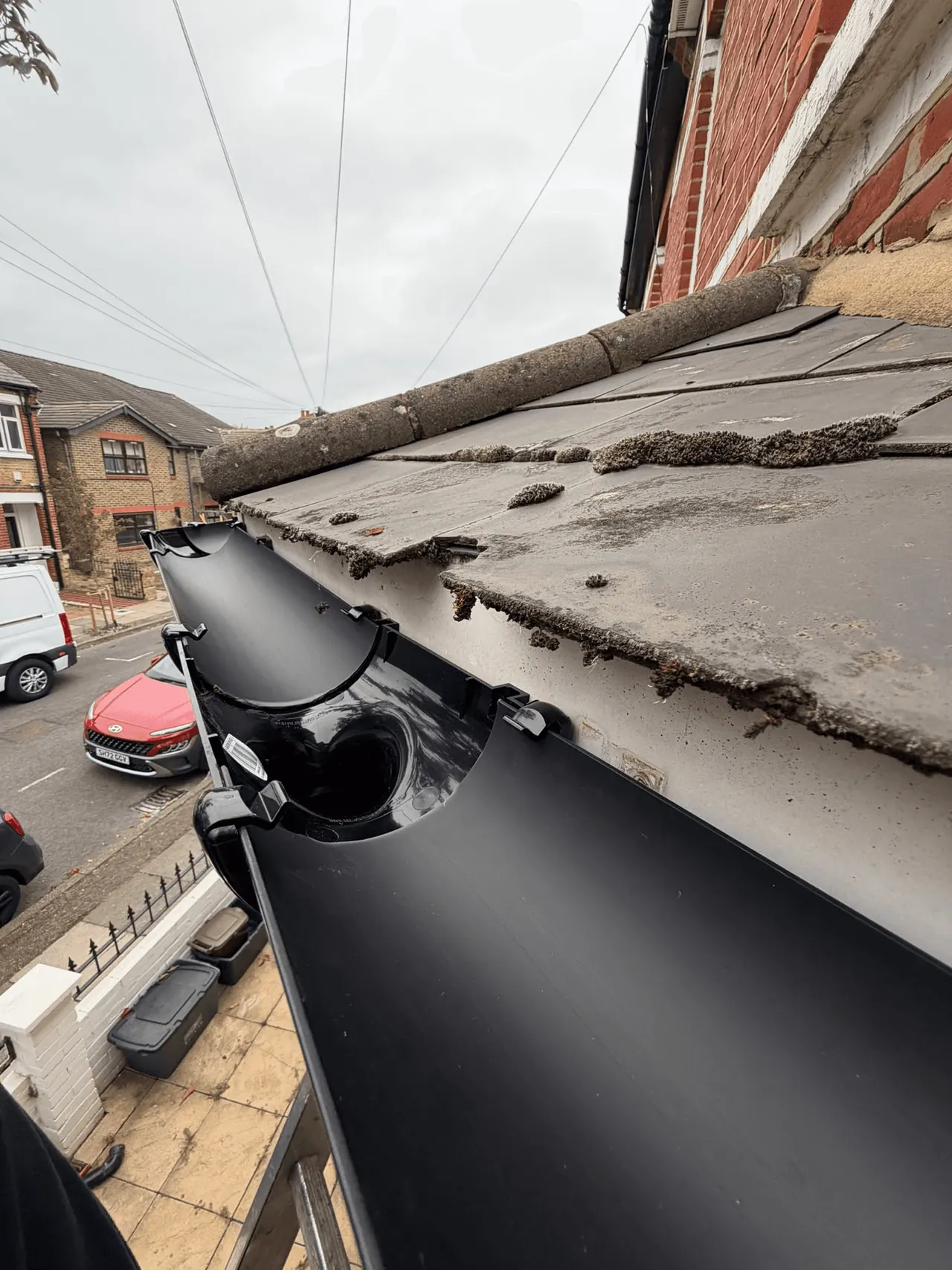
Your stretch of a Tybenham Road terrace
We start by checking the fascias, since a new gutter needs sound boards behind it. If yours are soft, our fascia and soffit replacement in Merton Park comes first. Then each run is measured, the outlet positions are agreed so the water goes to the existing gullies, and the fall is set towards each outlet as the run goes up.
On a terrace, each owner has their own stretch of gutter. A seamless run stops at your party line, with a joint where it meets next door's gutter. That joint is the one place we take extra care over, because it sits between two different systems.
MyJobQuote's gutter replacement guide gives £55 to £78 per metre for aluminium guttering in general, supply and fit, as a UK guide range. That covers aluminium broadly, not only seamless, and it sits well above uPVC, so seamless is a choice for fewer joints and a longer life rather than a cheaper one. For a standard sectional system, see our Merton Park gutter installation page, and our main seamless gutter installation page explains how the gutters are formed.
Frequently asked questions
Will a seamless gutter on my Kenley Road terrace look odd beside next door's plastic one?
It comes with a coloured coated finish, so it can be matched to your windows and fascias or to the neighbours' gutter. We go through the colours with you before the run is formed, so the row still looks tidy from the street.
Would seamless suit a post-war semi in George Square?
Often, yes. The rooflines are simple, so the runs are long and there are few corners. We measure up and tell you how many joints it would save.
Can seamless go on the back of a conservation area house on Mostyn Road while the front stays cast iron?
That mix is possible and keeps the front in line with the council's guide. Check with Merton Council if you are unsure what it will accept on your house.





