



 Google reviews

A garden suburb on a dead-level site
Stand at one end of Langley Road or Manor Gardens and the street looks dead level, and it very nearly is. Merton Council's character assessment describes the John Innes (Merton Park) Conservation Area as almost entirely flat, at about 15 metres above sea level, with a height difference of barely over a metre between its lowest point in the west and its highest in the east. It sits in a low-lying belt between the River Wandle and the Beverley Brook.
For a gutter, that means nothing outside helps the water along. All of the movement towards the downpipe comes from the slope built into the gutter itself, and from the downpipe and drain being able to take it away. A run fitted dead level, or one that dips between two brackets, holds water in rain and holds leaves the rest of the year.
Setting the fall on long Innes eaves
The assessment describes many John Innes houses with smaller roofs over projecting bays and a mix of hips and gables, so one gutter often collects from several slopes. We measure each run, work out where the outlets go, and set the brackets to a fall of roughly 1 in 600 towards each downpipe as a rule of thumb. On a very long run, a second outlet is often better than a steeper fall, because it keeps the gutter looking level from the street.
Bracket spacing matters just as much. Cast iron is heavy, and a full gutter is heavier still, so the brackets go in at the right centres and into sound timber. Every joint is sealed, and the downpipes take the water to the gully or drain rather than onto the wall. If the fascia behind is soft, our Merton Park fascias and soffits work can replace it on the same visit, before the new gutter goes up.
What goes on a conservation area front
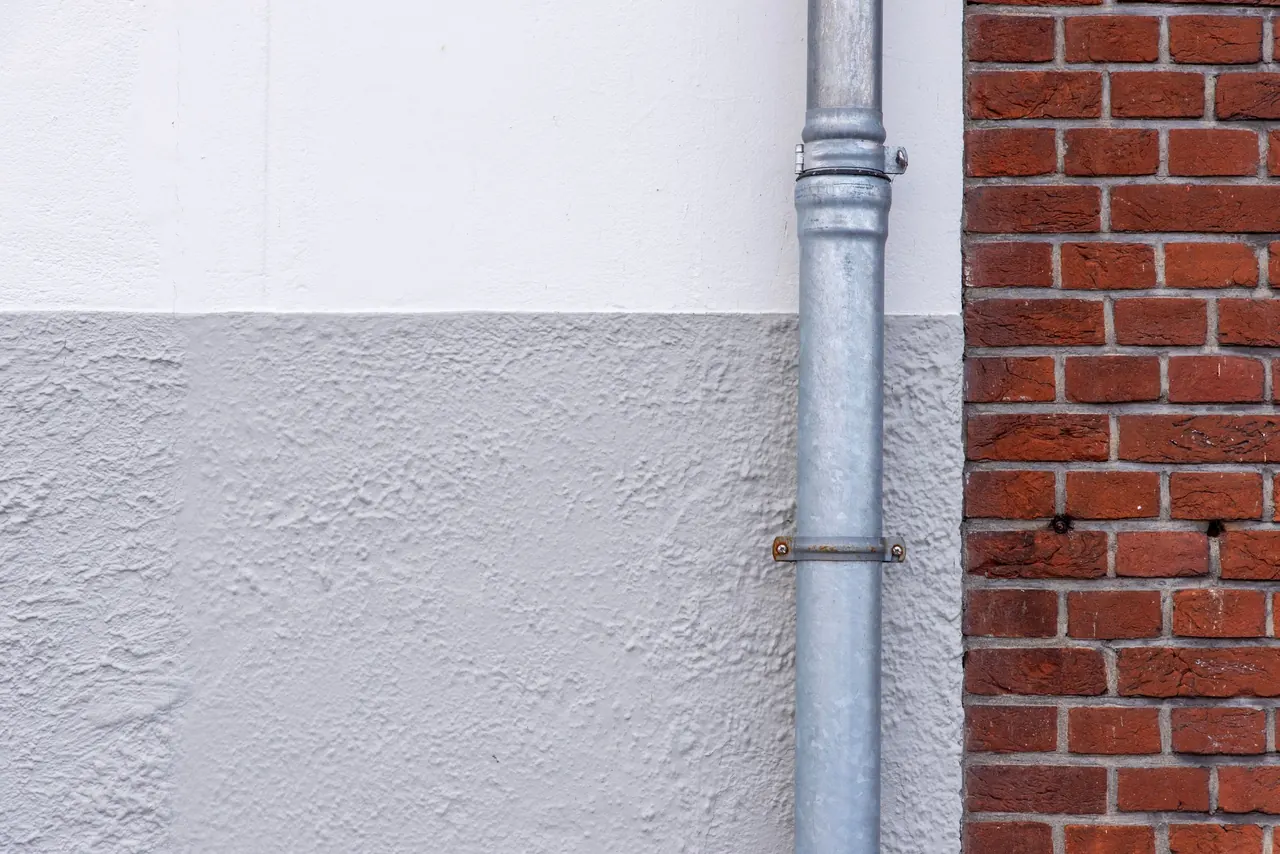
The council's design guide for the John Innes conservation areas says the gutters and downpipes here were originally cast iron. For replacements it suggests:
- cast iron, as more in keeping and generally more durable than plastic
- powder-coated aluminium, which looks very similar, is lighter and can cost less
- black plastic if plastic is used, ideally kept to rear or secondary elevations
- no extra pipework on the front of the house
We fit all three materials, so on a big conservation area house it often makes sense to price cast iron or aluminium on the front and black uPVC on the back. On the 1920s and 1930s streets south of the conservation area, round Circle Gardens and Kenley Road, there are no such controls and uPVC is the usual choice.
Profile is part of the look. Half-round suits most of the older houses, and ogee gives a deeper, more decorative line on some. Checkatrade's gutter replacement guide puts fitted cast iron at £85 to £275 per metre against £30 to £70 for uPVC, as UK guide rates, which is why a mixed front-and-back approach saves money on a wide house.
Timing the job round the leaf fall
Most of the John Innes roads have large street trees, so late summer is a good time to fit new gutters, so the system is in and running before the leaves come down. If you want fewer joints along a long eaves line, seamless guttering in Merton Park may suit the back of the house. Profiles and sizes are compared on our gutter installation page.
Frequently asked questions
My Manor Gardens house has one downpipe for a long gutter. Can you add another without spoiling the front?
Often, yes. The design guide asks for no extra pipework on the front, so we look for a route at a side or rear corner first, and only suggest a front pipe if there is no other way.
What fall do you set on a gutter on level ground like Langley Road?
Roughly 1 in 600 towards each outlet as a rule of thumb. On long runs we would rather add an outlet than tilt the gutter so much it looks crooked.
My house is one of the 1930s terraces on Kenley Road. Do the conservation area gutter rules apply?
No. Kenley Road sits outside the John Innes conservation area, so uPVC is fine. Matching the profile and colour next door keeps the terrace looking like one row.





