



 Google reviews

Render on Whatley Avenue and Cannon Hill Lane
Whatley Avenue and the north side of Cannon Hill Lane were built together in 1926 as rendered terraces with simple overhanging porches and hipped red clay tile roofs. At the south end of Cannon Hill Lane, the art deco semis have white rendered fronts, and around Hillcross Avenue many houses are pebbledashed.
On a smooth rendered wall, a gutter that drips at a joint or overflows at a corner leaves a dark streak that is hard to clean off, and over time it lets water into the render itself. When a whole system is being replaced on these houses, the aim is simple: every drop reaches an outlet, and nothing runs down the face.
- Outlets sized for the roof: a hipped roof sends water to the eaves on every side, and a corner outlet can take water from two slopes at once.
- Downpipes held off the wall: fixed with proper clips so the pipe does not sit tight against the render and stain it behind.
- A clean discharge: into a gully, drain or butt, never left to spill onto the base of the wall.
A gutter round four sides
A gabled terrace has gutter front and back. A hipped semi or end-of-terrace has it on three or four faces, with an external corner at each hip and often a short run round a bay. That means more metres of gutter than the size of the house suggests, and more corners to seal and support.
When we plan a new system on a hipped house, we work out how much roof drains to each outlet before deciding where the downpipes go. On an end-of-terrace or a semi, a corner at the side can often take a downpipe that serves two slopes, which keeps a pipe off the front wall. We set the fall towards each outlet and space the brackets closely enough to carry a full gutter in a storm. The boards behind have to be sound first, and our fascias and soffits page for Cannon Hill covers that side.
On the Whatley estate, keeping pipes off the front has a planning angle too. Merton's character study lists drainpipes added to front walls for front bathrooms among the changes that have spoiled the estate. That is about waste pipes rather than rainwater, but a tidy front helps either way.
Matching the house next door
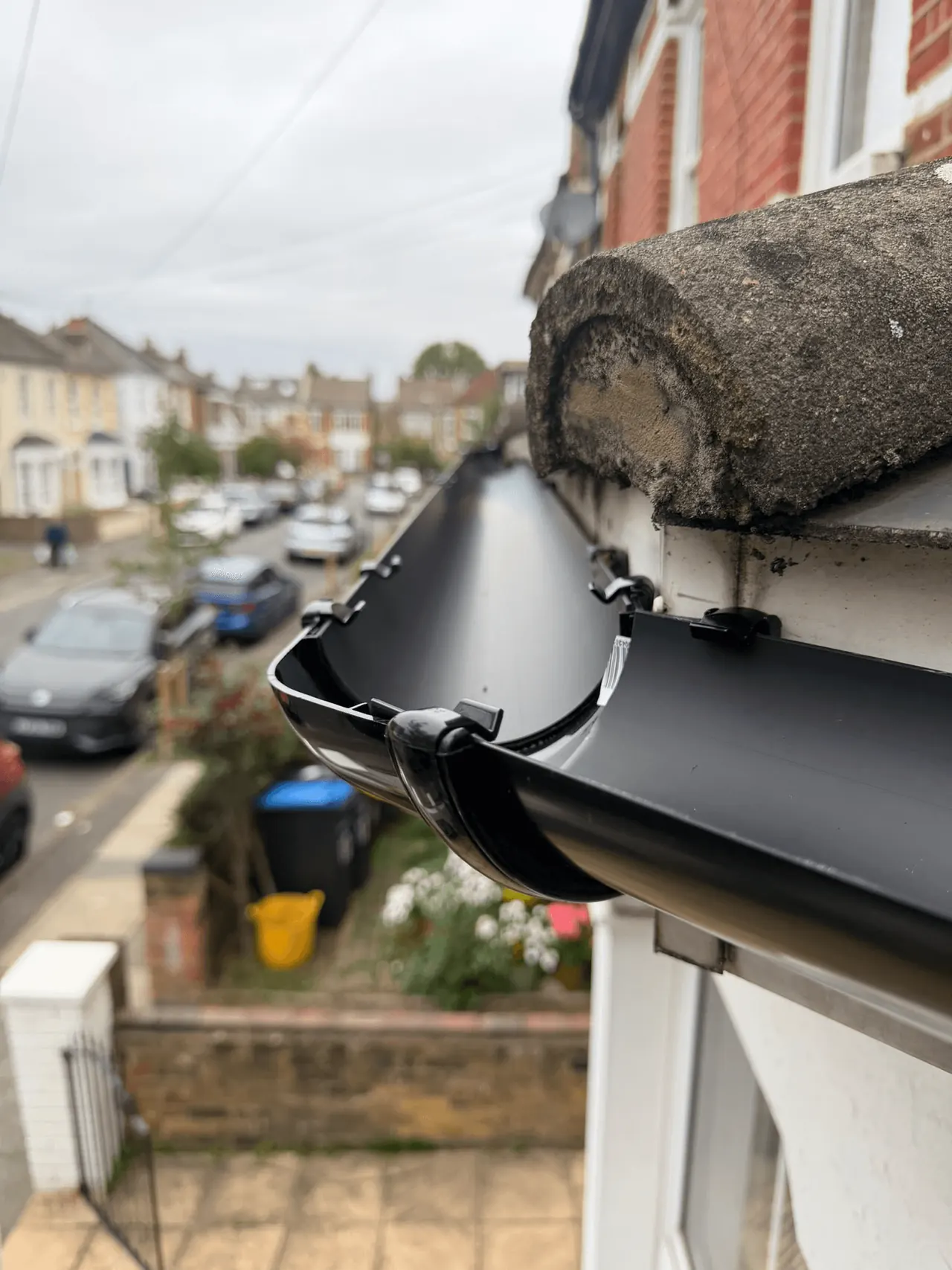
On a terrace or a semi, your gutter often meets next door's at the party wall. If the neighbour's is a different profile, the join needs an adaptor or a stop end and a separate outlet, and the run should line up so it does not show a step from the street. On the 1926 terraces, where the render and roofline make a row read as one building, it is worth matching the neighbour's profile and colour where you can.
For budgeting, MyJobQuote's published gutter replacement guide gives standard uPVC guttering at roughly £40 to £50 a metre fitted. Measure round the whole house rather than just the front. If a tired system can still be saved, our gutter repair page for Cannon Hill covers when that makes sense, and the main gutter installation page covers the fitting in more detail.
Frequently asked questions
Can a downpipe on the front of our Botsford Road house be moved round the side?
Often, if there is a drain or soakaway that a side or rear outlet can reach. If the only gully is at the front, moving the pipe means new underground drainage, which we point out before you decide.
Next door on Whatley Avenue kept their old gutter. Can ours join it at the party wall?
Yes. We fit an adaptor where the profiles allow it, or finish ours with a stop end and its own outlet where they do not. Either way the joint sits at the party wall, so a later change next door does not disturb your run.
The hanging porch on our Mawson Close house drips onto the doorstep. Can it have its own gutter?
A small gutter can usually be fitted to a porch canopy, discharging into the main downpipe or to one side. On the estate it is worth keeping it small and neat so the original porch detail still shows.





