



 Google reviews

Small gutters, big storms
The rain that causes trouble in West Barnes arrives in short, heavy bursts. The area is Merton's Critical Drainage Area 001, and what happens below ground in those storms is explained on our blocked gutter page for West Barnes. What happens at roof level is simpler. A gutter either carries the water to the downpipe or it tips it over the front edge and down your wall.
Many gutters on these houses, original or fitted in later decades, are a standard small half-round. That profile copes with steady rain but overflows when a storm drops a lot of water in a few minutes, especially at the end of a long run where the water from the whole slope arrives at once. Replacing like with like puts back the same limit.
Working out the load on each run
Most houses here have hipped tiled roofs, so on a semi or end house rain comes off three slopes rather than two, and a semi may drain into gutters on three sides plus a separate small gutter over the front bay. Every length of gutter has to carry what falls on the slope above it. Where a house already overflows, three things are looked at before a new system is chosen:
- Profile. A deeper half-round, or a box or ogee profile, holds and moves more water than a shallow gutter of the same width.
- Outlets. On a long run with one outlet, all the water from two slopes heads to one corner. A second outlet and downpipe, where there is a drain to take it, halves that load.
- Valleys. Where a loft dormer or a rear extension creates a valley, the gutter below it takes a concentrated flow and needs an outlet close by.
Loft conversions add their own small gutters. A dormer gutter usually discharges onto the main roof or into a pipe of its own, and where it empties straight onto the tiles, all of that water lands on one stretch of the main gutter, so that stretch and its outlet are sized to take it.
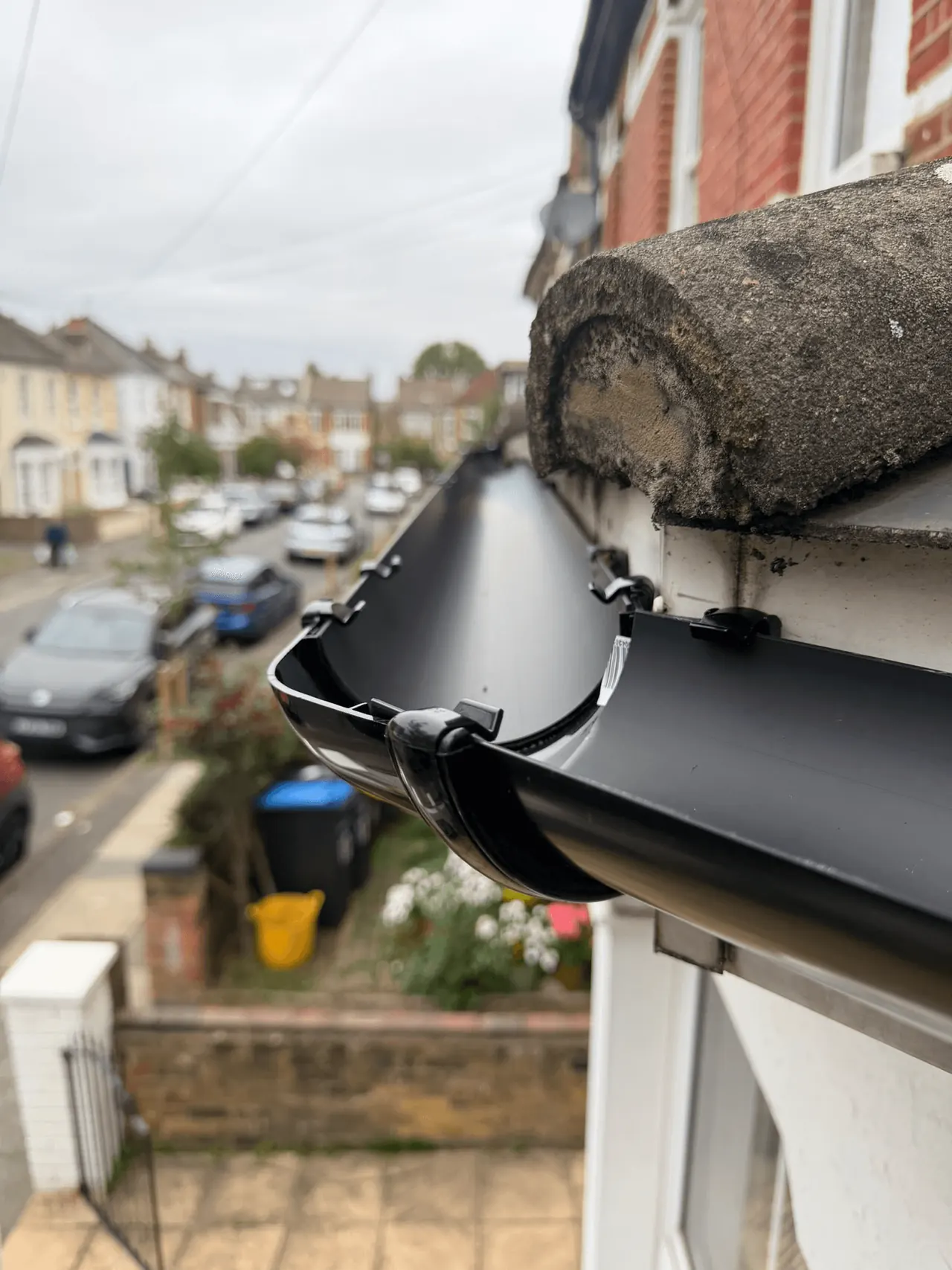
Cast iron, plastic and what replaces them
Plenty of houses here now carry a mix: original cast iron on one elevation, plastic fitted later on another, with an awkward joint between. A full new system gets rid of those adaptors and puts every run on the same profile and fall.
The fascia boards are checked first, because brackets need sound timber to hold. If the boards are soft, they are best replaced through our fascia and soffit service in West Barnes before the gutters go up. Then the brackets go on at the right spacing, the gutter is set with a gentle fall towards each outlet, angle pieces go on at the corners, and the downpipes run into the drain or a water butt with an overflow. On a semi, your gutter meets your neighbour's at the boundary with a proper union.
uPVC is the usual choice on houses like these, because it is light and needs little upkeep. Cast iron and aluminium last longer and cost more, and for runs with as few joints as possible, seamless aluminium guttering in West Barnes is worth comparing. For a sense of cost, MyJobQuote's national replacement guide prices new uPVC on a three-bed semi with about 32 metres of gutter at £1,300 to £1,600. The main gutter installation page goes through the materials in detail.
Frequently asked questions
Our semi has cast iron along the front and plastic down the side. Should it all be replaced at once?
If the cast iron is rusting at its joints and the plastic is brittle, yes. One system on one profile drains better and has no adaptor joints to fail. If the cast iron is sound and only the plastic is tired, the plastic runs can be renewed on their own with a proper adaptor at each joint.
The gutter on our West Barnes loft dormer empties straight onto the main roof. Is that acceptable?
It is common, and it works if the main gutter below can take the extra water. Where that stretch overflows in storms, the dormer gutter can be piped down to the main gutter's outlet, or the main gutter below it can be given a bigger profile and its own outlet.
Does the small gutter over a West Barnes front bay need replacing with the rest?
Usually, yes. The bay roof sheds its own water and catches whatever drips off the main roof above, and its outlet is the easiest on the house to overload. Renewing it with the main runs keeps the profile and colour consistent.





