



 Google reviews

The back of the house has changed
Seen from the pavement, a West Barnes semi looks much as it did when it was built: a tiled hip, a bay with its own small roof, a stack on the party wall. Round the back, a lot of them are different houses. Many were extended after the Second World War, often with loft conversions and conservatories, and a converted hipped roof tends to have either a flat-topped rear dormer or a side hip that has been built up into a gable.
Each of those changes cut into a roof laid between the wars. The new section might be perfectly sound, but the line where it meets the original tiles is only as good as the flashing and tiling done on the day, and you cannot see it from the street or from your own garden. On a converted house, that join is the first thing we look at.
Where a converted hipped roof gives way
On a hip-to-gable conversion, the weak spot is where the new gable wall meets the neighbour's half of the roof at the ridge. On a semi or a terrace that is a party-wall line, and if the tiles were cut short or the mortar bed is thin, rain driven across the ridge finds its way down inside the gable.
On a rear dormer there are three places to check: the lead or tiling where the dormer cheeks meet the main slope, the apron at the bottom edge of the dormer face, and the flat roof on top. A dormer roof is small and easy to forget, and water that sits on it in a heavy shower will look for any gap at the edge trim.
The rest of the roof gets the same attention as any interwar house:
- hip and ridge mortar, which on an unstripped roof of this age is often cracked
- the bay roof and its flashing against the front wall
- the party-wall stack, its lead, its flaunching and its pots
- the gutter as it turns each hip, with an angle joint at every corner
- any flat roof over a rear extension, which usually sits below the dormer and catches what runs off it
Getting a look without walking on old tiles
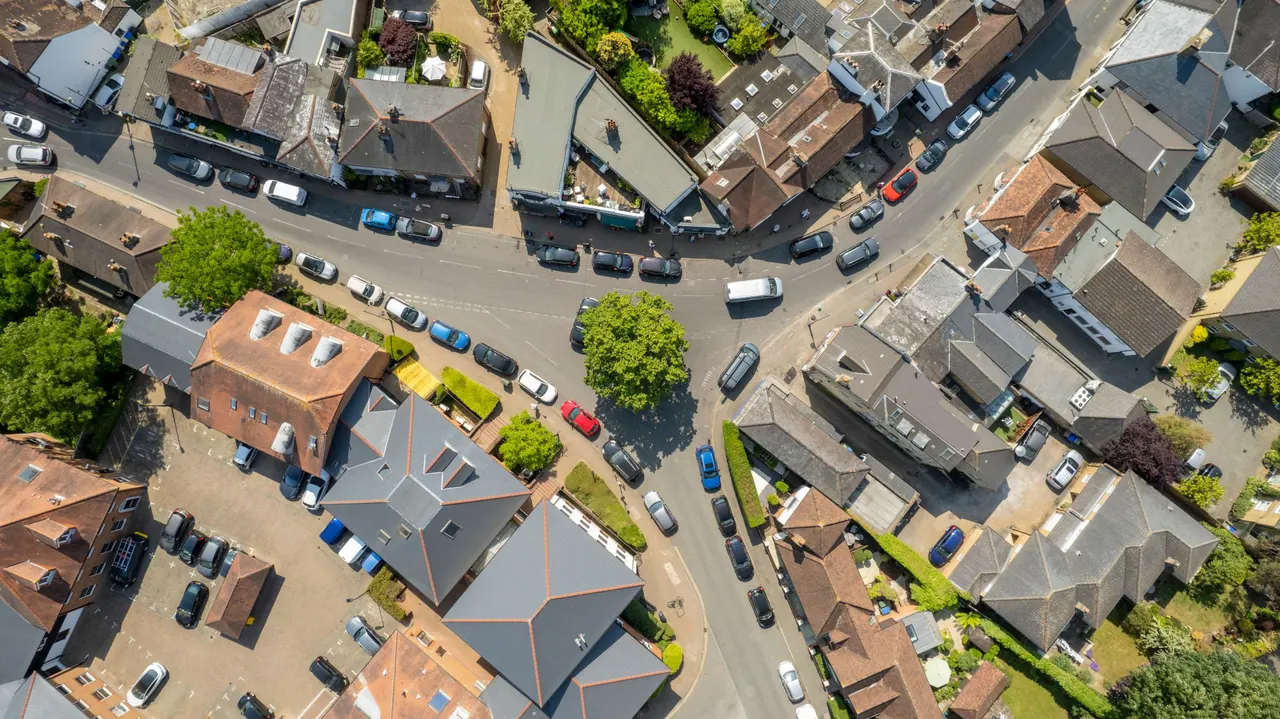
Flying usually from your front or back garden, the drone can rise over the hip and look straight down onto the rear slope, the dormer top and the extension roof, so nobody walks on ninety-year-old tiles and no scaffold goes up just to look. Big garden trees and overhead cables are planned around, and if the wind makes a flight unsafe, it waits for another day.
A drone sees the outside only. Inside a converted loft there is less to see, because the rafters are boarded over, but the eaves cupboards usually give a view of the original roof at its lowest point, where tired felt and wet battens show first. In an unconverted loft the whole underside is visible, including daylight through gaps and staining under the stack.
You get the photos with a plain account of what each one shows, the urgent items kept apart from the ones that can wait. For a sense of cost, MyJobQuote's survey price table puts a drone survey at £200 to £350 nationally.
If the photos turn up work, the usual next step is a repair to the hips, bay or dormer join. When the whole covering has had its day, a re-roof in West Barnes is the other route. The main roof inspection page explains what a full inspection covers.
Frequently asked questions
Our semi's side hip was built up into a gable in the 1990s. Can you tell if it was done properly?
From the outside, mostly yes. The photos show whether the new tiles line up with the old, how the gable meets the ridge and verge, and whether the junction with next door's hip is sound. Inside, staining on the gable wall or in the eaves shows whether water has been getting in.
Can the flat roof on top of a rear dormer be checked without anyone going up?
Yes. The drone gives a clear view of the dormer top, the edge trims and any ponding. If something needs a closer look, you are told what access that would take before anything is booked.
We are buying a converted semi near Motspur Park station. What should we ask the seller?
Ask for the Building Regulations completion certificate for the loft conversion, and when the dormer roof was last re-covered. A mortgage valuation rarely looks closely at the dormer join, so have the roof seen before you exchange. Our article on a roof inspection before buying a house lists other questions worth asking.





