



 Google reviews

Back additions on the TW11 terraces
Most of Teddington's houses came after the railway arrived in 1863, and by 1901 the population had risen from under 1,200 to over 14,000, which is why most of TW11 is Victorian and Edwardian streets.
That history decides what sits on the roofs. A Victorian terrace of this period typically has a slate roof, brick chimney stacks and a two-storey back addition behind each house. The Edwardian houses that followed, many of them towards the river, mix clay plain tiles and slate, with steeper pitches, gables and decorative ridges. Add a loft dormer or a single-storey kitchen extension, and one house can carry three different roof coverings.
On the terraces, the first faults to show are usually slipped slates and the valley or lead-lined gutter where the back addition meets the main roof. Leaves and grit settle in that junction, water backs up under the slates, and the first sign is a stain on the back bedroom ceiling. Our roof repair work starts by clearing and checking that valley before replacing anything, because a blocked valley and a worn one look the same from the garden. As a national guide, Which? puts replacing one to six broken standard roof tiles at £75 to £400 before VAT (Which? roofer costs). It gives no separate figure for slate.
Shop roofs on Broad Street and the High Street
Teddington's two main shopping streets were built at different times. The High Street was the old village centre, and its south side was largely rebuilt as Edwardian shopping parades after the road was widened in 1903 to take the trams. Broad Street and The Causeway, on the other side of the railway, grew as a separate Victorian and Edwardian commercial street, with flats over the shops, bracketed gables, dormers and, on one building, a turret with its original slate roof.
Both streets are conservation areas, and the council's appraisal for Broad Street is unusually specific about roofs. It lists poor-quality or oversized roof additions as a problem, along with uPVC, roofing felt and GRP products. That matters if you own a flat or shop here and the rear roof, a dormer or the gutter line can be seen from the street or the rear lanes. We will tell you what we find, photograph it, and price a repair that keeps the existing slate, ridge and leadwork wherever we can, so you have the facts before you speak to the planning team about anything larger.
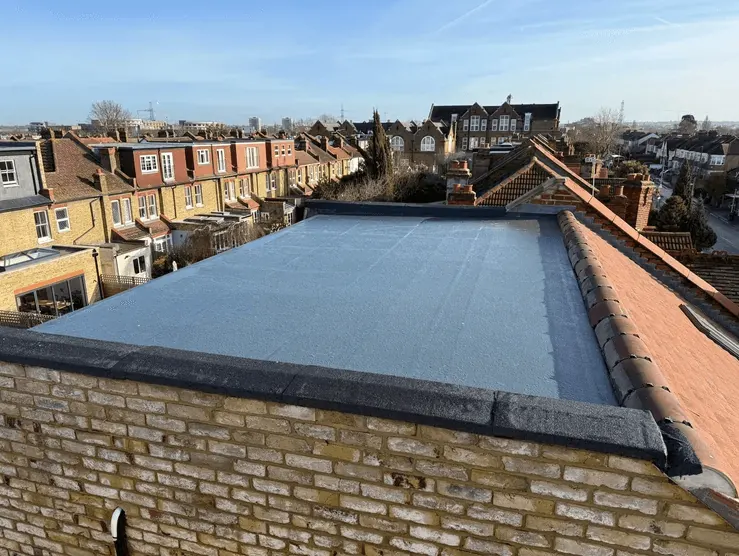
Behind the parades the picture is different. Where a shop has been extended at the back, the extension is usually a small flat roof over a store or stairwell, and it can often only be reached from the flat above. Those roofs tend to collect water at the outlet, and a blocked outlet will flood a felt roof in one heavy storm. Our flat roofing team can repair the existing covering or replace it, and we explain how each choice would look if the roof is in view.
Gables, roughcast and big stacks towards Broom Road
South of the High Street, the streets around Broom Road were built up around the turn of the century, and this is where Teddington's roofs get most varied. Broom Water, laid out around a river inlet, has individually designed houses in red and yellow brick, tile-hanging and roughcast, with an alternating run of steep gabled and hipped roofs in plain tile or slate and prominent chimney stacks. Along Broom Road and Kingston Road, the Teddington Lock conservation area takes in a group of early 20th century roughcast houses with stone window surrounds and hipped slate roofs.
King Edward's Grove, close by, was laid out as Cornelius Road in the 1880s and renamed, most likely in honour of Edward VII, who came to the throne in 1901. Its detached and semi-detached houses, built between about 1901 and 1904 and partly designed by a Teddington firm of architects, have large chimneys, decorative ridge tiles and finials. The council notes that dormer extensions are still on only a minority of these roofs.
On houses like these, the work is mostly about keeping detail in place. Steep plain-tile slopes shed tiles when the nibs or nails fail, decorative ridges crack along their bedding, and tall stacks lose pointing and flaunching at the top where nobody looks. Our chimney repairs cover the lead flashing, repointing and flaunching on those stacks, and where a ridge tile or finial is broken we look for a matching piece before suggesting a substitute.
Church Road, Elfin Grove and the older back streets
Church Road runs north from the junction of Broad Street and The Causeway up to Teddington Cemetery, and Kelly's Directory for 1899 lists over 40 trades along it, some probably run from converted front rooms. Its conservation area also covers Elfin Grove and Walpole Crescent, where the former cottage hospital dispensary of 1883 is a single-storey building with a hipped roof and a large stack at each end.
Roofs on these mixed streets are rarely uniform. A former shop may have a parapet with a hidden gutter behind it, the next house a plain slate pitch, and the one after a later flat-roofed extension. Hidden gutters behind parapets are worth checking every year, because water that overflows them runs inside the wall rather than down the front. A roof inspection with our drone lets us see behind the parapet, along the valleys and around the back of the stack without anyone climbing up first.
Frequently asked questions
My Victorian terrace near Church Road leaks where the back addition meets the main roof. What is usually wrong?
Usually one of three things: the valley or lead gutter at the junction is blocked with leaves, the lead has split or lifted where it meets the wall, or slates next to the junction have slipped. We clear it first, then check the lead and slates, so you only pay to replace what has actually failed.
The rear flat roof behind my Broad Street flat is felt. Can it be replaced with GRP?
It can be, but the council's Broad Street appraisal lists roofing felt and GRP among materials that can harm the conservation area where they are visible. If the roof can be seen from the street or the rear lanes, check with the council's planning team first. We can price GRP, EPDM and felt so you can compare them.
My house on Broom Road has a hipped slate roof and roughcast walls. What tends to fail first?
The hips and ridge usually go first, as the mortar bedding cracks and lets the hip tiles loosen. After that, look at the lead where the roof meets the stack and at the gutters, because overflowing water soaks into roughcast and leaves dark streaks on the render below.
A decorative ridge tile on our King Edward's Grove house has cracked. Does the ridge have to be replaced?
Not usually. Sound ridge tiles and finials can be lifted, cleaned and rebedded, and a cracked one replaced on its own. The council's appraisal picks out the decorative ridge tiles and finials on that road, so we look for a matching piece before suggesting a plain substitute. If the bedding has failed along the whole run, it is rebedded at the same visit. You can get in touch with a photo of the ridge to start.





