



 Google reviews

Which roof do you have?
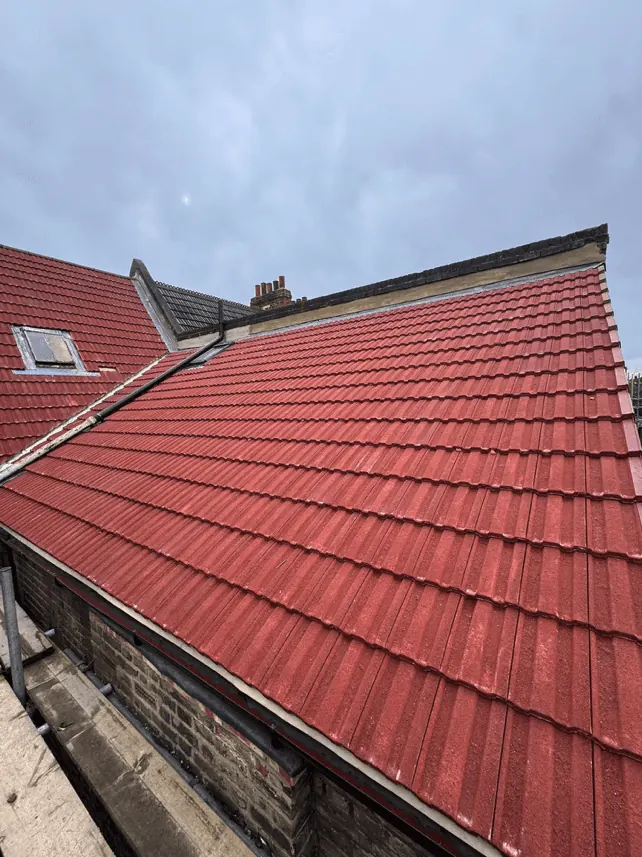
The first question on any Cannon Hill roof is the same one: concrete tile or clay. The answer depends far more on the street than on the age of the house, because the area was built by different hands in a short run of years.
- The Whatley estate, the 1920s council estate north of Martin Way: two storey terraces and semis with splayed hipped roofs in grey or red concrete tiles.
- The 1926 rendered terraces on Whatley Avenue and the north side of Cannon Hill Lane: hipped red clay tiles over rendered walls.
- The 1930s private streets from Hillcross Avenue up to Martin Way and along Parkway: red clay hips, often with tile-hung bays at the front.
Getting that right decides which tile is ordered for a repair and what goes back on in a re-roof. Our page on repairing Whatley estate and clay roofs goes through how we identify the tile before anything is ordered.
Council estate first, private streets after
Martin Way crosses the north of Cannon Hill, with a few streets beyond it reaching Bushey Road, and Hillcross Avenue runs along its southern edge. Cannon Hill Lane runs from the Martin Way roundabout down to Grand Drive, and the area straddles the SW20 and SM4 postcodes.
The council estate came first. Bakers End farm was demolished in 1920 and the Whatley estate was laid out on its fields, designed by John Sidney Brocklesby and Wallace Marchment on garden city lines. Martin Way followed in 1923 on the line of the old Green Lane, and in 1926 another 100 council homes went up on Cannon Hill Lane and the extension of Whatley Avenue. George Blay's private building had reached Cherrywood Lane and The Green by 1929, he built Eastway in 1930, and New Ideal Homesteads finished his estate around 1939.
Whoever built them, most of the original houses share a shape: two storeys, hipped, with eaves running round most of the house. That means more hip lines to keep bedded and more corners in the gutter than a gabled house of the same size. Cannon Hill Common, on the western side, opened as a public park on 9 April 1927 and, despite the name, is not common land.
Changes the council's study picks out
None of Cannon Hill is in one of Merton's conservation areas, and the council's roof-related Article 4 directions apply elsewhere in the borough. Like-for-like re-roofing and repair is normally maintenance. Merton's borough character study for Cannon Hill is still worth reading before any alteration, because it sets out what the council would like to see kept:
- On the estate: loft extensions to the rear only, original rooflines respected, and repointing that follows the original joint. It lists unmatched roof tiles, strap pointing and drainpipes added to front walls among the changes that have worn the estate down.
- Facing the Common on Parkway and Cannon Hill Lane: the original hipped roofline kept, with hip-to-gable conversions, front dormers and front skylights recorded as problems.
- Around Maycross Avenue and Ashridge Way: side extensions that keep the pair balanced, with rear extensions considered first.
If you are planning an alteration rather than a repair, check with the council before drawings are done. For the repointing side, our chimney repairs on the Whatley estate page explains how we match the original joint on a stack.
Bays, dormers and the odd ones out
On the 1930s houses, the tile hanging and the roof or gable over the front bay are a common source of damp above a front window, and the hip mortar may still be original. Behind the terraces either side of Martin Way, around Monkleigh Road, kitchen extensions, porches and rear dormers have added flat roofs one house at a time. When a pitched roof has had decades of patching, our Cannon Hill roof replacement page explains how the hip and the tile are kept.
A few roofs are one of a kind. Two detached 1930s houses at the entrance to Southway from Parkway have green glazed tiles, which our replacement page covers. A short terrace off the roundabout on Cannon Hill Lane, once called Cromwell Cottages, has butterfly-shaped roofs and is thought to date from the late Georgian or early Victorian period, well before the estates around it.
Trees matter for gutters here more than for roofs. The Common's woodland and Cherry Wood sit close to Parkway and the Hillcross Avenue streets, while Whatley Avenue has few street trees, so the clearing a house needs varies a lot from road to road. Our gutter cleaning in Cannon Hill page sets that out.
Most jobs start with a look at the whole roof. We can photograph it by drone without scaffolding, as our roof inspection page for Cannon Hill explains, and check the loft from inside.
Frequently asked questions
Is my Whatley Avenue house roofed in concrete or clay?
If it is one of the 1926 rendered terraces, Merton's study records hipped red clay tiles. The terraces at the Martin Way end of the road belong to the estate itself, where concrete is the norm. Many roofs have had patches since, so we confirm it on site before ordering tiles.
Our hip was turned into a gable on Cannon Hill Lane years ago. Does that change anything?
It adds a gable wall, a new section of roof and often a dormer, each with its own joints and flashing. Those junctions are where we look first if the roof leaks.
We live in one of the old Cromwell Cottages off the roundabout. Can you work on a butterfly roof?
Yes. A butterfly roof usually falls inwards to a valley down the middle rather than out to the eaves, so we look at that valley and wherever it discharges, as well as the slopes either side.
There is damp above the front bay window of our Hillcross Avenue semi. Is that a roof problem?
Often. The tile hanging on the bay, the roof or gable over it and the flashing or valley where it meets the main house can all let water in just above the window, so we check them before looking at the main roof.





