



 Google reviews

Reading a Lower Morden roof from the pavement
The builders sold the Tudor Drive houses as "of the picturesque Tudor design, half-timbered and gabled with pretty lattice bay windows", in a brochure the society has reproduced online. Those words still fit what you see on Tudor Drive and Lower Morden Lane: a front gable with timbering and bargeboards, a two-storey bay under its own small roof, and a chimney on the party wall shared with next door.
Around Garth Road and Wydell Close the semis are hipped instead, with the roof sloping down to the eaves on three sides and a gutter that turns the corners of the house. Many of them have since been squared off with a hip-to-gable loft conversion, usually with a flat-topped dormer at the back. Where only one half of a pair has been converted, a new join runs up the party line between a gable wall and an old hip.
Then there are the flats and later houses. Lynmouth Avenue has maisonettes from the mid 1930s, with an upstairs and a downstairs flat sharing one roof and one set of gutters. Grand Drive has its post-war blocks of flats and a shopping parade. The 1980 houses around Derwent Road are around half the age of everything else, which means different faults on a different timetable.
Kennels Farm, Peacock Farm and the 1927 register
Until the 1930s Lower Morden was a handful of farms about half a mile west of Morden village. The memories collected by the Merton Historical Society include the 1927 electors' register, which still lists Kennels Farm, Lower Morden Farm and Peacock Farm, and horse-drawn funerals making their way down Lower Morden Lane to what was then Battersea Cemetery. Hatfeild School now stands on the site of Lower Morden Farm, and the green in Cardinal Avenue sits where the Franks Farm cottages once were.
In the 1930s the farmland gave way to housing. G T Crouch Ltd laid out its Morden Park Tudor Estate around Tudor Drive and Wates built in the Garth Road area, according to the society's history of Lower Morden and Morden Park, and most of the houses here date from the late 1930s. After the war came council houses in Tudor Drive and the flats at Edinburgh Court and Thornton Court on Grand Drive. The last sizeable addition was the small estate of Buttermere Close, Coniston Close and Derwent Road, finished in 1980.
For anyone looking after a roof here, the dates are the useful part. Neighbouring houses were roofed at about the same time, so their mortar, lead and timber have had a similar length of time in the weather. When one house on a row needs its ridge re-bedded, the rest of the row is usually not far behind.
Cemeteries, playing fields and the Pyl Brook
Lower Morden has a lot of open land. Morden Cemetery covers about 20 hectares off Lower Morden Lane, with a drive lined with Lombardy poplars and grounds the London Gardens Trust describes as well planted with mature trees. The Merton and Sutton Joint Cemetery, opened in 1947, sits off Garth Road, and King George's Playing Fields take up 8 hectares off Tudor Drive.
Two things follow for roofs. Houses on the edge of that open ground tend to be more exposed to the wind, which our emergency roof repair page goes into. And gutters near the trees fill faster. Merton's Local Plan notes that residents value Lower Morden's grass verges, front gardens and street trees, so leaves are part of living here.
The Pyl Brook runs along the lower side of the area, behind Derwent Road, and the footbridge between Garth Close and Lynmouth Avenue marks where an old lane once crossed it. On that lower ground, where your downpipes empty is worth a look, which we cover on our blocked gutter page for Lower Morden.
What houses like these tend to need
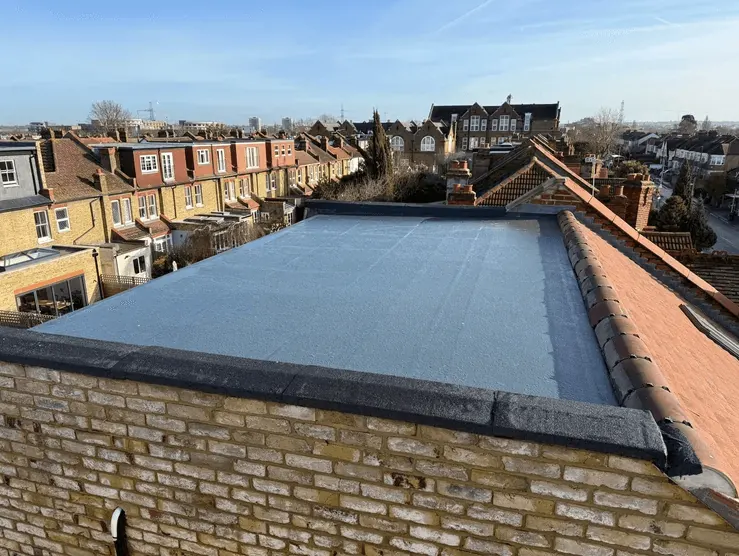
On roofs of this age and shape, the work that comes up is fairly predictable. Hip and ridge tiles lose their mortar bedding and start to rock. The small roofs over two-storey bays and porch canopies have flashing that tires before the main roof does. Shared stacks need lead and pointing. Flat roofs on rear dormers and extensions reach the end of their covering. Timber bargeboards on the gables rot from the ends. Our Lower Morden roof repair page goes through the hipped-roof faults in more detail.
A new roof is a different decision. If several of those faults are showing at once, and the felt in the loft is brittle or torn, it may be time to compare repair costs with a full re-roof. Our article on common roofing problems in Morden homes covers how the faults build up on houses of this era.
If you are not sure what state your roof is in, a roof inspection is the cheapest place to start. The drone photographs the rear slopes, the valleys behind the gables and the top of the stack without scaffolding, Simranjeet, our surveyor, goes through the pictures, and you get a plain account of what needs doing now and what can wait.
To arrange a visit, ring 0330 133 4111 or use our contact page. It helps to say whether the house is a semi, a maisonette or a converted loft, and roughly what you have noticed.
Frequently asked questions
Our Lynmouth Avenue maisonette shares a roof with the flat upstairs. Who arranges the work?
Your lease decides that. On many maisonettes the roof and gutters are shared, so both owners split the cost and agree the work. Either of you can ask us to look, and the photos from the inspection can go to both flats so you are working from the same information.
We live on the low ground by the Pyl Brook. Does that change anything on the roof?
Not the roof itself, which takes the same weather as the rest of the estate. What changes is the bottom of the system: on ground that drains slowly, a downpipe that is broken or empties beside the wall leaves water standing against the brickwork. When we look at your gutters we follow each pipe down to its drain.
We back onto King George's Playing Fields. Will the roof need more looking after?
Not necessarily more work, but a different pattern. Wind across open ground can work at ridge and verge tiles on the exposed slope, and the gutters on that side catch whatever blows across. A look at that slope after a big storm and a clear of the back gutters each autumn covers most of it.
Our house is on the 1980 estate around Derwent Road. Is it treated like the 1930s houses?
No. A roof from 1980 is roughly half the age of the semis around it, so we look at it on its own timetable. The checks are the same in principle, covering, ridges, flashings, gutters and the loft, but what we expect to find is different.





