



 Google reviews

Extension gutters meeting the 1930s line
Most of Lower Morden was built in the mid and late 1930s, and few houses of that age still have their original gutters. Merton's planners noted in a 2018 report on a Garth Road house that many homes nearby feature single-storey side extensions and gabled roofs. Each of those added its own length of gutter, fitted by whoever built it, at whatever date it went on.
The result on many semis is a run made in stages: an older length across the front, a newer section where the side was rebuilt, a low run along the extension, and perhaps a dormer gutter high on the back. Joints between runs of different ages are where leaks start. A half-round plastic run from the 1980s does not always meet a newer one of a slightly different profile cleanly, and the adaptor between them is often a bodge of sealant.
Where Lower Morden gutters let go
- The step down to the extension: where a side or rear extension roof drains into a gutter that joins the main run, the connection is often a short offset that pulls apart as the plastic moves with the seasons.
- Bay runs: the short gutters over two-storey bays have tight angles at both ends. A failed seal there drips onto the bay window or the porch roof below.
- Brackets: a bracket works loose or the screw loses its grip in the fascia, and the gutter sags. Water sits in the dip instead of reaching the outlet.
- Dormer outlets: on converted lofts, a dormer gutter often ends in a short pipe onto the roof below, and the connection at the top works loose.
- Downpipe sockets: offsets that have pulled apart send water down the brickwork rather than into the drain.
If the water is running down the wall behind the gutter rather than over the front, the fault is often the fascia or the line of the gutter against it. Our article on water leaking behind a gutter explains why.
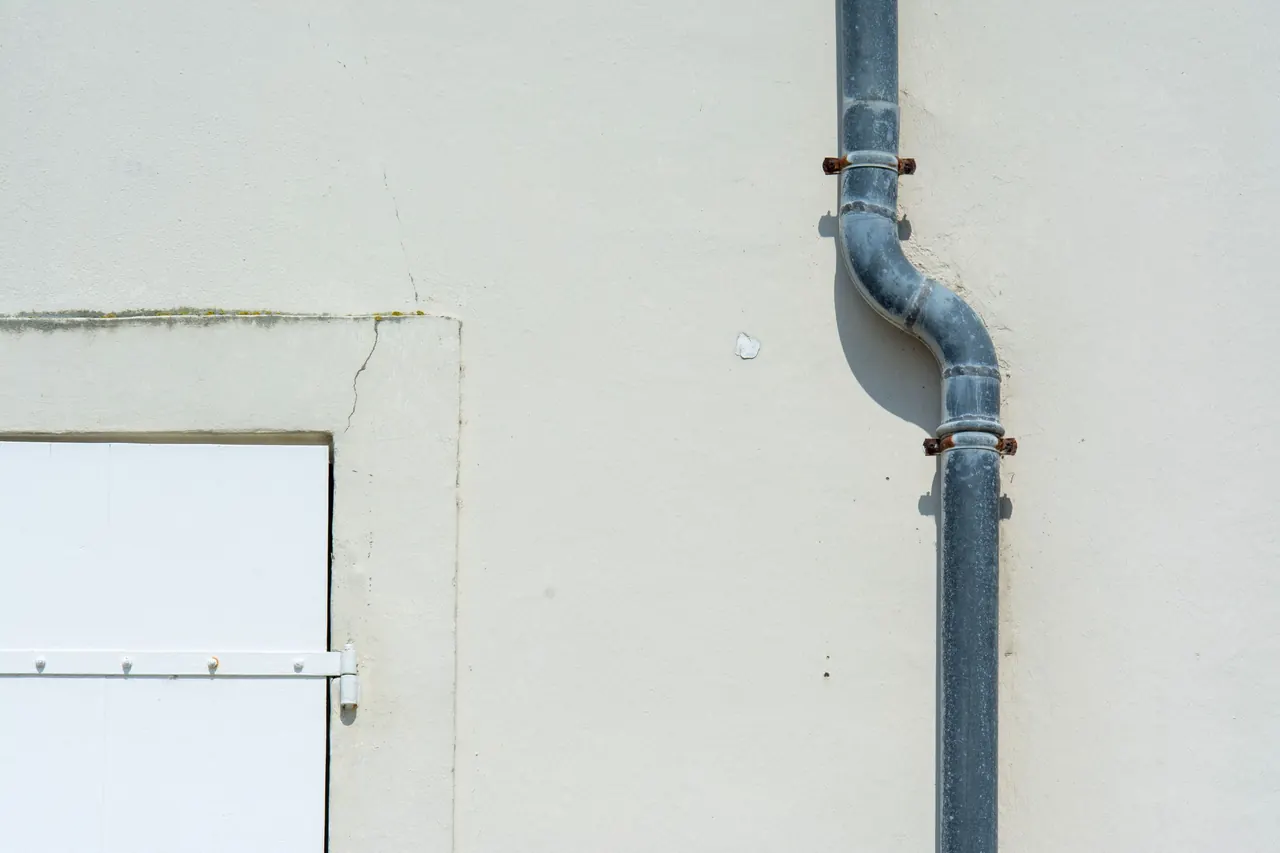
Repairing a run fitted in stages
The fix is usually small: the right adaptor between two profiles, a replacement angle, extra brackets, a reset fall, or swapping a cracked length for a matching one. The skill is in finding the right join, because water can run along the back of a gutter for a metre before it drips. We follow it back to where it gets out, rather than sealing the spot where it lands.
As a national average, MyJobQuote gives around £215 for a gutter repair, with access and the number of faults making most of the difference.
If the run is brittle, a patchwork of profiles, or leaks somewhere new every winter, replacing it in one go makes more sense, and our Lower Morden gutter installation page covers that. The main gutter repairs page lists the repairs we carry out.
Frequently asked questions
Our new extension gutter on Kingsbridge Road meets the old run and leaks at the join. Why?
The two are often different profiles or sizes, and the connection was made with whatever was to hand. Fitting the correct adaptor, or replacing a short length so both runs match, normally cures it.
The dormer gutter on our Garth Road loft drips onto the extension roof. Is that a repair or a new pipe?
Usually a short new pipe. A dormer gutter that empties straight onto a flat roof wears the covering at that spot and splashes onto the walls. A downpipe from the dormer to the main gutter or the drain stops both, and the repair to the flat roof, if any, is small.
Water drips from the gutter over the bay on our Lower Morden Lane semi. Is it the gutter or the bay roof?
Often the gutter angle at one end of the bay, which is easy to reach and quick to fix. If the drip carries on in dry weather after rain has stopped, the bay roof flashing above may be feeding it, and we check that at the same visit.





