



 Google reviews

A terrace changed one house at a time
When Sutton reviewed the Longfellow Road Area of Special Local Character, its 2009 Heritage Study noted how much the 1860s terraces had changed: painting, rendering, pebble-dashing and new windows, applied differently from house to house along the road. Gutters on a row like this can follow the same pattern: where one house has kept cast iron and the next has gone to a plastic half-round or a square profile, the two meet at the party wall.
That meeting point is a common place for a terrace gutter to leak. Two different profiles never sit perfectly together, and a joint bodged with sealant years ago dries out and opens. The fix is a proper adaptor between the two systems, or a short matched length either side, set so water falls away from the join rather than towards it.
On the rendered and pebble-dashed houses, the leak also shows faster. Water from a failed joint leaves a dark streak and then green growth on the coating, and over time it gets behind the render and cracks it, so an early repair saves patching the wall later.
Cast iron on the Victorian houses
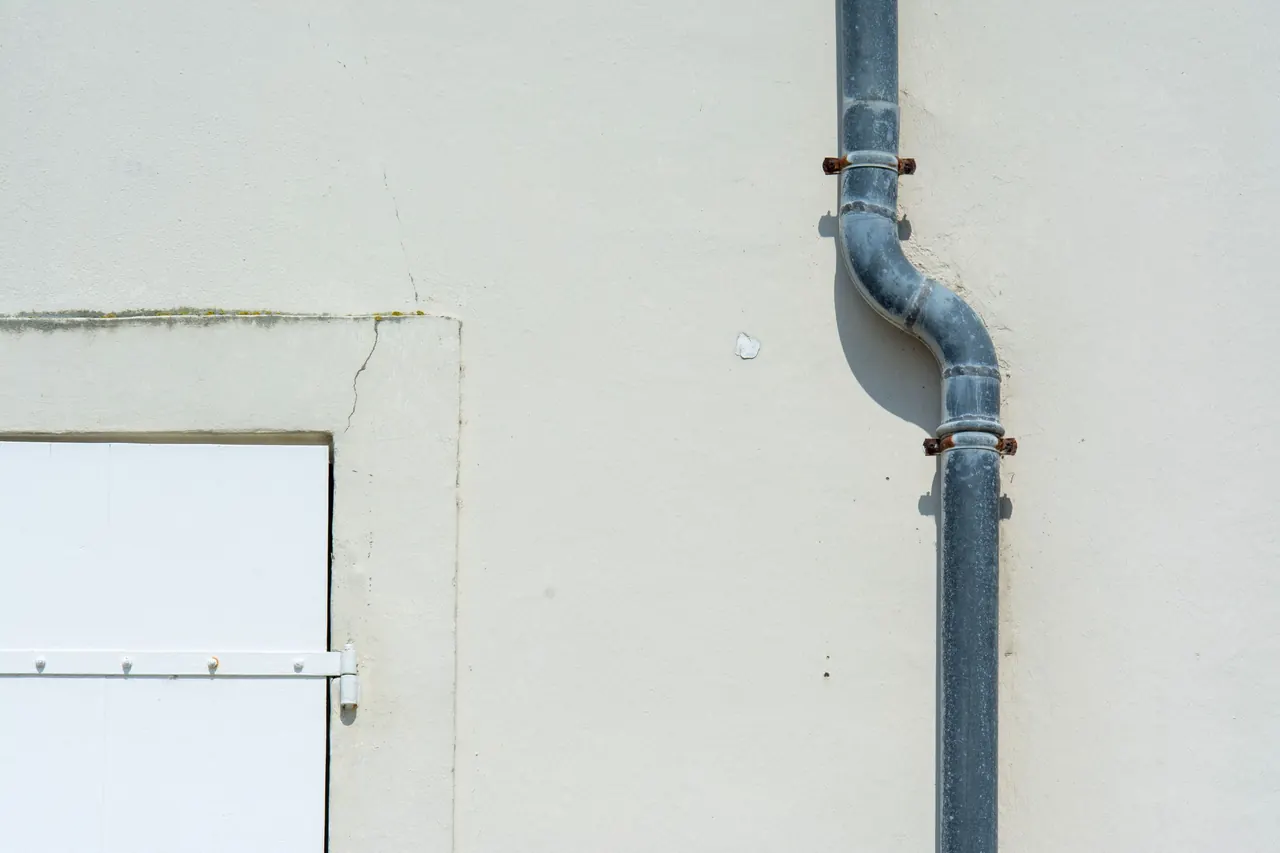
Where a Longfellow Road house still has cast iron gutters or downpipes, or sections of them alongside later plastic, they are usually worth keeping. Cast iron lasts a very long time when it is painted and kept clear, but its weak points are the bolted joints, which rust and open, and the brackets, which corrode where they are fixed into the wall or rafter feet. A cracked length can be replaced with a matching section and joints can be remade, so a sound cast iron run does not have to come down because one part has failed.
Where one downpipe serves two houses, a fault in the shared section affects both, so it is worth a word with next door before booking.
Plastic gutters on the interwar semis
On the 1930s semis that fill most of North and South Worcester Park, the gutters are usually plastic replacements, and many of those are now old themselves. The rubber seals in the union joints dry out and leak, brackets work loose so a run loses its fall and holds water, and stop ends and corner pieces crack after years of sun. Faults often start at the corners, where two slopes empty into one fitting.
A repair visit covers the whole run, not just the drip, because a sag at one end can come from a failed bracket several metres away. As a guide, MyJobQuote puts the average gutter repair at around £215. If the run is brittle and cracked in several places, or the fascia behind it is soft, a new gutter installation in Worcester Park is the better buy.
Above the shops and on The Hamptons
Over the Central Road shops, the gutters serve flats and the shop below, and the freeholder or managing agent is normally responsible for them. A leaking gutter there often shows as staining around an upstairs window or above the shop sign. At The Hamptons, the gutters are much newer, and repairs are usually about a single joint, a bracket that has given way under a load of leaves, or a downpipe knocked loose. If water is getting behind the gutter rather than over it, our article on water leaking behind the gutter explains why, and the main gutter repairs page has more detail.
Frequently asked questions
Next door on our Longfellow Road terrace has a different gutter profile, and the join leaks. Can the two be joined properly?
Usually, yes. There are adaptors made to join many common profiles, including cast iron to plastic. Where no adaptor fits, a stop end on each side with a shared outlet or a short downpipe at the party wall can take the water away. Either way, next door needs to agree, since half the join is theirs.
I own a flat over a Central Road shop and the gutter leaks by my window. Can I book the repair myself?
Check your lease first. The gutters are usually part of the structure the freeholder looks after. Report it to the managing agent in writing. If they ask you to arrange it, we can quote and send the invoice to whoever is responsible.
The gutter on our Hamptons house has sagged next to the downpipe. Is it worth repairing on a system this new?
Yes. On a newer system it is usually one bracket that has failed or was spaced too wide, and a sag next to an outlet is often where leaves have built up and added weight. We clear it, add or refix brackets and reset the fall.





