

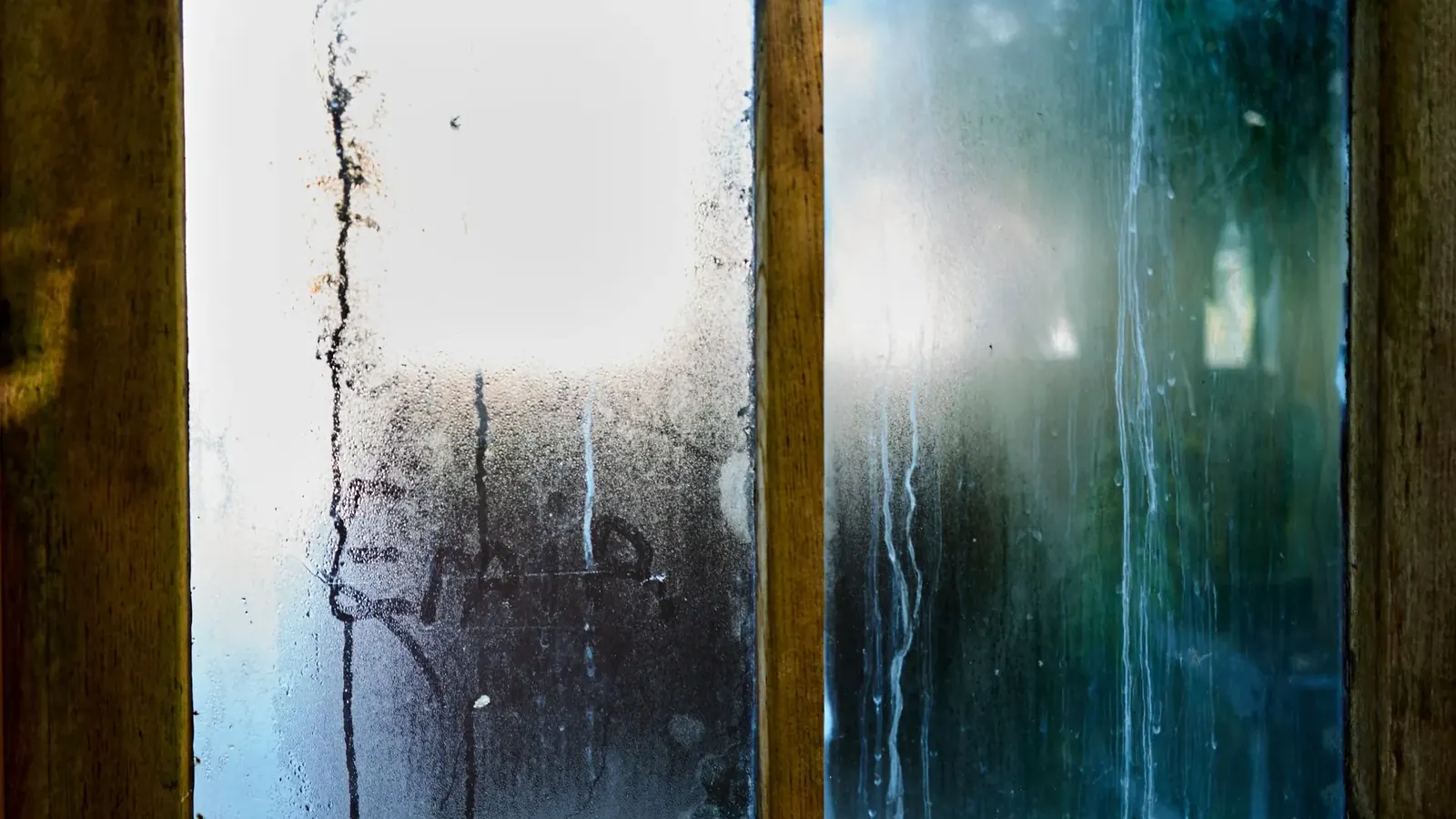
Condensation in loft spaces shows as damp spread across the underside of the roof, droplets or frost on nail tips and black mould on timbers, worst on cold mornings whether or not it rained. A roof leak is usually one patch or trail that appears during or soon after rain. If the damp follows the rain, suspect the roof; if it follows the cold, suspect condensation.
In short
- Condensation spreads across both slopes and shows on cold mornings, rain or not; a leak is one patch or trail that follows rain
- Thicker loft insulation keeps the roof space colder, which can increase condensation
- Bathroom fans should extract to outside, at least 15 litres per second under Approved Document F
- Keep eaves ventilation clear and the loft hatch sealed
Both can happen in the same loft, and both can stain a ceiling, so it is worth checking properly before paying anyone to fix the wrong thing. If water is already coming through a ceiling, call us on 0330 133 4111 at any hour and we will talk it through.
Condensation in loft spaces or a roof leak: the quick test
Go into the loft with a good torch, standing or kneeling only on the joists or on boarded areas. Look at the underside of the roof slopes, the timbers, the nails and anything stored up there, then compare what you see with this table.
| What you see | Points to condensation | Points to a roof leak |
|---|---|---|
| When it appears | Cold nights and mornings, often after a sharp drop in temperature, rain or not | During or within hours of rain, especially wind-driven rain |
| Where it appears | Across large areas of both slopes, often worst on the north-facing side | One spot or a trail running down from a single point |
| Nail tips | Droplets, frost or rust on the tips of many nails through the battens | Usually dry apart from those right under the wet area |
| Timbers | Black mould spotting along rafters and the sarking boards or felt | Dark tide marks and staining below one point, sometimes soft timber |
| Insulation | Damp on the surface in places, musty smell throughout | A sodden patch directly under the drip |
| Daylight | None | Sometimes a chink of light at a slipped tile or failed flashing |
| Pipes and tanks | Sweating on cold pipes, tanks and extract ducting | Not usually affected |
A simple test helps if you are still unsure. Lay a dry sheet of plastic or newspaper on the insulation under the damp area and check it after the next dry, cold night, then again after the next rain. Wet after the cold night with no rain points strongly to condensation.
Why condensation forms in a loft
Everyday living puts a lot of water into the air: showers, cooking, drying washing and simply breathing. That warm, moist air rises and finds its way into the loft through the ceilings, and when it meets the cold underside of the roof it turns back into water. The NHBC's guidance on condensation in the roof space notes that vapour gets in through gaps around cables, pipes, loft hatches and downlights, and that most cases happen when it turns cold or there is a big drop between day and night temperatures.
The same guidance makes a point that surprises many people: thick loft insulation keeps the house warm, but it also keeps the roof space colder, which can increase the risk of condensation. That is why a loft that was dry for decades can start dripping in the first winter after a top-up of insulation, especially if the new quilt has been pushed into the eaves and blocked the air paths.
The usual causes are:
- Blocked eaves ventilation. Insulation stuffed tight into the eaves stops outside air flowing through the roof space.
- Bathroom or kitchen fans venting into the loft. An extractor that blows into the roof space, or a duct that has come apart, dumps steam straight onto cold timbers.
- An unsealed loft hatch. A loose or unlined hatch above a landing acts like a chimney for warm, damp air.
- Old bitumen felt with no ventilation. Many older roofs were felted with an underlay that does not let vapour through, and some were never given eaves or ridge vents. By contrast, the NHBC notes that some roofs need no separate ventilation because the underlay lets water vapour pass through to the outside.
- Drying washing indoors. A rack of wet clothes in winter puts a lot of water into the air, and some of it ends up in the loft. The NHBC suggests that if you have to dry clothes indoors, you open the window and close the door of that room.
How to reduce condensation in the loft
Most loft condensation can be brought under control by cutting the moisture coming up from the house and letting the roof space breathe. Work through these in order, cheapest first.
- Check where your extractor fans go. Follow the ducting in the loft. Approved Document F says bathrooms and kitchens should have extract ventilation to the outside, and sets a minimum intermittent extract rate of 15 litres per second for a bathroom (Approved Document F, Volume 1, 2021 edition). A fan that stops in the loft needs extending to a roof or soffit vent, which is usually a small job.
- Use the fans properly. The NHBC suggests keeping the extractor on, or the window open, for about 20 minutes after a bath, shower or cooking, with the door closed.
- Seal the loft hatch. Fit a draught seal around the hatch and keep it closed. The NHBC advises against leaving it open for long periods.
- Clear the eaves. The NHBC explains that many pitched roofs have a ventilation slot along two opposite eaves so air can flow across the roof space, and that these must not be blocked. Pull insulation back from the eaves so air can pass, or fit plastic eaves ventilation trays between the rafters to hold it clear. Our guide to loft ventilation and soffit vents explains the options.
- Add ventilation where there is none. Which? suggests roof ventilation tiles and ventilated soffits to let air through the loft. On older roofs these are fitted from outside, which is roofing work.
- Keep the loft clear. Boxes packed against the roof slopes block airflow, and the NHBC notes stored items can be damaged by condensation.
A rule change is worth knowing about. At the time of writing (November 2026), the 2021 edition of Approved Document F is the one in force. A 2026 edition has been published that takes effect on 24 March 2027 for most work in England, and it keeps the same 15 l/s bathroom figure.
Black mould in the loft: how worried should you be?
Spotty black mould on rafters and sarking boards is the classic sign of long-running condensation. On its own it is usually a surface growth rather than rot, but it tells you the timbers are getting wet often enough to matter. If the wood is soft when pressed with a screwdriver, or crumbles at the surface, the problem has gone further and the affected timber needs looking at.

Mould in the house itself is a health issue. Government guidance on damp and mould says they primarily affect the airways and lungs, and that older people, children and anyone with a weakened immune system are at greater risk. Mould in the loft is less direct, but if it is spreading onto bedroom ceilings below, deal with the cause rather than painting over it.
Wear a dust mask and gloves if you are cleaning mould off timbers, and fix the moisture source first or it will come back within a winter.
When the wet loft is the roof after all
Sometimes the checks point the other way. These are the signs that rain, rather than condensation, is getting in:
- The damp follows the weather. It turns up in heavy or wind-driven rain and dries out in a dry cold spell.
- It is in one place. A single wet area near a chimney, a valley, a roof window or a wall junction is far more likely to be a leak.
- There is a trail. Water running down a rafter or along the felt from one point higher up.
- You can see daylight. Any light coming through means a gap in the covering.
- The underlay has failed. Old felt that has torn, sagged between rafters or turned brittle at the eaves lets in any water that gets past the tiles. Our guide to breathable roof membranes explains when it needs renewing.
Our step-by-step guide to finding a roof leak covers tracing the water back to where it gets in. If you have a stain on a ceiling and are not sure whether it is the roof, plumbing or condensation, read our guide to a water stain on the ceiling.
What to do next, and when to call a roofer
The jobs you can safely do yourself are all inside the house and loft: rerouting or checking extractor ducting you can reach, sealing the hatch, clearing insulation from the eaves, cutting down on drying washing indoors and keeping lids on pans. Give those a few weeks of cold weather before deciding they have not worked.
Call a roofer when:
- the damp is in one place or follows the rain, which means a leak is likely;
- the roof has no eaves or ridge ventilation and needs vents or vent tiles fitting from outside;
- the felt is torn, sagging or crumbling;
- timbers are soft, or the mould keeps coming back despite the fixes above.
Do not go onto the roof yourself to look for a cause, particularly in wet or icy weather. Our roof inspection covers the loft and the outside of the roof together, using a drone where slopes are hard to see, so we can tell you whether it is condensation, a leak or both. If it is a leak, our roof repair team can usually put it right without disturbing the rest of the roof.
Frequently asked questions
Is some condensation in the loft normal?
A little, in the coldest spells, is common and not usually harmful, especially in a well-insulated loft. The NHBC says most cases are temporary. It becomes a problem when it is heavy enough to drip, soaks the insulation, causes mould on timbers or keeps returning through the winter. If any of those apply, the moisture coming from the house or the ventilation in the roof needs dealing with.
Can condensation in the loft drip through the ceiling?
Yes. In a bad case water runs down the underside of the felt or drips from nail tips onto the insulation, and it can soak through to the ceiling below, leaving a stain that looks just like a leak. The giveaway is timing: condensation drips show up on cold, dry mornings, and you often find damp in several places rather than one.
Does a dehumidifier in the loft help?
It can dry things out in the short term, but it treats the symptom. A loft is meant to be ventilated to the outside air, and a dehumidifier there is working against the weather. Cutting moisture at the source, sealing the hatch and getting extract fans to vent outside usually does more, and costs less to run.
Why did condensation start after new loft insulation?
Thicker insulation keeps more heat in the rooms below, so the roof space gets colder and moisture condenses more easily. If the installer also pushed insulation into the eaves, the air paths that kept the loft dry may now be blocked. Pulling it back or fitting eaves trays usually solves it.
Who do I call for condensation in the loft?
If the cause is inside the house, such as a fan venting into the loft, an electrician or ventilation installer can fix the ducting. If the roof itself needs vents, the felt has failed or there may be a leak as well, a roofer is the right call, because those jobs are done from the outside of the roof.
Getting a damp loft looked at in Morden and nearby
Precise Roofing & Guttering is a family run roofing firm on Kenley Rd in Morden, working across south-west London and north Surrey. When you call, we ask what you have seen and when, then arrange a visit to check the loft and the roof, with a drone inspection where it helps. Quotes are free and often the same day, our work carries a 10 year guarantee, and OAPs get 20% off. Call 0330 133 4111 or request a free quote online.



 Google reviews
