



 Google reviews

From Sutton Heath to the Sutton Common Road ridge
Before it was enclosed in about 1810 to 1812, this was open common, known earlier as Sutton Heath. Its heavy clay made it poor farmland, so it was used for grazing and for cutting peat, turf and timber. The enclosure award kept a small part back as a recreation ground at Sutton Green. Through the 19th century large villas went up on the old common, and several have since gone. Fairlands was demolished in the 1920s to make way for Reigate Avenue and is remembered in Fairlands Road. Aysgarth is now a block of flats, Aysgarth Court.
The houses most people live in arrived between the wars. Sutton Common station opened on 5 January 1930, the first Blenheim Road houses were approved in 1932, and by 1937 the terraces of Broomloan Lane had replaced two old villas by Clensham Lane. Apart from a few Victorian and Edwardian houses, most roofs here date from the 1930s or later, and a 1930s roof can still be on its original covering or only its second.
The district follows Sutton Common Road, which runs along a ridge between the Pyl Brook to the south and the East Pyl Brook to the north. Benhilton lies to the east and Lower Morden and Morden Park to the west. Homes south and east of Oldfields Road (the A217) have SM1 postcodes and those north and west have SM3. Our base on Kenley Rd in Morden is under 2 miles away.
The Hallmead Farm Estate by the station
The best known houses in Sutton Common are the semis of the Hallmead Farm Estate: Blenheim Road, the pedestrian Coombe Walk, part of Hallmead Road and five pairs on Sutton Common Road. They were built by J.B. Greene, sold through Soar and Soar, and advertised as 'country cottages' with easy access to the new station. The estate is an Area of Special Local Character, described in the Hallmead Farm Estate character appraisal prepared by residents with Sutton Council in 2021.
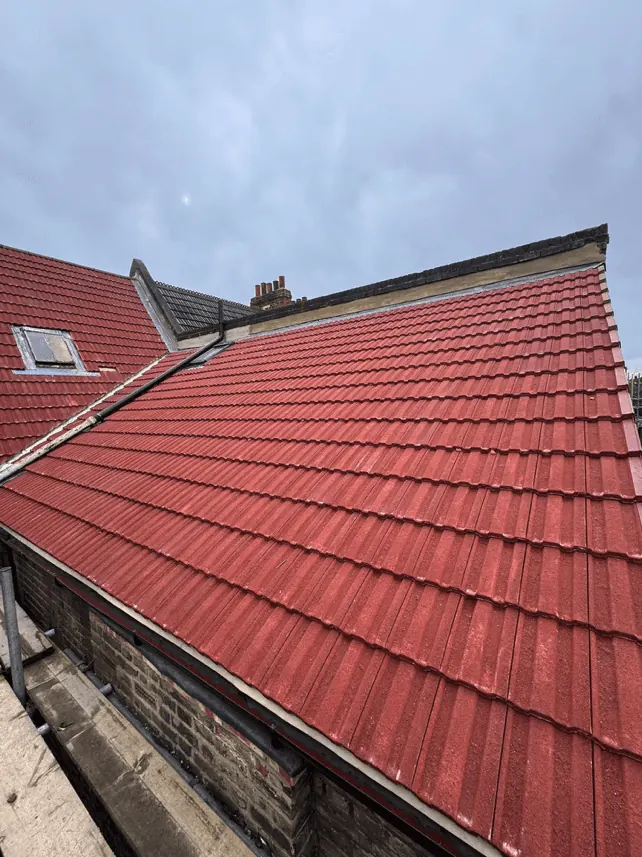
Their roofs are what set them apart. The appraisal describes high roofs with Dutch hip ends, where a small section of each gable is replaced with a little hip, all in red clay plain tiles. The same tiles cover the pitched roof over each semi-hexagonal front bay and the portico-style canopy over the side door. So one house can have three or more separate roofs, each with its own flashing, gutter and junction to look after.
The designation does not remove permitted development rights. The checklist the council applies does ask owners to keep the Dutch hipped style and to use tiles that match the roof, bay and canopy, and residents named changes to roof lines among their concerns. When we repair or re-cover one of these roofs, we keep the hip shape and match the clay tile. Our roof repair page for Sutton Common goes into the details, and re-roofing in Sutton Common covers full replacements on the estate.
Semis, terraces and 1930s flats beyond the estate
Most of Sutton Common is not the Hallmead estate. The appraisal notes that from the late 1930s the estate was followed by semis on both sides of Sutton Common Road that mostly do not share its style. Hamilton Avenue, Oldfields Road and Stayton Road were built between the wars too, and so was most of the ground west of Ridge Road and Forest Road towards Stonecot Hill, at about the same time as the St Helier estate but with less of a single design.
- Later 1930s semis, usually with plainer hipped roofs, and on many a loft dormer or rear extension added since. The joins between old and new roofs are where leaks tend to start.
- Terraces such as Broomloan Lane, built by 1937 on the site of two old villas at Clensham Lane, where one gutter line and one roof slope run across several houses.
- Purpose-built flats, which make up a large part of the area. Some are 1930s, such as Highfields on Sutton Common Road, listed on the UK Modern House database as a staggered terrace of rendered flats with curved bays. Our page on flat roofing in Sutton Common covers block roofs and the extension roofs behind the semis.
- Older houses: a few Victorian and Edwardian houses survive along Sutton Common Road and near Sutton Green, often with tall stacks that have been repaired many times. Chimney repairs in Sutton Common explains how we treat them.
Shops are scattered rather than gathered on a high street: around the station, by Glenthorne High School, near the Ridge Road roundabout and at Stonecot Hill. Where a shop trades below, the roof work is planned around its opening hours.
Clay ground, park trees and the railway cutting
Clay and downpipes. The Pyl Brook rises in Sutton Common near Stayton Road and Pylbrook Road, and the ground is heavy clay. Water that spills from a blocked gutter soaks into clay slowly, so we check where each downpipe ends when we look at the gutters.
Trees. Sutton Common Park has mature trees along its boundary with Sutton Common Road. The railway runs in a deep cutting beside Blenheim Road with trees along its banks, and many Hallmead gardens still have fruit trees thought to be left from the farm's orchard, which drop blossom in spring as well as leaves in autumn. Our gutter cleaning page for Sutton Common covers how that changes the timing.
Slopes. Blenheim Road falls steeply from the station, and some streets off the ridge are linked by stepped footways. That decides where a ladder, tower or scaffold can go, and it is one reason we often start with a drone inspection, which needs none of them.
Frequently asked questions
Is my house in the Hallmead Farm Estate, or just near it?
The estate covers houses in Blenheim Road and Coombe Walk, part of Hallmead Road and five pairs of semis on Sutton Common Road. Similar cottage-style houses on Clensham Lane are outside it. If you are unsure, the appraisal includes a map, and we can check when we visit.
Our 1930s house west of Forest Road went up when St Helier did. Will its roof be like the St Helier cottages?
Not necessarily. The streets west of Ridge Road and Forest Road went up at about the same time, but they were not part of the London County Council's St Helier estate or built to one plan, so roofs vary from one street to the next. We look at your own roof rather than assume.
We live in one of the Victorian houses by Sutton Green. Is its roof treated differently from the 1930s semis?
Often, yes. An older house may have natural slate or an early clay tile, and a stack built with soft bricks and lime mortar. We repair it in materials that suit its age, rather than the concrete tiles and cement that suit a later house.





