



 Google reviews

Brocklesby's stacks on Mostyn Road and Watery Lane
Merton Council's character assessment photographs several of Brocklesby's chimneys and picks out the brickwork on each. At 17 Mostyn Road, a tall brick stack has his characteristic detailing at the top. At 29 Mostyn Road, a tall slim chimney carries a projecting vertical line of bricks up its face. At 17 Watery Lane, the house he designed for his own family, a tall chimney projects from the wall with patterned brickwork at its head. At 78 Church Lane the chimney brickwork is detailed in the same way.
Quartermain's stacks are just as distinctive. The assessment records tall angled and paired brick chimneys at 9 Sheridan Road, and substantial chimneys with brick detailing at the top on 12 Mostyn Road and 56 to 57 Church Lane. The council's design guide says the stacks, with their corbelled brick courses and terracotta pots, are an important part of the skyline here.
Where the water gets into a decorated stack
The patterned top of a chimney is the most exposed brickwork on the house. Projecting courses and corbels hold rain on their upper faces, and once the mortar between them washes out, water soaks into the stack and works down inside. The first sign is often a stain on the chimney breast upstairs, or crumbs of mortar in the gutter below.
The other usual faults are the same as anywhere: lead flashing that has lifted where its mortar joint has gone, old sand and cement fillets cracking away from the brick, and flaunching round the pots that has split and lets water in at their base. On a tall stack, all of these are harder to see from the ground, so we photograph every face by drone before quoting. That also tells us whether the work can be done from roof ladders or needs a scaffold round the stack.
Repointing and rebuilding to the original pattern
The design guide asks that repointing match the original in method and mortar mix, and that it only be done where the old pointing has badly decayed. On a decorated stack we rake out only the joints that need it and repoint to match the existing joints, so the brick pattern still reads from the street.
Where the top courses have loosened, we take them down carefully, keep the sound bricks, note the pattern, and rebuild it course by course. The pots are rebedded on new flaunching. The guide also asks for flashings in lead fitted by an experienced contractor, and for sand and cement upstands to be avoided, so failed cement fillets are replaced with dressed lead.
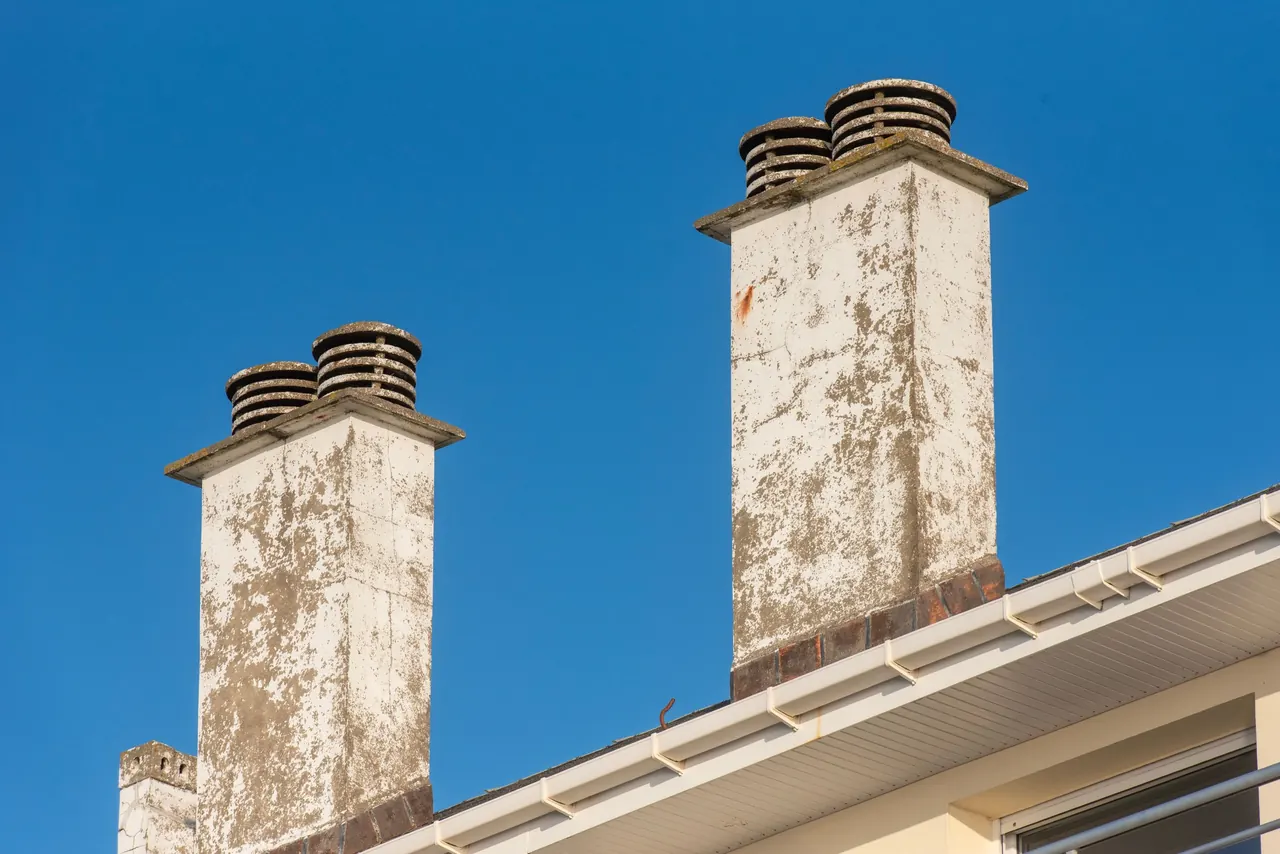
If a flue is no longer used, the guide says the stack should be kept and the pot can be capped as long as air can still move through it. We fit ventilated caps on disused pots and a cowl suited to a working flue on one that still serves a fire or stove.
MyJobQuote's chimney flashing guide gives £150 to £250 for a patch repair and £350 to £460 for full leadwork without scaffolding as national guide figures; most tall stacks here will need a scaffold on top.
The plain stacks on the 1920s and 1930s streets
The mid-1920s semis on Mostyn Road and the late 1920s and 1930s houses round Circle Gardens have simple chimney stacks, as Merton's Merton Park character study describes them. These are shorter and easier to reach, and often the flashing or a cowl can be done from roof ladders. On a pair of semis the stack usually sits on the party wall, so it is worth telling next door before work starts. Once the stack is sound, the tiles round it are covered by our Merton Park roof repairs, and our chimney maintenance guide lists what to check each year. Further north, our Wimbledon chimney repairs page covers the taller Victorian stacks there, and leadwork, flaunching and cowls are explained on the chimney repairs page.
Frequently asked questions
The patterned brickwork at the top of my Mostyn Road stack is crumbling. Can it be rebuilt the same way?
Yes. We photograph and note the pattern before taking anything down, keep every sound brick, and rebuild the courses to match. Where bricks are broken, we look for the closest match in size and colour.
My Sheridan Road house has paired stacks. Do both have to be done at once?
Not always, but if one needs a scaffold, it is usually cheaper to deal with both while it is up. The drone photos show whether the second stack needs work yet.
Why does the council's guide say no to cement fillets round my Church Lane chimney?
Cement is rigid and cracks as the stack and roof move, and water then runs in behind it. Lead moves with the building and lasts much longer, which is why the guide asks for it.





