



 Google reviews

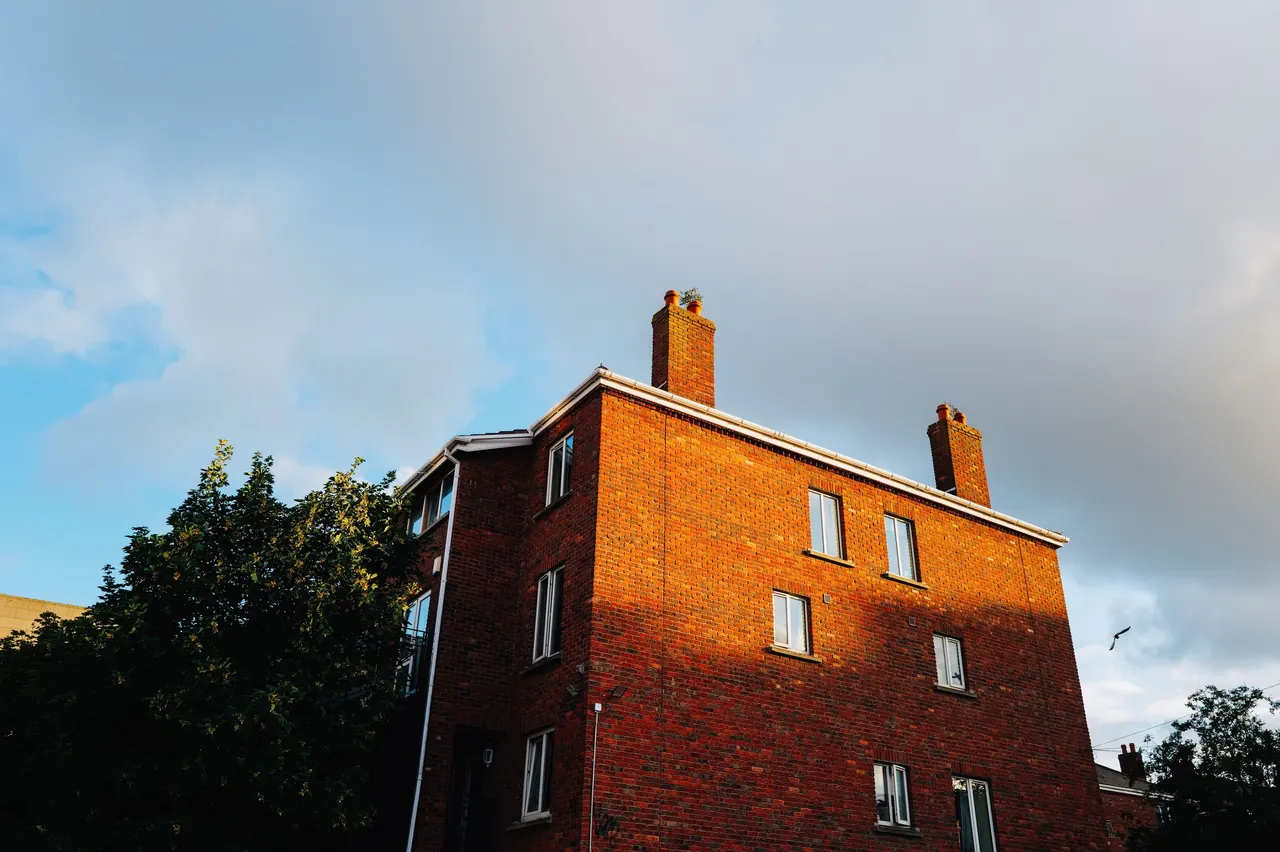
The very tall stacks at Queen Alexandra's Court
Queen Alexandra's Court on St Mary's Road is a set of four residential blocks around a garden quadrangle, built from 1904 to designs by Ernest George and Yeates, and each block is Grade II listed. Merton's character assessment for the conservation area describes steep hipped roofs in green slate, punctuated by very tall and massive brick chimneys, above heavily dentilled stone eaves.
A stack that tall and that heavy takes the weather. Rain driven against it soaks into the brickwork and mortar, frost opens up the joints near the top, and the lead at the base has to seal a large brick mass against green slate that cannot easily be replaced. Because the blocks are listed, any alteration needs listed building consent from Merton. Like-for-like repairs, such as repointing in a matching mortar or renewing lead to the same lines, are the usual route, and we agree the detail with whoever manages the building before starting.
There are other big stacks nearby: on the pair of large houses from around 1890 at 6 and 7 Lake Road, and the five tall chimneys on the front of the pre-war school building on Mansel Road.
Party-wall chimneys on the 1881 shop terrace
Down in the town centre, the 30 to 56 Wimbledon Hill Road terrace works differently. Its party walls break up through the plane of the slate mansard, and the chimneys sit on top of them. Each stack straddles two units, so the lead on each side can belong to a different owner.
Water getting in where a party wall rises through the mansard can travel along the wall and show in either building. A stack over a shop is also directly above a busy pavement, so cracked flaunching or a loose pot is a public hazard as well as a leak. Where work affects both sides, the Party Wall etc. Act 1996 may apply, and we can photograph both sides so each owner sees the same thing.
Angled Tudor stacks and coped gables up the hill
On the residential streets, some chimneys are as much decoration as flue. 22 Raymond Road, an arts and crafts house of 1892, has a pair of Tudor-style brick chimneys set at an angle to the building. Angled stacks have more corners to flash, and each corner is a place where lead can lift. At 10 Malcolm Road, from 1894, the walls of the gables rise above the roof and are capped with coping stones, so the roof meets brickwork along each gable as well as at the chimney. The joints in those copings, and the fillets where the tiles meet the gable wall, behave much like a chimney abutment.
On stacks like these the usual work is redressing or renewing lead at the corners, repointing in a mortar that suits the old brick, and rebedding pots where the flaunching has cracked. Our article on chimney flashing problems in Wimbledon explains what you can spot from the ground.
On houses this high, a drone look at the pots, flaunching and lead before anyone pays for scaffold is worth having, and you can book that as a roof inspection in Wimbledon on its own. For a sense of cost, MyJobQuote's chimney leadwork guide gives national figures of £350 to £460 for full leadwork replacement without scaffold and £700 to £920 with it. If a leak turns out to be in the slopes around the stack rather than the stack itself, it runs on as a Wimbledon roof repair.
Frequently asked questions
My flat is in Queen Alexandra's Court. Can chimney repairs go ahead without listed building consent?
Like-for-like repairs that match the original materials usually can. Anything that alters the stack, such as taking it down, changing its height or using different materials, needs consent from Merton. The freeholder or managing agent should confirm before work starts.
Water runs in along the coped gable on my Malcolm Road house. Is that the chimney?
Not always. On a gable that rises above the roof, the joints in the coping stones and the junction with the tiles can leak in the same way a stack does. We check the coping, the fillet and the lead before deciding.
The angled chimneys on my Raymond Road house have lead lifting at the corners. Can that be redressed?
Often, if the lead itself is sound. Each corner of an angled stack needs its own fold of lead, and we redress or renew those pieces rather than smear sealant over them.
A pot on the stack above my shop on Wimbledon Hill Road is leaning. What happens next?
It should be looked at quickly, because it is over the footway. We secure or lift the pot, then reset it in new flaunching once the stack has been checked.





