



 Google reviews

Flat-topped bays on Mansel Road
Staining on the ceiling inside a bay window, or soft paint on the head of the window frame, usually means the little flat roof above it has let go. On Mansel Road there are a lot of those. Merton's conservation appraisal records square-plan bays with flat roofs at 1 and 3 and at 9 and 11, single-storey flat-roofed canted bays at 2 and 4, and flat-roofed bays again at 12, 14 and 16. These houses date from 1888, so whatever is on top of the bay now has probably been replaced several times.
A bay roof is small but it carries a lot of water. Rain from the wall above runs down onto it, and the joint where the covering turns up the brickwork is where it fails. Re-covering a bay roof is a self-contained job: strip the old covering, check the deck, re-cover, and dress a new upstand and flashing into the wall. On a single-storey bay, scaffold is rarely needed, and most of the effort goes into the upstand and the edge detail rather than the flat area itself.
For a guide to cost, Checkatrade's flat roof cost guide gives national figures of £95 to £120 per square metre plus VAT for a new GRP fibreglass roof and £80 to £100 for EPDM rubber. On a bay of a few square metres, the access, the strip-out and the flashing make up much of the price.
Dormers and oriels on Malcolm Road
Higher up, Malcolm Road has a run of flat roofs on houses built between 1897 and 1901. 12 and 14 have large flat-roofed dormers on the front slope. 16, from 1897, has a flat-roofed dormer, a first-floor oriel with a flat roof and a small pediment, and two ground-floor bays that are both flat-roofed with a raised cornice. 19, 21 and 23 each have a two-storey flat-roofed canted bay.
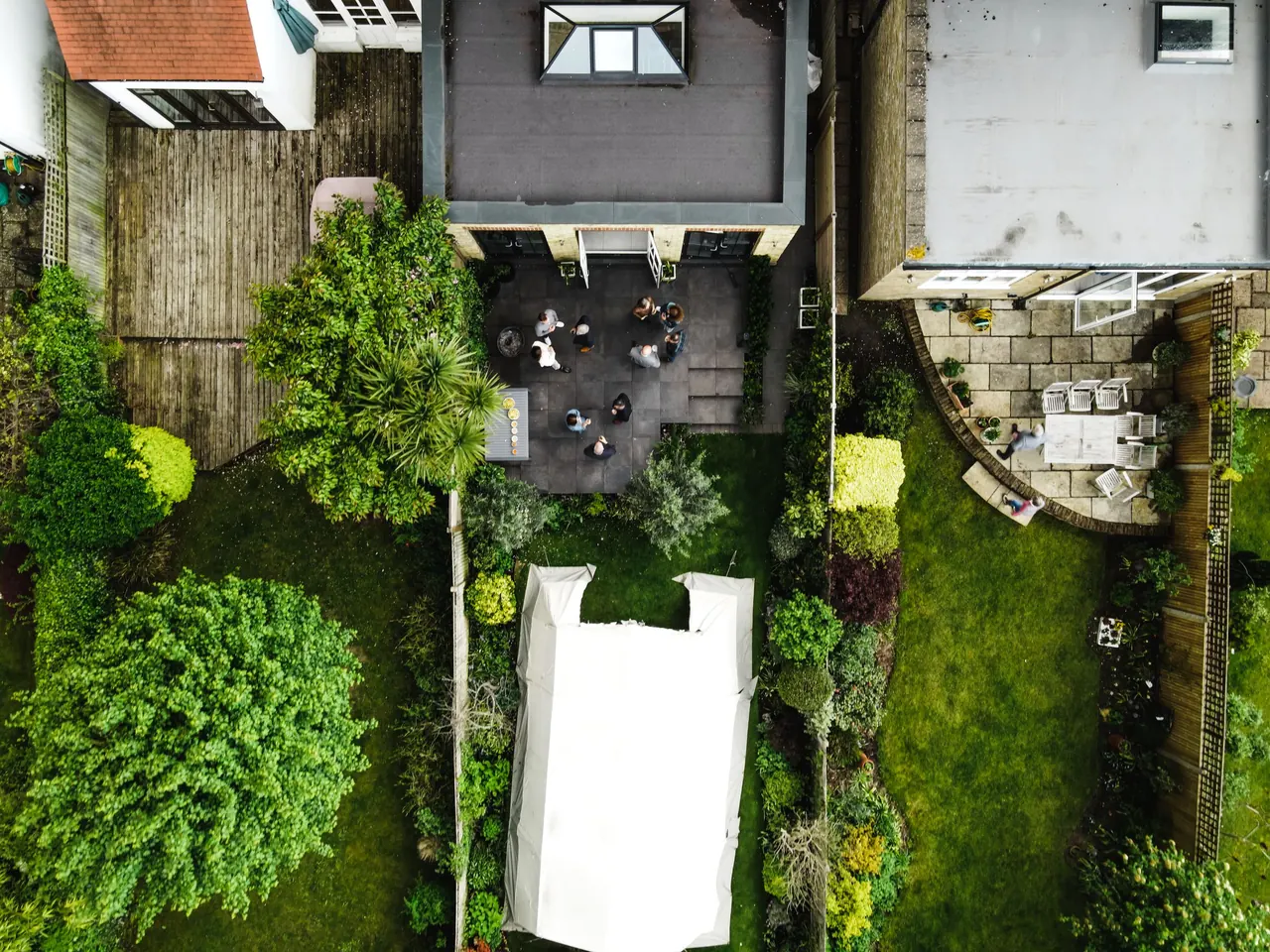
Dormer and oriel roofs are high and exposed, and you cannot see them from anywhere in the house. A failure usually shows first as a damp patch in the room inside the dormer. Our roof inspections in Wimbledon use a drone to photograph them, so you can see the covering before deciding whether a repair or a new covering is needed. On an oriel the cost is mostly in safe access to that height, which we plan before quoting.
Not every small roof here is felt. A curved bay at 76 Woodside is roofed in lead, and a bay at 20 Malcolm Road in rounded copper panels. Those are original features in the conservation area, and we would talk to you about repairing them in the same metal before suggesting any change.
Which covering suits a small, awkward roof
We work in three systems. GRP fibreglass is laid as a seamless finish, which suits small roofs with awkward shapes, such as canted bays, oriels and dormers with a pediment or cornice to work around. EPDM rubber is a single membrane, which suits larger, simple roofs such as a rear extension. Torch-on felt is the familiar option and a sensible like-for-like replacement where a felt roof has done well. Whichever you choose, it lasts only as long as the deck under it and the fall that takes the water away.
The town also has whole flat-roofed blocks, such as Swan Court at 2a Mansel Road and Wellington House on Wimbledon Hill Road, both from the 1970s. On roofs that size, drainage is everything, and a blocked outlet behind a parapet can fill the whole roof. Where the problem is in the gutter or downpipe below, it runs on as a blocked gutter repair in Wimbledon, and our guide to standing water on a flat roof explains when ponding matters.
Frequently asked questions
Can the flat roof on my Mansel Road bay be re-covered without touching the main roof?
Yes. The bay roof is separate. We strip it, check the deck, re-cover it and dress new flashing into the wall above.
Can a lead or copper bay roof, like the one at 20 Malcolm Road, be swapped for GRP?
Physically yes, but in the conservation area a metal bay roof is an original feature, and replacing it in a different material may need Merton's approval. Repairing it in the same metal is usually the better first step.
The flat top of my Malcolm Road oriel leaks into the bedroom. Is it worth repairing?
Usually. Oriel roofs are small, so a re-cover is a modest job once access is sorted. GRP suits the shape, since it can be worked round the pediment without seams.





