



 Google reviews

Extensions in the Liberty Avenue closes
The 1980s and 1990s houses off Liberty Avenue and Brangwyn Crescent were built with pitched pantile roofs. Where a flat roof appears, it is most likely on a later addition such as a single-storey rear extension. Their problems are the ones every low flat roof has: a split or blister in old felt, an upstand against the house wall that has pulled away, or a deck that has dipped and holds water after rain.
The part that fails first is usually the upstand, where the covering turns up the back wall of the house under a flashing. From inside, that shows as damp at the top of the extension wall, right against the old house. A ceiling stain in the middle of the room is more often a split in the covering or water standing in a dip.
Standing water two days after rain is the warning sign. Our article on pooling water on flat roofs explains when a puddle is harmless and when it means the deck has sagged. Where the trouble is the gutter along the low edge rather than the roof, see blocked gutter repair in Merton Abbey.
Where a dormer has a flat top
Merton's Church Road character study notes dormers on a number of the houses in the closes. Where one of those dormers has a flat top rather than a pitched one, that small roof is the easiest to forget. It is high, invisible from the ground on a three-storey house, and a leak there runs into the dormer cheek, the wall below or the bedroom ceiling, so it is easy to blame the tiles instead.
The junction matters as much as the covering. Where the dormer roof meets the main slope, and where the cheeks meet the pantiles, the lead has to follow a deep tile profile, so the whole dormer is checked, not only the flat part.
Bennett's Courtyard and the roof gardens
Bennett's Courtyard, finished in 2005 next to Merton Abbey Mills, is two long yellow brick blocks with a communal roof garden. Merton's 2007 Merton Priory appraisal judged that Bennett's Courtyard merits a place on the council's local list, so any change to the roofline or edges there is worth raising with the council first. At the mills themselves, the appraisal notes the 1929 Shop as the only flat roof among the original buildings.
A roof garden is a different job from an extension. The waterproofing is buried under paving, soil or decking, and a leak usually shows several metres from where the membrane has failed. Finding it can mean lifting finishes in a small area. Outlets matter more than anything else: soil from planters and leaves from the riverside trees wash into them, and one blocked outlet can flood a section of roof quickly. Work on these roofs is commissioned by the freeholder or managing agent rather than by individual flat owners.
Laying a new deck to shed leaves
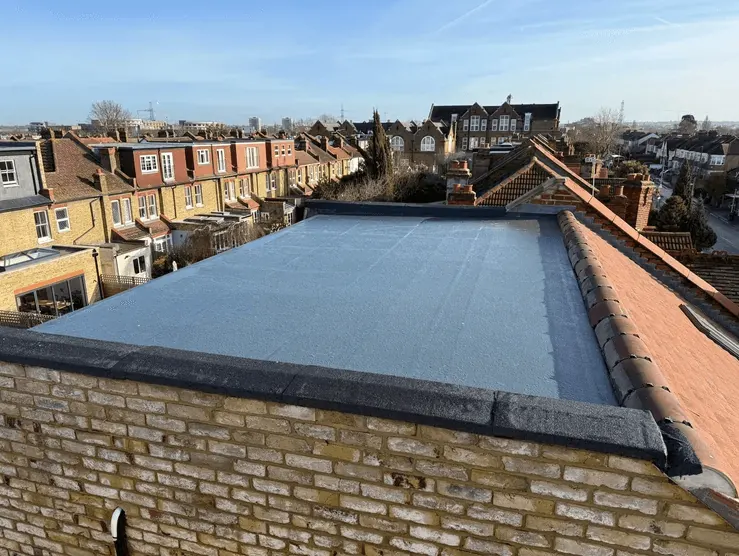
When a flat roof here needs replacing, the choice is between GRP fibreglass, EPDM rubber and torch-on felt. GRP suits small, awkward shapes such as dormer tops, and its hard surface copes with being swept. EPDM goes on as one sheet with very few joints, which suits a larger extension. Felt is the lower-cost option and usually has the shortest life of the three.
Under trees, the fall of the deck matters as much as the material. A roof laid to a proper fall towards a wide outlet or gutter sheds leaves with the rain, while a near-level deck keeps them. A new roof is built on a sound deck, with insulation where the room below needs it, edge trims and a sealed upstand. For a brand-new extension or dormer roof, see new roofs for Merton Abbey extensions, and our main flat roofing page has more on each material.
Frequently asked questions
Can you check the flat top of my dormer in Ruskin Way without scaffolding?
For a look, yes. The drone can photograph the dormer top, its edges and the junction with the main roof, which shows whether it needs a repair or a new covering. Doing the work on a three-storey house will usually need a scaffold or tower.
The council's appraisal put Bennett's Courtyard forward for its local list. Does that affect a roof garden repair?
Repairs that keep the roof looking as it does now do not usually raise any issue. Changes visible from the street, such as new edge trims in a different colour or raised parapets, are worth discussing with Merton's planning team through the managing agent first.
Damp shows at the top of the wall where my extension meets the house in Landseer Close. Is it the flat roof?
Usually it is the upstand or the flashing above it, where the covering turns up against the old wall. It can also be the main roof or a gutter discharging onto the extension, so both are checked before anything is stripped.





