



 Google reviews

Stacks on the Green Lane estates
The two estates either side of Green Lane carry a lot of chimneys. South of the road, on the estate built for officers' families, the Upper Morden appraisal describes the later 1930s semis at Trenchard Close as having a chimney at the ridge above each party wall and further chimneys on each flank wall, so every pair carries three stacks. Hill Top has three substantial stacks on the ridge of each of its two blocks, and South Close, the Precincts and the Sanctuary all have substantial brick chimneys along their tiled ridges. North of the road, on the Douglas Haig Memorial Homes, chimneys line the ridges of the pantiled roofs at Lawrence Weaver Court and Legion Court.
A stack on a ridge has roof slopes on both sides of it, so it has lead on all four faces: an apron where each slope meets it and stepped flashing down each side. On steep pantile and tiled roofs, the lead where the tiles meet the brickwork is fiddly to dress well, and where it has lifted or split, water runs down the outside of the stack into the roof space. These are conservation area chimneys, so repairs keep the height, brick and detailing of the stack as they are.
Shared stacks on the 1930s avenues
On the semis around Rosedene Avenue, Rutland Drive and Hartland Avenue, the usual arrangement is one stack shared over the party wall. Half the lead and half the brickwork belong to each house. One owner may have re-leaded their side while the other half still has its original flashing, so it is worth knowing what condition both halves are in before deciding what to do. We repair your side properly and photograph what we can see on the other. Work that crosses the party wall can bring in the Party Wall Act.
Tall stacks at Hatfeild Mead
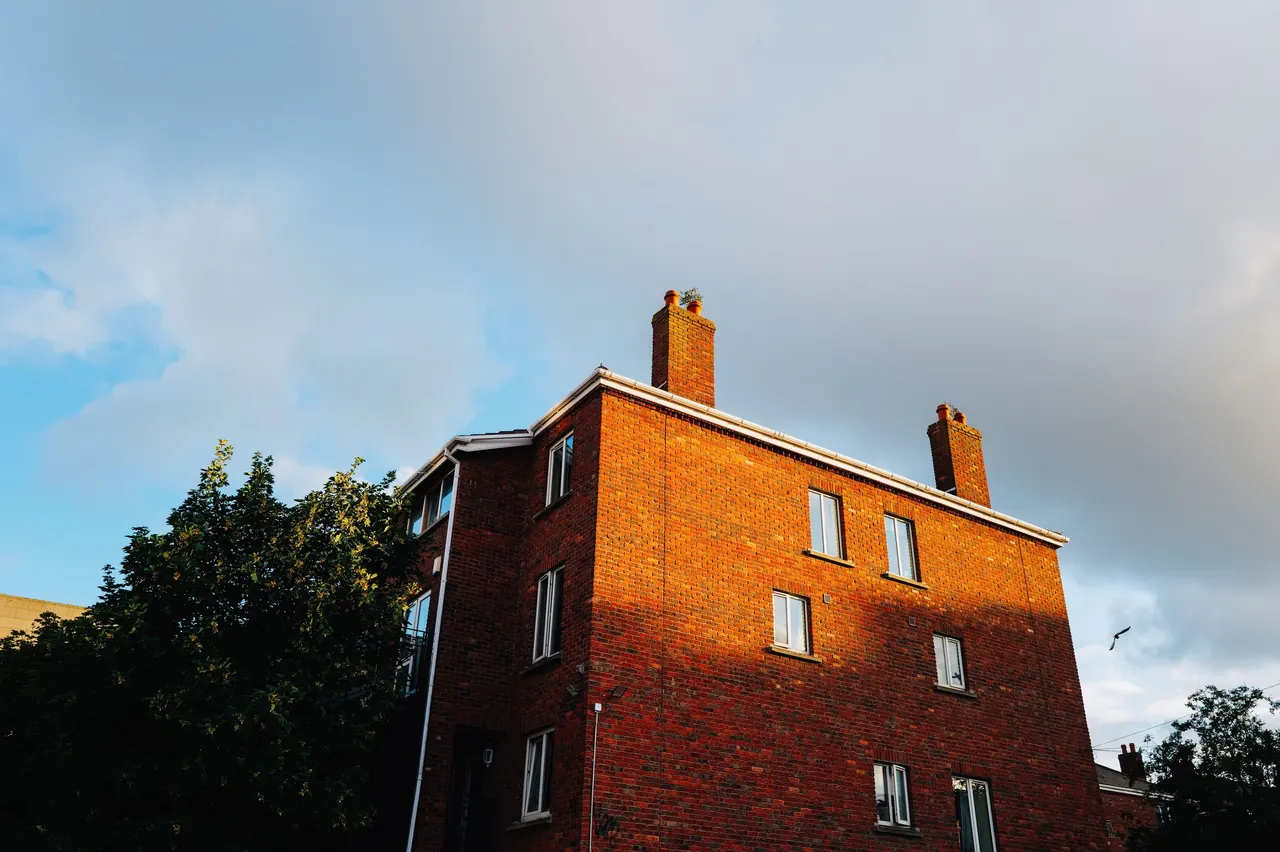
Merton's character study notes a tall chimney stack in the centre of the front elevation on each of the two-storey Hatfeild Mead blocks. Tall stacks catch more wind and rain, and the flaunching round the pots on top takes a beating. Cracked flaunching lets water down inside the stack, and loose pots on a stack that height are a hazard to anyone below. Who arranges work on the blocks is covered in our Morden Park overview.
Two storeys at Trenchard Close, three at the Sanctuary
Height decides most of the cost here. A small lead repair on a two-storey semi at Trenchard Close or Hill Top can often be done from roof ladders. The Sanctuary is three storeys with its top floor in a mansard, and the Legion Court blocks are three storeys under steep pantiles, so re-leading a whole ridge stack there, or rebuilding the top courses of a tall stack, usually needs scaffold round the chimney.
The drone goes up beside the stack before anything is priced, so the lead, pots and pointing are seen close up and the quote says plainly whether scaffold is in it. Slipping tiles round the base of a stack are a roof repair job in Morden Park and can be done on the same visit. Lead, repointing, flaunching and pots are each explained on the main chimney repairs page.
Frequently asked questions
The lead round the ridge stack on my Trenchard Close semi is lifting. Can it be fixed without scaffold?
Sometimes. If the lead has only pulled out of the mortar joint, it can often be refixed and repointed from roof ladders. If it is split or perished on several faces, it needs replacing, and on a steep tiled roof that usually means a small scaffold round the stack.
Bits of mortar from the top of the stack are landing in the gutter at Hill Top. Is that urgent?
It is a sign the flaunching round the pots is breaking up. It is not usually an emergency, but water will start getting down inside the stack, and loose pots can follow. Get it looked at before winter.
Should a tall Hatfeild Mead stack be repointed or rebuilt at the top?
If the bricks are sound and only the joints have eroded, repointing is enough. If the top courses are loose or the bricks are spalling, rebuilding those courses is the lasting fix. A close-up drone photo usually settles it.





