



 Google reviews

Between the railway and Dighton Road
South of Wandsworth Town station, the streets off Old York Road, among them Alma, Dalby, Bramford and Podmore Roads and Ballantine Street, are rows of small two-storey cottages in London stock brick. Just west of Tonsley Hill, outside the Old York Road Conservation Area, are Tonsley Road, Tonsley Place and Tonsley Street, the streets that give the Tonsleys its name. North of the railway, along the Thames towards Wandsworth Bridge and the mouth of the Wandle, the riverside is now lined with large blocks of flats.
South of Dighton Road is the older Wandsworth Town Conservation Area, which takes in the High Street, the Ram Brewery site and West Hill and reaches west across the Wandle to Point Pleasant. Those streets, along with East Hill, are covered on our Wandsworth area page, so the two pages do not repeat each other.
The station opened in 1846 and took the name Wandsworth Town in 1903. Wandsworth Council's Old York Road conservation area appraisal records that most of the conservation area was open land sold off for housing in 1836, and that the workers' cottages went up between the late 1870s and the 1890s. The Alma, built in 1872 opposite the station, was the first commercial building and at three storeys still stands above the two-storey terraces round it.
We have been a family business for over 20 years, and Liam is our Lead Roofer.
What the 2019 conservation area means for a roof
The Old York Road Conservation Area was designated in June 2019, and its appraisal was adopted in August 2023. It runs from the railway in the north to Dighton Road in the south, and from Tonsley Hill across to Trinity Road. Several of its findings bear directly on roof work:
- Roof form. Long terraces with gabled roofs and hipped ends, separated by low party walls. The hipped terrace ends on Podmore Road are singled out as largely unaltered.
- Coverings. Slate or tile originally, but many roofs have been re-covered in artificial slate or concrete tile, which the appraisal calls unsympathetic pastiche materials.
- Extensions. Mansard and outrigger extensions are common and have often raised the ridge. New rear roof work should not project above the existing ridge.
- Front walls. Painting the brick fronts is discouraged, and blocks of flats in the area have no permitted development rights.
For most repairs none of this changes anything, because like-for-like work is normally maintenance and needs no consent. It matters when a covering is being changed, a loft is being added, or a front is being altered, and in those cases the right step is to check with Wandsworth Council before ordering materials. We raise it with you if we think a job needs that check.
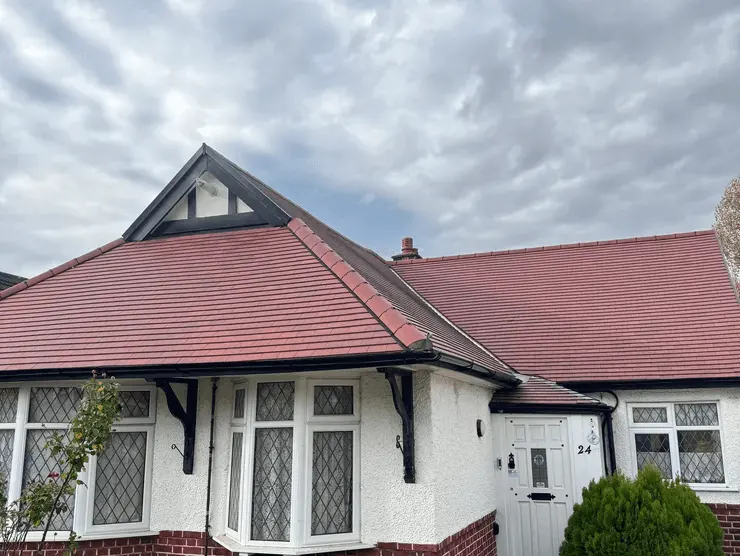
Cottages, one street at a time
The appraisal is useful because it does not treat the area as one block. Alma Road has some of the earliest development, including a Georgian group with tiled mansards and a single central dormer. Dalby Road repeats a single plan in pairs. Bramford Road has the most decoration and the biggest trees, several mature London planes. Parts of Ballantine Street have bow windows and rendered ground floors. Dighton Road is mostly side walls and hipped ends.
Those differences show up on the roof. A re-roof on one half of a Dalby Road pair has to sit beside the other half, which our page on roof replacement in Wandsworth Town goes into. Aerials and dishes, which the appraisal lists among the features that harm the area, are often bolted to stacks and loosen their joints, as our chimney repairs page explains. Leaves from Bramford Road's planes can fill the gutters below them in autumn, and the gutter cleaning page deals with reaching the back of a mid-terrace house. On Dighton Road the eaves turn the corner round hipped terrace ends, which our fascias and soffits page looks at.
At the back of many of these houses there is a back addition beside next door's, often with a valley or gutter between the two, and in many cases a rear mansard or dormer on top. Those are the parts of the roof that cannot be seen from the street, and the parts most likely to hold water without anyone noticing.
The riverside: Battersea Reach and Riverside Quarter
Across the tracks towards the Thames, the scale jumps. Battersea Reach, near Wandsworth Bridge, holds over 1,100 apartments and penthouses, and Riverside Quarter, where the Wandle meets the Thames, adds 751 more. Roofs on blocks like these are large and mostly flat, broken up by plant, rooflights and parapet outlets, and faults usually show as a stain in a top-floor flat or under a balcony. We quote for managing agents and residents' associations as well as owners.
Looking at a roof under the heliport
The whole of Wandsworth Town sits inside the 2 nautical mile air traffic zone of London Heliport at Battersea. The heliport's drone restriction applies to drones of any size at all hours, and it asks for flight requests to be submitted 48 hours ahead, with air traffic clearance before launch. In practice that means a drone survey of a roof here usually has to be requested at least two days ahead rather than flown the day you call. Ordinary roof work is unaffected, and a loft check or a look from a ladder is not held up by it. Our roof inspection page for Wandsworth Town explains how a survey fits round those rules.
Frequently asked questions
Is my street covered by this page or the Wandsworth page?
If you are between the railway and Dighton Road, from the Tonsleys across to Trinity Road, or in the riverside blocks north of the railway, this page and its service pages are for you. South of Dighton Road, the old town centre, East Hill and West Hill are on our Wandsworth page.
Does the heliport affect roof work as well as drone surveys?
No. The heliport's restriction is about drone flights. Repairs, re-roofs and gutter work go ahead as normal, and on an urgent job the roof is looked at from ladders, the loft and the roof itself rather than from the air.
What should I check on an Old York Road cottage roof before winter?
From the street: slipped slates on the front slope, loose hip tiles on end houses and the pots on the stack. From an upstairs back window: the valley or gutter between your back addition and next door's, and the gutter below any mansard. Damp in the top corners of rooms is worth a look before the heavy rain arrives.
I own a flat in one of the Podmore Road blocks. Can I arrange roof work myself?
Usually the roof of a block belongs to the freeholder, so work is arranged through them or the managing agent, and your lease sets out who pays. The appraisal also notes that these blocks have no permitted development rights, so anything beyond like-for-like repair should be checked with Wandsworth Council first.





