



 Google reviews

Bramford Road and Ballantine Street fronts
A new gutter on a plain house can be almost anything. On the decorated fronts of Bramford Road it is part of the elevation. The council's Old York Road appraisal gives Bramford Road's houses the greatest degree of architectural embellishment in the area, while Nos. 2 to 32 and 3 to 33 Ballantine Street show more alteration, including bow windows and rendered ground floors. Dalby Road is more uniform, a single plan repeated in pairs.
On houses like these a half-round or ogee profile in black, in cast iron or a metal-look finish, usually sits better than a square white section. Where a row has already settled on one profile, matching it matters more than anything else, because each front run is short and the line of the eaves reads along the whole terrace.
Sizing the back of the house
A two-storey cottage here has only a few metres of front gutter. The work is at the back: a run along the back addition, often a short run on a dormer or mansard above it, and the downpipes that link them. The gutter on the outrigger takes water from its own slope and, on many houses, from the main roof as well, so it is often worth a deeper profile than the front, even where the front is kept to the original size.
Where a rear mansard currently spills onto the slope below, a new installation is a good moment to sort that out, and our gutter repair page for Wandsworth Town explains why it matters.
Downpipes on houses with no front garden
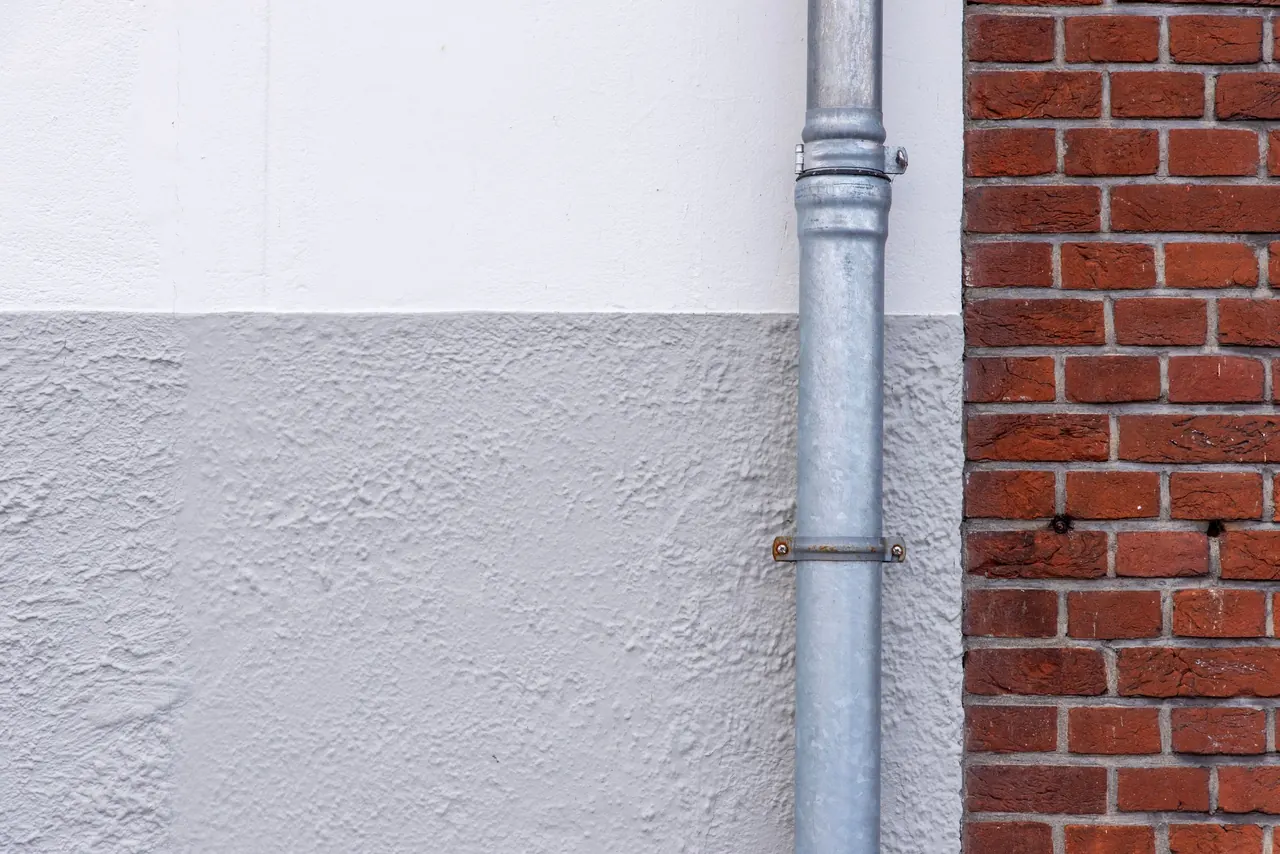
Where a cottage has no front garden at all, the front downpipe ends beside the pavement and its drain is in a fixed place. The pipe normally stays on its existing line so it meets the original drain. The drain is checked before the new pipe goes on, and the pipe is clipped tight to the wall at a height where bins and bikes will not knock it.
Where a bow window or rendered front sits near the party line, as on parts of Ballantine Street, the pipe has to clear the bay and the render without trapping water behind it. A swan-neck offset at the top usually solves that.
Cast iron, coated metal or uPVC on these rows
- Cast iron is the original material on most of these fronts. It is heavy and long-lived when kept painted, and suits the decorated houses on Bramford Road.
- Coated aluminium in black passes for painted metal from the pavement and does not rust. Where a run is long enough for a one-piece length to matter, our seamless gutter page for Wandsworth Town covers it.
- uPVC is the cheapest and the common choice at the back, on outriggers and mansards.
As national guide figures, MyJobQuote's guttering cost guide, updated in October 2026, gives supply-and-fit prices of £40 to £50 a metre for uPVC, £50 to £75 for cast iron and £55 to £78 for aluminium. On a short cottage front the gap between them is smaller than it looks, because access takes up much of the time.
A new gutter needs sound timber behind it. If the boards are soft, our page on fascias and soffits in Wandsworth Town covers replacing them first.
Frequently asked questions
Next door on Bramford Road still has cast iron. Will a new gutter on my house look wrong beside it?
Not if the profile and colour match. A cast iron or black-coated ogee or half-round set at the same height reads as one line from the street. Where the two systems meet, a proper adaptor or a stop end with its own outlet keeps the join from becoming a leak.
Does replacing gutters on an Old York Road block of flats need planning permission?
The appraisal says blocks of flats in the conservation area have no permitted development rights, so external alterations need consent. Like-for-like replacement may not count as an alteration, but a change of material or colour on a front elevation might. Check with Wandsworth Council or the freeholder's agent before ordering.
Should the back addition gutter be bigger than the one at the front?
Often, yes. It usually collects water from more roof, and on many cottages a mansard above adds to it. A deeper profile at the back costs little extra and is not seen from the street.





