



 Google reviews

Fitting gutters above the East Hill pavement
East Hill climbs out of the Wandle Valley as the A3, and it is a busy road all the way. Wandsworth Council's appraisal of the Wandsworth Town Conservation Area records that the front gardens of 152 to 162 East Hill were lost when the road was widened in the 1920s, so those houses meet the pavement directly. Elsewhere on East Hill the front gardens that survive are small.
That changes how a new front gutter goes up. A tower or ladders stand on a public pavement next to heavy traffic, and the run is three storeys above it. Where the equipment goes, how the pavement is kept safe for people walking past and the order of work are all planned before the day, so the front is open for as short a time as possible. Where the back can be reached through the house or a side passage, the rear runs are often done first.
Sizing runs on a three-storey East Hill terrace
The appraisal describes the terraces along East Hill as keeping a fairly consistent three storeys, with a grid of late Victorian streets to the north laid out by two or three local builders. A tall terrace does not always have a bigger roof than a short one, but the gutter at the back often collects more than its share: the main rear slope, sometimes a rear wing roof as well, and all of it feeding one downpipe that runs a long way down.
So before a gutter is chosen, the roof area draining to each run is worked out, along with where it goes. If an old gutter overflowed at the corner even when clean, the cure is often a deeper profile or a second outlet rather than a straight swap. On a long drop, every bend and offset around a rear wing slows the water and gives debris a place to settle, so the downpipe route gets as much thought as the gutter.
Cast iron fronts on the conservation area streets
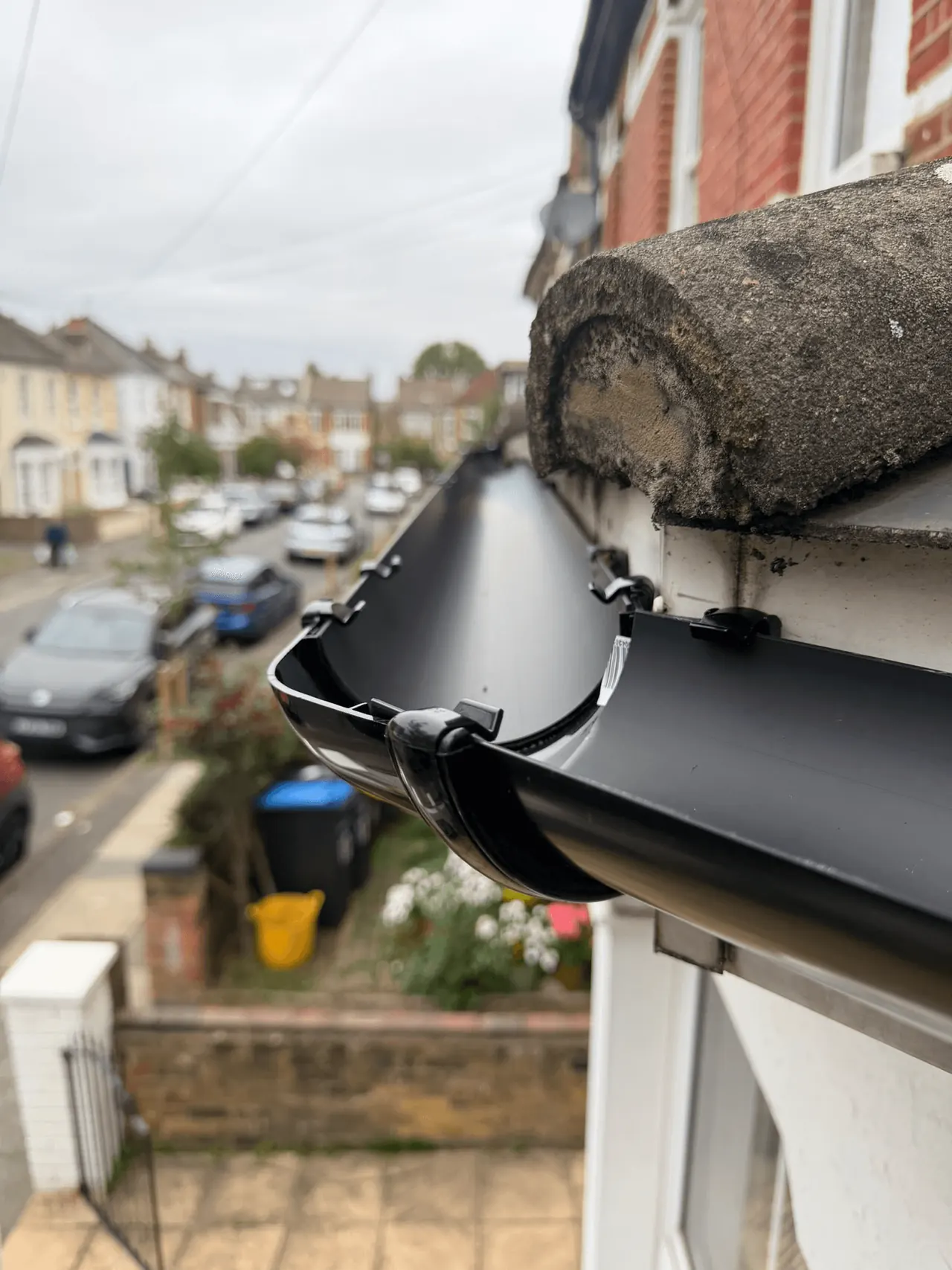
We fit uPVC, cast iron and aluminium. On the front of a Victorian terrace in the conservation area, a half-round or ogee profile in a dark colour, or cast iron where the house still has it, keeps the street consistent. On a rear elevation that faces only the gardens, uPVC is usually the practical choice. If a long, plain back run is what you want renewed, our seamless gutter page for Wandsworth explains that option.
A gutter is only as secure as the board it is screwed to, so the fascia is checked before any brackets go on, and our Wandsworth fascias and soffits page covers replacing it. New runs are set to a steady fall towards each outlet, every joint is sealed, and the downpipes are taken into the drain rather than left to discharge onto the wall or the pavement.
What new gutters cost on East Hill
As a national guide, MyJobQuote's gutter replacement guide puts uPVC at £40 to £50 per metre and cast iron at £50 to £75 per metre supplied and fitted, with scaffold for a whole house around £1,000 where it is needed. On East Hill, the access is what moves the total most: a tower on the pavement at the front, a long climb at the back, or scaffold where neither is safe. The full process is on our main gutter installation page.
Frequently asked questions
Our East Hill house meets the pavement directly. How are the front gutters fitted safely?
The access is planned around the pavement and the traffic, the work area is kept guarded, and the time spent at the front is kept as short as possible. Rear runs reached through the house are often done first.
Can cast iron go back on the front of a terrace north of East Hill?
Yes. Where neighbours still have cast iron, matching it keeps the row consistent, and a uPVC run can still be used at the back where nobody sees it.
Does the rear gutter of a three-storey East Hill terrace need scaffold?
Not always. A tower often reaches it if the garden allows, but a narrow plot or a rear wing in the way can make scaffold the safer option. That is decided at the quote.





