



 Google reviews

Seymour Road and the twentieth-century infill
The West Hill Road estate was built slowly, and plots stayed empty well past the end of the 19th century. The council's appraisal records the result: alongside the Victorian villas there is interwar housing on Seymour Road, early and mid 20th-century semi-detached houses infilled across the area, all two storeys, and some later blocks of flats.
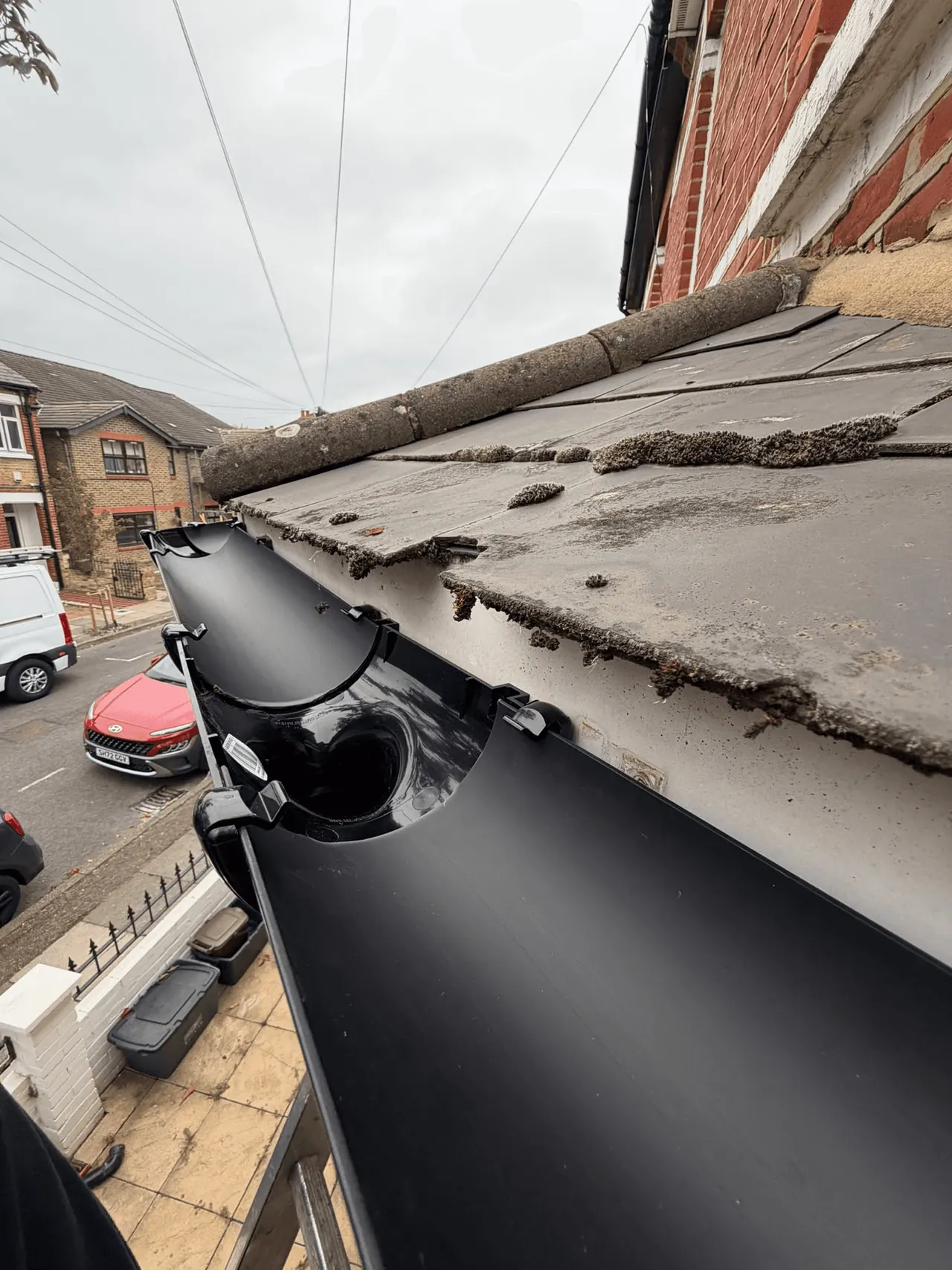
These are the buildings where seamless aluminium guttering is most often worth pricing. Houses and flats of this age usually have plainer eaves than the villas, with less decorative detail to work around. A run formed to the length of each eaves goes up in one piece, so the only joints left are at the corners and outlets. On a 1930s house where the same gutter joint has been resealed winter after winter, that is the main attraction.
The fascia has to be sound enough to hold the brackets, and on an interwar house it may be original timber that has been wet for years, so it is checked before anything is measured. If the boards need replacing, our fascias and soffits page for Wandsworth covers that, and doing both together saves a second visit.
Lime Gardens and buying for a whole block
The appraisal says some of the later infill blocks are better in scale than the semis, and singles out those in Lime Gardens as good in detail and setting too. Blocks like these tend to have long eaves on each elevation and a single freeholder or managing agent responsible for them. For the person who has to keep the building dry, fewer joints along those lengths mean fewer places to leak and less to check each year.
Because one body pays for the whole roofline, a block usually wants a price for every elevation at once, with each run measured and the number of corners and outlets set out. On a long elevation a run may be split at an outlet to keep it manageable to lift, which adds no leaking mid-run joint. Any planning question for a block in the conservation area is covered on our Wandsworth flat roofing page, and a like-for-like gutter swap is normally simple maintenance.
Mount Pleasant, Thanet Place and the villas
The Victorian villas, and the short two-storey terraces such as Mount Pleasant and Thanet Place on Merton Road, are a different case. The appraisal notes these terraces use the same materials and similar detailing as the big houses. Where their fronts keep a traditional profile or cast iron, that detail is part of the character the conservation area protects. On those, our gutter installation page for Wandsworth covers like-for-like options.
A seamless run can still suit a long, plain rear elevation on a villa that nobody sees from the street, so some houses end up with traditional gutters at the front and aluminium at the back. Aluminium comes in a range of colours, so a dark finish at the back can sit quietly with cast iron at the front.
Measured on site, formed to length
Because each length is made to a measurement, every run is measured precisely before anything is formed. Brackets go on at the correct spacing, the fall is set towards each outlet, and the corners and downpipes are fitted last. Water is then run along each length to check there are no low spots. The main seamless gutter installation page explains the system in more detail.
Frequently asked questions
Would a seamless gutter suit an interwar house on Seymour Road?
Very likely, if the eaves are plain and straight, which the survey confirms. Seamless guttering removes the mid-run joints that usually start leaking first.
We manage a block like Lime Gardens. Can every elevation be priced at once?
Yes. Each elevation is measured and priced in one quote, so the freeholder or residents can see the whole cost before deciding.
Does seamless suit the terraces at Mount Pleasant on Merton Road?
Not at the front, where a traditional profile matches the rest of the group. A long, plain rear run can be a good candidate.





