



 Google reviews

Back wings off Shelgate and Salcott Roads
On the terraces of Abyssinia, Shelgate, Bennerley and Salcott Roads, the side streets of the old Conservative Land Society estate off Northcote Road, the back additions run a long way into the garden, and the gutter along the side of each wing is often the longest single run on the house. It hangs over the side return or the neighbour's wall, so a leaking joint there causes damp in two houses. Forming that run in one length removes every joint along it, and with them the slow drips that stain a side-return wall or rot the edge of a kitchen extension roof below.
The same goes for the wider villas and semi-detached pairs in St John's Hill Grove and on Louvaine Road, where the eaves run is longer and less broken up than on a terrace. And where a freeholder is renewing all the rainwater goods on a whole building at once, such as a shop with flats above, seamless runs at the back and sides cut down the number of joints anyone has to look after later.
Aluminium is light, does not rust and comes with a coated colour finish. MyJobQuote's gutter repair guide says metal gutters such as aluminium can last up to 50 years when properly cared for.
Shop fronts and terrace fronts
The shop terraces on St John's Hill mostly have London roofs behind a parapet, so there is no eaves gutter at the front at all. Their rain leaves through the back wall into a hopper, which a standard gutter installation in Clapham Junction sizes and replaces. Seamless matters on those buildings only for the rear and side runs.
On the house terraces in the Clapham Junction and St John's Hill Grove conservation areas, many fronts still carry cast iron or a sectional system that matches the row. There the joint that most often leaks is the one at the boundary with next door, which a seamless run cannot remove unless your neighbour changes too, so a matching sectional front usually serves better.
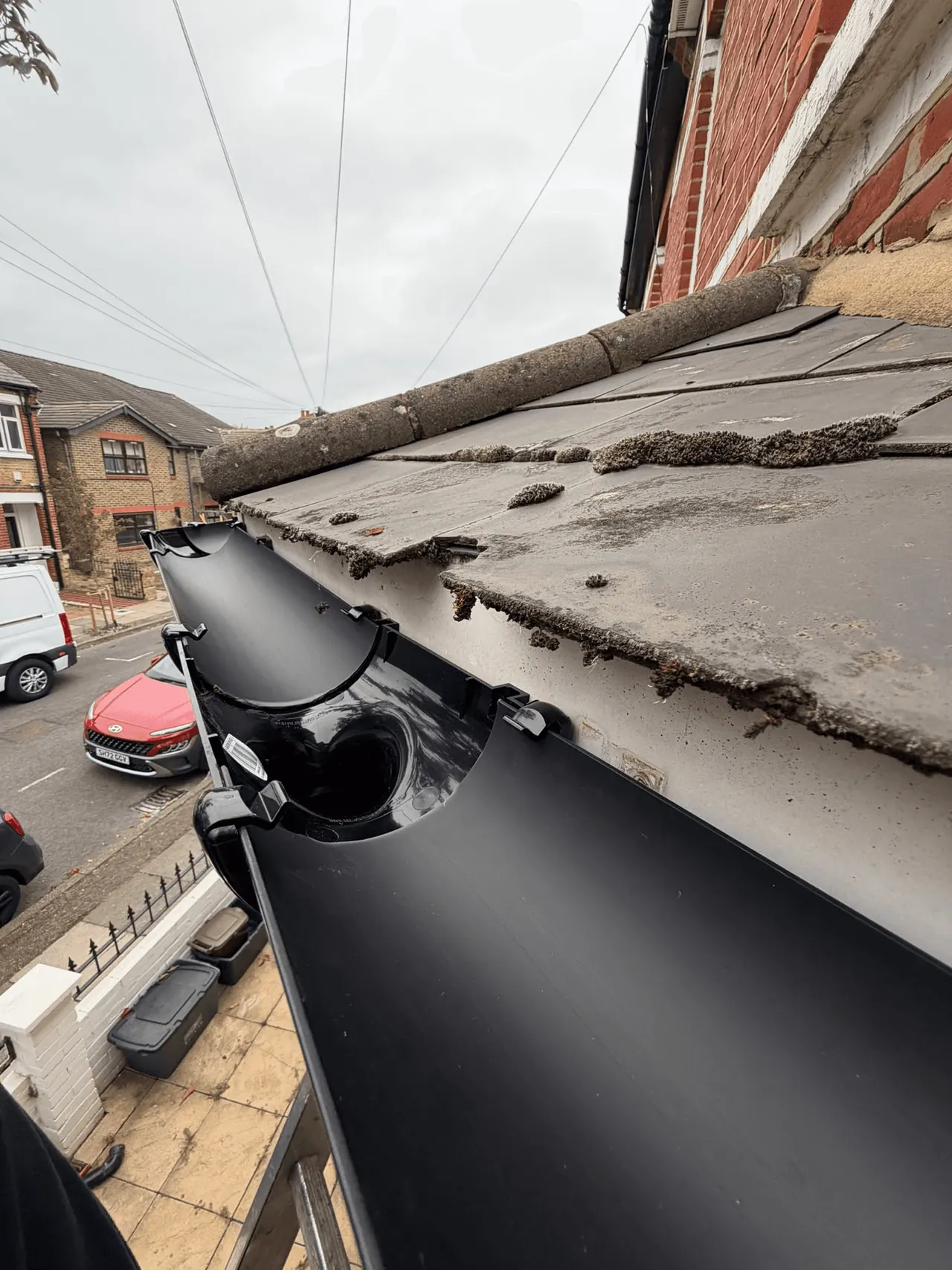
Measuring every run
Each run is made to length, so the measuring has to be exact. Back additions sometimes drop a level partway along, and a terrace on a slope may step at the party wall. We measure every run separately, including where it turns a corner or steps down. The aluminium is then formed to that length, often on site, the brackets go up at the correct spacing with a fall of around 1:600 towards the outlet, and the only joints left are at corners, stop ends and downpipes. Water is run through at the end to check there are no low spots. Because the lengths cannot be trimmed later the way sectional pieces can, we would rather spend longer measuring than risk a run that stops short of the outlet.
A new gutter is only as good as the board behind it. If your fascias are soft, it is worth replacing them first through our fascias and soffits team. Our seamless guttering page compares aluminium with uPVC.
Frequently asked questions
Our villa in St John's Hill Grove has a long side eaves. Is that where seamless makes sense?
Often, yes. A long, unbroken side run is exactly where sectional joints add up. We look at the front and back too and tell you which runs would gain from it.
If the back addition on our Shelgate Road house drops a level, can a seamless run follow it?
Yes, but not as one piece. Where the eaves drop, the run is split at the step, with a proper outlet or corner there, and each level gets its own continuous length.
We own a whole building above a shop on St John's Road. Can every run be renewed at once?
Yes. Doing the whole building in one visit means one access plan for the height. Seamless suits the rear and side runs, and we may suggest keeping a traditional look on the street front.





